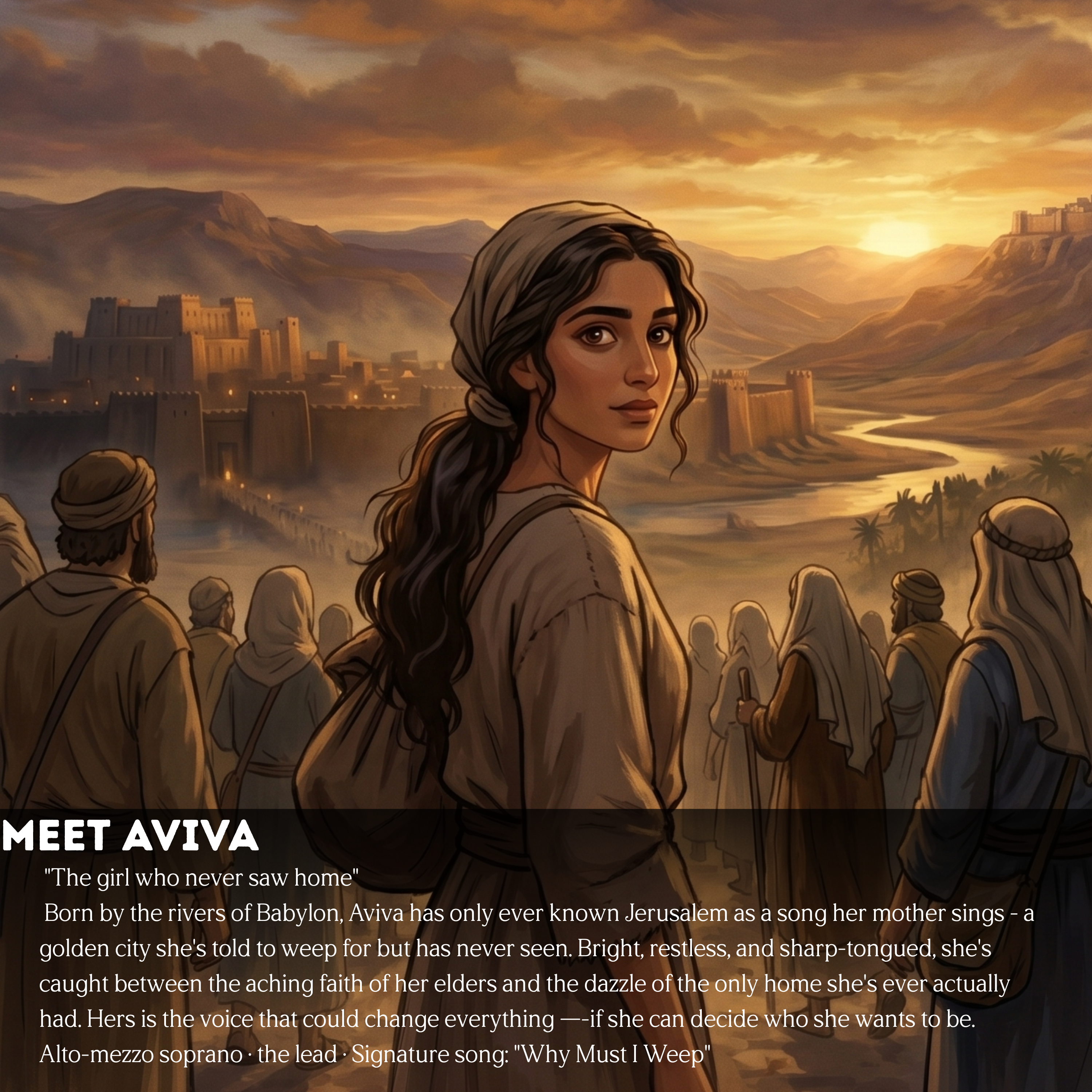
Over the next several days, I want to introduce you to the people who carry “Bring Us Home.” We’ll start with the one whose journey is the show: Aviva.
Who is Aviva?
Aviva is a young woman, born by the rivers of Babylon — seventy years into the exile. She has never seen Jerusalem. Never walked through its gates, never stood in the Temple, never smelled smoke rising from the altar. Everything she knows about her “homeland” comes from one source: the songs her mother, Miryam, sings to her.
A golden city. Doves in the morning. A temple full of music. That’s Jerusalem, to Aviva — not a memory, but a melody.
And for most of her life, that’s been enough. Until it isn’t.
Bright, restless, and caught between two worlds
What I love about Aviva is that she’s not a passive figure waiting for a calling to find her. She’s bright. She’s sharp-tongued. She’s restless — and honestly, who wouldn’t be? She’s been told her whole life to ache for a place she’s never seen, while living in a place that, frankly, has a lot going for it. The markets. The music. The girls her age teaching her counting games with rhythms that aren’t from “home” but are still genuinely fun.
She’s not wrong to notice that tension. That’s what makes her real.
Her “I want” song: “Why Must I Weep”
Aviva’s signature song in the show is called “Why Must I Weep.” It’s her breaking point — the moment she finally says out loud what she’s felt for years: “How do I grieve a home I’ve never had?”
It’s not rebellion for the sake of rebellion. It’s an honest, aching question from someone who has spent her entire life carrying a longing she didn’t choose and has never fully understood. And by the end of the song, something starts to shift in her — she starts to wonder if the very weight of that longing might be proof the city is real after all.
The voice that changes everything
There’s a moment earlier in the story — when Aviva is just a child — where a soldier threatens the camp, and she instinctively sings a fragment of her mother’s lullaby. It stops him cold. The whole camp falls silent. And her grandfather, Saba Elan, watches with something that isn’t quite pride — it’s fear.
Because he knows: a voice like that, Babylon will hear about.
That moment sets up everything that follows. Aviva’s gift — the very thing that’s kept her connected to a home she’s never seen — is the same thing that gets her noticed by the empire that wants to make her forget it.
Where her journey leads
I won’t give away everything here (that’s what the “Behind the Song” posts are for!), but I’ll say this: Aviva’s arc is the arc of the entire musical. She starts the show as a girl who only knows Jerusalem as a song. By the end, she’s the one leading her people back to it — carrying a harp that hasn’t been played in seventy years, and a question that finally has an answer.
Get to know her with me
💬 Comment below — what do you think it would feel like to carry a “calling” you’ve never actually experienced firsthand? Have you ever felt like Aviva?
📱 Follow me on Instagram and Facebook at @TheMelanieGrace — I’m introducing the rest of the cast over the next few days.
💌 Sign up for my email list for deeper looks at every character and every song.
🎧 Follow me on Spotify, Apple Music, Amazon Music, and YouTube Music so you hear Aviva’s songs the moment they release.
Tomorrow, meet the woman who kept the songs alive for her — Aviva’s mother, Miryam.





Leave a Reply