Of everything in “Bring Us Home,” this might be the relationship people ask me about the most once they hear a little about it. So today, let’s talk about Nabu — and the quiet, aching almost-romance between him and Aviva.
Who is Nabu?
Nabu is a young Babylonian court musician — born and raised in the shadow of the empire’s splendor. He’s earnest, a little awkward, and genuinely kind, even when he doesn’t quite know how to talk to people. He believes music is mathematics: structure, rules, a perfect ladder of sound climbing toward heaven, “one perfect brick laid on the next.”
When Aviva is brought to the palace, Nabu is assigned to “refine” her — to retrain the “raw” sound of her voice into something that fits the court’s polished style.
He has no idea what he’s about to walk into.
Two musical worlds meet
The first real scene between them is almost comedic — Nabu fumbling his assignment, Aviva sharp and guarded, both of them very aware of the power imbalance between “court musician” and “captive girl assigned to be refined.” But then Nabu plays her his music — that rigid, mathematical, ascending melody — and Aviva tells him exactly what’s missing from it.
“It doesn’t lack discipline. It lacks a ceiling.”
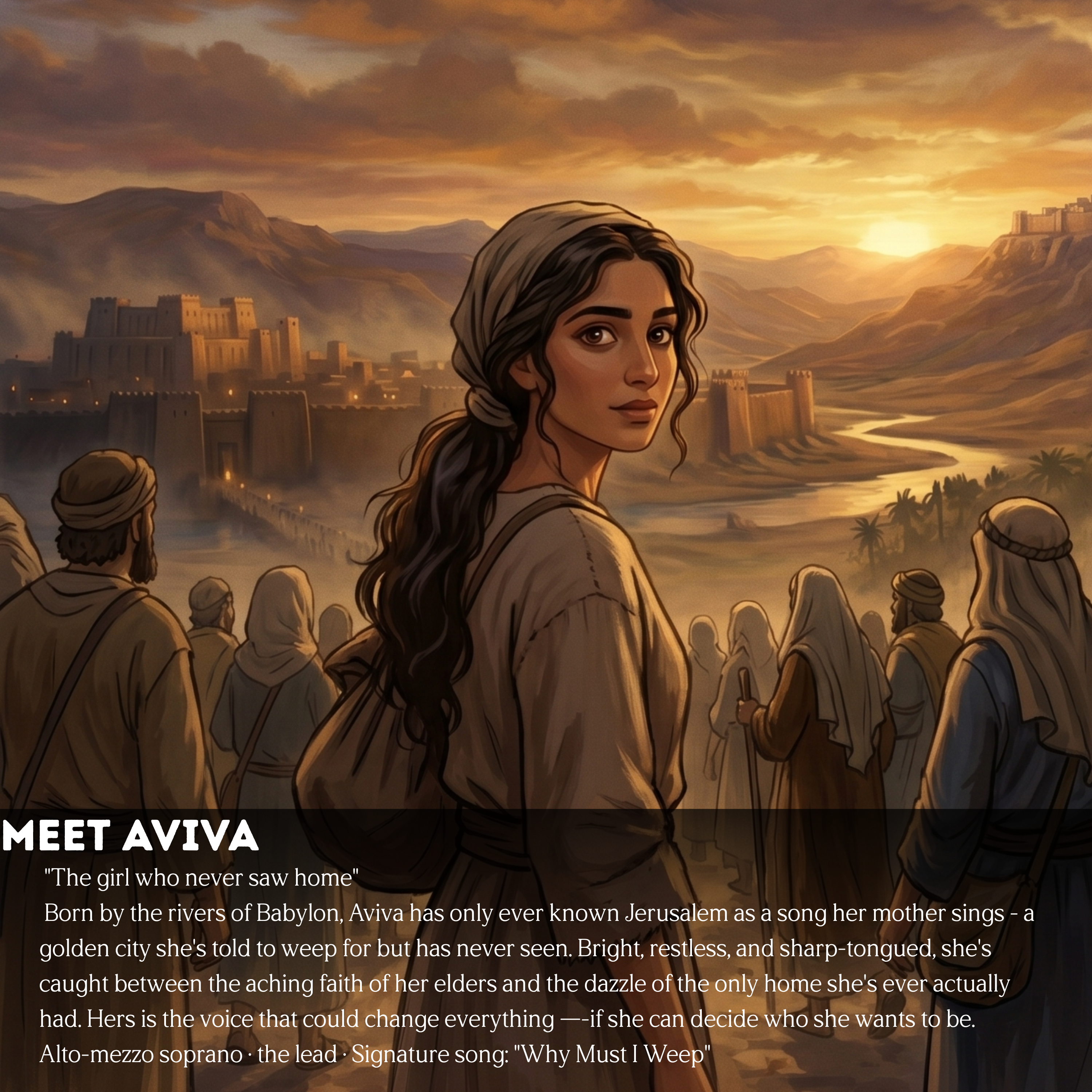
Then she sings him a fragment of her mother’s lullaby — and Nabu hears something he’s never heard in his entire life inside those palace walls: a melody that aches. A bent note. A sound that moves like water around a stone instead of climbing a staircase.
“I don’t think I have ever once heard a song that aches,” he tells her. “Everything here is a shout of victory. We have no chord for… missing something.”
“Two Rivers”
This moment becomes their duet, “Two Rivers” — two musical languages, two completely different worlds, weaving together into something neither of them could make alone. It’s tender, it’s a little funny, and it’s the emotional center of the whole Babylon section of the show for me.
Why it’s an “almost”
Here’s the thing about Nabu and Aviva — this was never going to be a simple love story, and I wrote it that way on purpose. Nabu represents everything that’s trying to absorb Aviva into Babylon: comfort, safety, beauty, belonging. And for a while, there’s a real pull there — not just romantic, but the pull of fitting in somewhere, finally.
But the story isn’t about whether Aviva chooses Babylon or Jerusalem through a romance. It’s bigger than that. So what Nabu and Aviva have stays exactly what it is: real, tender, and ultimately untouched — which I think makes it hit even harder.
The moment that changes everything
Without spoiling the climax (that’s coming in a future post!), I’ll say this: when everything falls apart at Belshazzar’s feast, Nabu has a choice to make — and so does Aviva. And the line he says to her in that moment is one of my favorites in the entire script: “I was wrong about what a song is for. Some things are worth more than a city.”
He chooses her. Not in the way you might expect — but in a way that costs him something real.
A love story that’s really about identity
If I’m honest, Nabu and Aviva’s story isn’t really “about” romance at all. It’s about what happens when someone from “the other side” genuinely sees you — your culture, your music, your ache — and it changes them. And it’s about the cost of choosing truth over comfort, even when comfort has a face you’ve grown to care about.
Talk to me about this one
💬 Comment below — have you ever had a relationship — romantic or not — that changed how you saw your own story, even if it didn’t “work out” in the traditional sense?
📱 Follow me on Instagram and Facebook at @TheMelanieGrace for more on this duet and the rest of the cast.
💌 Sign up for my email list for the full story behind “Two Rivers” and every other song.
🎧 Follow me on Spotify, Apple Music, Amazon Music, and YouTube Music so this duet reaches you the moment it’s released.
Tomorrow: the king who thought his empire would last forever — Belshazzar, and the night everything changed.