Category: home

  • Grýla and the 1746 ban: when a king tried to outlaw a monster

    Grýla and the 1746 ban: when a king tried to outlaw a monster

    In 1746, the Crown issued a household ordinance for Iceland. It covered the ordinary business of a colonial administration deciding how its subjects ought to live: work, worship, the discipline of servants and children.

    Pre-Save the Album today!

    Buried in it is a clause about a troll.

    The ordinance instructs that the foolish custom practiced here and there about the country, of frightening children with Yule Lads or with ghosts, is to be abolished. Christian VI of Denmark, who ruled Iceland at the time, had been told that Icelandic parents were terrifying their children into obedience with a mountain ogress and her sons, and he decided this was not to continue.

    It is one of the earliest instances I know of a state trying to legislate a folk figure out of existence on the grounds that she was too frightening for children. Two hundred and eighty years later, Grýla has a statue at Keflavík airport and her sons have a museum schedule.

    The ban failed completely. That is the interesting part, and it is worth being precise about why, because the reason is not “the Icelanders were stubborn,” though they were.

    Start with who she is.

    Grýla is old, but she is not as old as the tourist copy says. Her name shows up in thirteenth-century Icelandic texts, in Íslendinga saga and in Sverris saga, where the first section of the saga is actually titled Grýla, meaning roughly bugbear or threat, because the section is about a menace. Snorri Sturluson lists her name in the Prose Edda among the names for troll-wives, and that is all he does. No description. Just a name on a list.

    Pre-Save the Album today!

    For four hundred years after that, she is not a Christmas figure at all. She is a generic ogress, available all year. The oldest poems about her show her as a beggar, going door to door, asking parents to hand over their disobedient children, and she can be turned away by giving her food or by simply chasing her off. She lived in a cottage. Only later does she get pushed out of town and into a cave.

    She does not become the mother of the Yule Lads until the seventeenth century, in the Grýlukvæði, the Poem of Grýla. And the Lads themselves are unstable for a long time after that. The number varies by region. Sometimes they are her sons, sometimes her brothers. One eastern Icelandic version has them coming out of the sea instead of down from the mountains. One nursery rhyme has two female ones who steal melted fat by stuffing it up their noses.

    By the late eighteenth century a poem settles on thirteen. In 1862, Jón Árnason, who had read the Grimms and set out to do for Iceland what they had done for Germany, publishes the first collection that gives the thirteen their names. In 1932, the poet Jóhannes úr Kötlum publishes Jólin koma, Christmas Is Coming, and the poem in it fixes the Lads in the form every Icelandic child now knows: the names, the order, the personalities, one per night from December 12.

    So the tradition the King banned in 1746 was, at that moment, less than a hundred years old as a Christmas custom and had not yet taken its final shape.

    He still could not kill it.

    Here is what I think happened. The ordinance was aimed at the wrong thing. It banned a method: do not frighten your children with the Lads. It could not touch the reason the method existed.

    The reason was that Iceland in 1746 was a place where children died. Not rarely. Cold, hunger, accident, the sea. Farms went weeks without contact. The sun cleared the horizon for a few hours and then quit. Every adult in that house knew the danger was real and knew that a small child cannot be reasoned into caution by an accurate description of hypothermia.

    Grýla could do what the accurate description could not. She made the danger a person, gave it a season, and gave the child something to do about it. Be good. Get your shoe on the sill. Do the wool work. Every one of those is an action available to a five year old, and every one of them, not coincidentally, maps onto a behavior that actually helped that child survive the winter.

    You cannot repeal that with a household ordinance. You can only replace it, and the King was not offering a replacement. He was offering “use gentler means,” from Copenhagen, to people who had buried children.

    What actually changed Grýla was not law. It was that Iceland got warmer, richer, and safer, over two centuries, until the thing she was built to do stopped needing doing. The Lads went soft in the nineteenth century, started leaving gifts instead of taking children, and now put candy in shoes. That is not the King’s victory. That is the danger receding and taking the monster’s job with it.

    She is still there, though. She did not get repealed and she did not get outgrown. She got retired, which is a different thing, and retirement can be reversed.

    Grýla cannot be killed. She can only be satisfied.

    Her chapter is one of twenty-three. The book is out in print on Wednesday.

  • What Is Coming Next From TheMelanieGrace

    What Is Coming Next From TheMelanieGrace

    There is something I need to tell you.

    I have been dropping hints for a couple of weeks now and I think it is time to be a little more specific, not fully specific, not yet, but a little more specific, because I am genuinely excited and I am not very good at keeping things I am excited about entirely to myself for very long.

    Something is coming this winter.

    I started working on it in the early mornings while Give Me Fall was still being written, because my brain does not really know how to work on one thing at a time and apparently fall and winter were both wanting to be written simultaneously. What started as a small idea grew into something I did not expect, something with its own world and its own sonic identity and its own very specific emotional territory that is different from anything I have made before.

    Here is what I can tell you. It is rooted in winter. It is rooted in tradition and the old stories that surround this season, the folklore and the legends and the ways that different cultures have made meaning out of the darkest, coldest, most beautiful time of year. It has an Irish and Celtic heart to it, which is something that has been living in me for a long time and finally found the right project to come home to. And it is, I think, the most atmospheric and transportive music I have ever made.

    I am calling it A Folklore Christmas.

    That is the name. I am not ready to share the full track list or all the details yet, but I wanted to give you the name because it feels like the right time and because I think it tells you exactly what kind of experience this is going to be. Not a traditional Christmas album in the conventional sense. Something older and wilder and more rooted than that. Something that sounds like candlelight and snow and ancient stories told around a fire that has been burning for centuries.

    I have been making music for years now and this project feels like one of the most personally meaningful things I have ever worked on. Right alongside Give Me Fall, which remains my love letter to autumn and which I hope you are listening to on repeat as the season settles in around you. Those two albums, one about the warmth and color of fall and one about the deep winter magic that comes after, feel like companion pieces to me. Like two chapters of the same story.

    If you want to be the very first to hear when I can share more about A Folklore Christmas, please get on my email list here. That is where announcements happen first, before social media, before blog posts, before anywhere else. I take my email list seriously and I want the people on it to always feel like they are on the inside.

    You can also follow me on Spotify, Apple Music, Amazon Music, Deezer, and Pandora so that when A Folklore Christmas releases it shows up for you automatically. That follow is the single most helpful thing you can do for an independent artist and it takes three seconds.

    Come hang out with me on Instagram, Facebook, and YouTube where I will be sharing more about this project as we get closer to the season.

    Tell me in the comments: what does the phrase A Folklore Christmas make you feel? What do you hope it sounds like? I am curious to know what that title conjures for you.

    More soon. I promise.

    Warmly, Melanie Grace


  • The cover: six passes and one medallion

    The cover: six passes and one medallion

    The reindeer kept coming back.

    I was generating the cover art, and every pass, the machine would slip a reindeer onto the rim. I would take it out, describe what I wanted again, and the next version would hand it back to me, a little larger, antlers up, standing there among the monsters like it had been invited.

    I understood why. A reindeer is what the tool thinks Christmas is. Feed a machine every Christmas image ever made and ask it for a Christmas picture, and it will reach for the softest thing in the pile, because the soft version is the one that got printed ten million times. The reindeer is Santa’s animal. It is the sleigh, the snow, the wholesome part. And this is a book about everything the wholesome part was built to cover.

    So the reindeer had to go, over and over, and getting it to stay gone turned out to be most of the work.

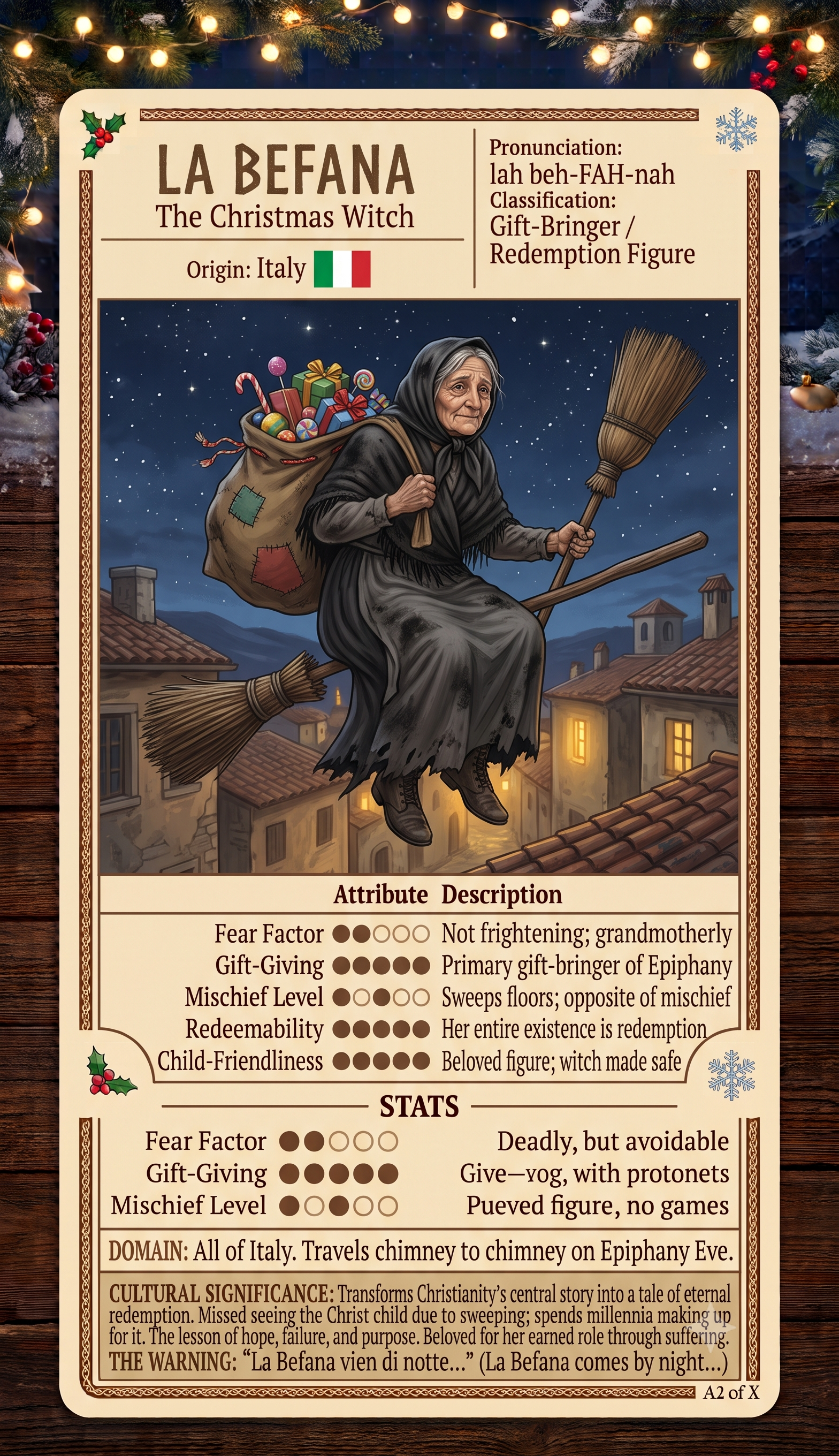
    Here is what the cover is, so the rest makes sense. It is a medallion, a disc, and around its rim walks the whole company: Krampus with the basket of children on his back and his tongue out, the Yule Cat black and enormous, Grýla at her cooking pot, La Befana on her broom with her sack, the Tomte holding his bowl of porridge, the Mari Lwyd’s beribboned skull, the Gävle Goat made of straw and already on fire, the goblins clustered and grinning, a woman with a key, a woman with a knife. They face inward. They ring the disc like figures on a clock, or on a plate, or on a shield.

    And the center, the thing they all surround, is empty. It is a still winter forest under a full moon. No creature in it. Just snow, and black trees, and the light coming back.

    That is the argument of the entire book in one image, and I did not plan it that cleanly. It arrived while I was trying to fix the reindeer. The monsters are the rim. They are not the point. They are what stands around the quiet center and keeps watch over it. Take them away and you do not get more of the peaceful middle. You get a plate with nothing holding its edge.

    The passes were mostly about who belonged on the rim and how much menace the disc could hold before it tipped into a Halloween prop.

    Pre-Save the Album today!

    One version came back on cream parchment, bright, in the style of an old illuminated manuscript, and it added a jester in bells and a mounted rider blowing a horn. It was, objectively, a nice picture. It was also busy and a little jolly, and jolly is the exact failure I was trying to avoid. Menace does not come from crowding the frame. It comes from restraint, from a few figures on a dark ground, given room. That version went in the bin.

    The black ground won. On black, the gold rim reads like something dug up rather than something printed, and the figures stop being cute and start being present. That is the difference between a monster you laugh at and a monster you would not want at your door, and it is almost entirely a lighting decision.

    Somewhere in the middle of all this the reindeer finally lost its spot, and what took its place was the Yule Cat. I want to note that swap because it is the whole book in one substitution. The reindeer is the animal that brings you gifts. The Yule Cat is the animal that eats you if your family did not finish the wool work. Same corner of the same disc. One is the Christmas we kept. The other is the Christmas we threw out. Putting the Cat where the reindeer wanted to be is not subtle, and I do not care.

    The final disc got cropped into its circle by hand, in Canva, because the clean edge mattered and I was not going to leave it to chance. Then it went onto a deep red board, and the red is doing a specific job. Black cover, black medallion, and the thing looks like a horror novel. Red underneath, and it looks like Christmas that has something wrong with it, which is correct. The disc is dark. The book around it is a holiday. You are meant to feel the tension between those two things before you have read a word.

    The back says “Before Santa, there were the others,” and then names a few of them, and ends with “Ye be warned,” which is also the first song on the album. The whole object is trying to tell you, at a glance, that this is Christmas with its teeth still in.

    The reindeer never made it. I checked the final file three times to be sure.

    The hardcover and paperback land October 1, and the medallion is worth seeing at full size. Until then, the Kindle carries the same cover, smaller, and is available now.

  • Happy First Day of Fall: It Is Officially Here and I Am Not Calm

    Happy First Day of Fall: It Is Officially Here and I Am Not Calm

    It is here. It is actually here.

    Happy first day of fall, everyone. Happy autumnal equinox. Happy official beginning of the most wonderful season of the year. Happy pumpkin spice everything and flannel jackets and windows cracked at night and early sunsets and hay rides and corn mazes and firepits and the particular golden light that arrives in October like a gift you knew was coming but that still surprises you every single year.

    I have been waiting for this day.

    I know some people feel this way about the first day of spring or the first day of summer, and I understand that intellectually, but I do not understand it personally. For me the year has always been oriented around this moment. The first official day of fall is the day the rest of the calendar has been building toward. Everything gets better from here, and I say that as someone who loves Christmas deeply and is already working on something for the winter season that I think is going to be special. But today is not about that. Today is about this.

    Fall arrived in some ways before the calendar said it could. The air has been shifting for weeks, the mornings getting crisper, the evenings pulling darkness in a little earlier each day, the coffee shops updating their menus, the neighbors starting to put pumpkins on their porches. Fall does not wait for permission. It shows up when it is ready. The equinox just makes it official.

    I released an album on August 31st called Give Me Fall and writing these fifteen songs was one of the most joyful creative experiences I have had in years. Not because it was easy but because it was so true. Every song came from a real feeling about a real moment in the fall season, and singing them back feels like reading something from my own journal except set to music and much better organized. The album opens with a song called Give Me Fall which is basically my annual declaration to the universe that I am ready, I am fully ready, give me all of it.

    Today feels like the right day to say that declaration out loud again. Give me fall. Give me the pumpkins and the hay rides and the corn mazes and the apple cider and the pumpkin spice lattes and the flannel jackets and the firepits and the golden hours and the last dinners outside. Give me the crisp mornings and the early sunsets and the leaves turning every color they have been saving up all year. Give me October light on ordinary things. Give me the slow Sundays and the cozy evenings and the long conversations around a fire that only happen when the weather finally gives everyone permission to stop rushing.

    And give me the people. That is the love thread that runs through every song on this album. Fall is always better with someone. The best version of every fall moment has another person in it. The hay ride is better with your arm around someone. The corn maze is more fun when you are lost together. The firepit is warmer when you are half in someone’s arms under the stars. Give me fall with you. That is the whole album in four words.

    If you have not listened to Give Me Fall yet today is the perfect day to start. Find it on Spotify, Apple Music, Amazon Music, Deezer, and Pandora. Follow me on all of them so you are the first to know when I release new music, and I will be releasing something new before this year is over that I think is going to be a beautiful gift for the winter season.

    Come celebrate with me on Instagram, Facebook, and YouTube. And join my email list here because that is where I share things first.

    Tell me in the comments how you are spending the first day of fall. I want to know every detail. What did you wear? What did you drink? Where did you go? This is important information and I am taking notes.

    Happy fall, friends. We made it.

    Warmly, Melanie Grace


  • The Coca-Cola red suit story is not true. Here is what is.

    The Coca-Cola red suit story is not true. Here is what is.

    In 1868, the United States Confection Company of New York ran an advertisement for a product called Sugar Plums. The ad has a Santa Claus in it. He is wearing red.

    Coca-Cola would not be invented for another eighteen years.

    That is the whole refutation, and I could stop there, but the true story is better than the false one, so let us do the true one.

    The claim you have heard is that Coca-Cola dressed Santa Claus in red in the 1930s to match the company’s branding, and that before that he wore green, or brown, or whatever the teller prefers. It is repeated every December by people who consider themselves too smart to be fooled by advertising, which is the joke, because the claim is itself the thing they are congratulating themselves for seeing through.

    Pre-Save the Album today!

    Here is the actual sequence.

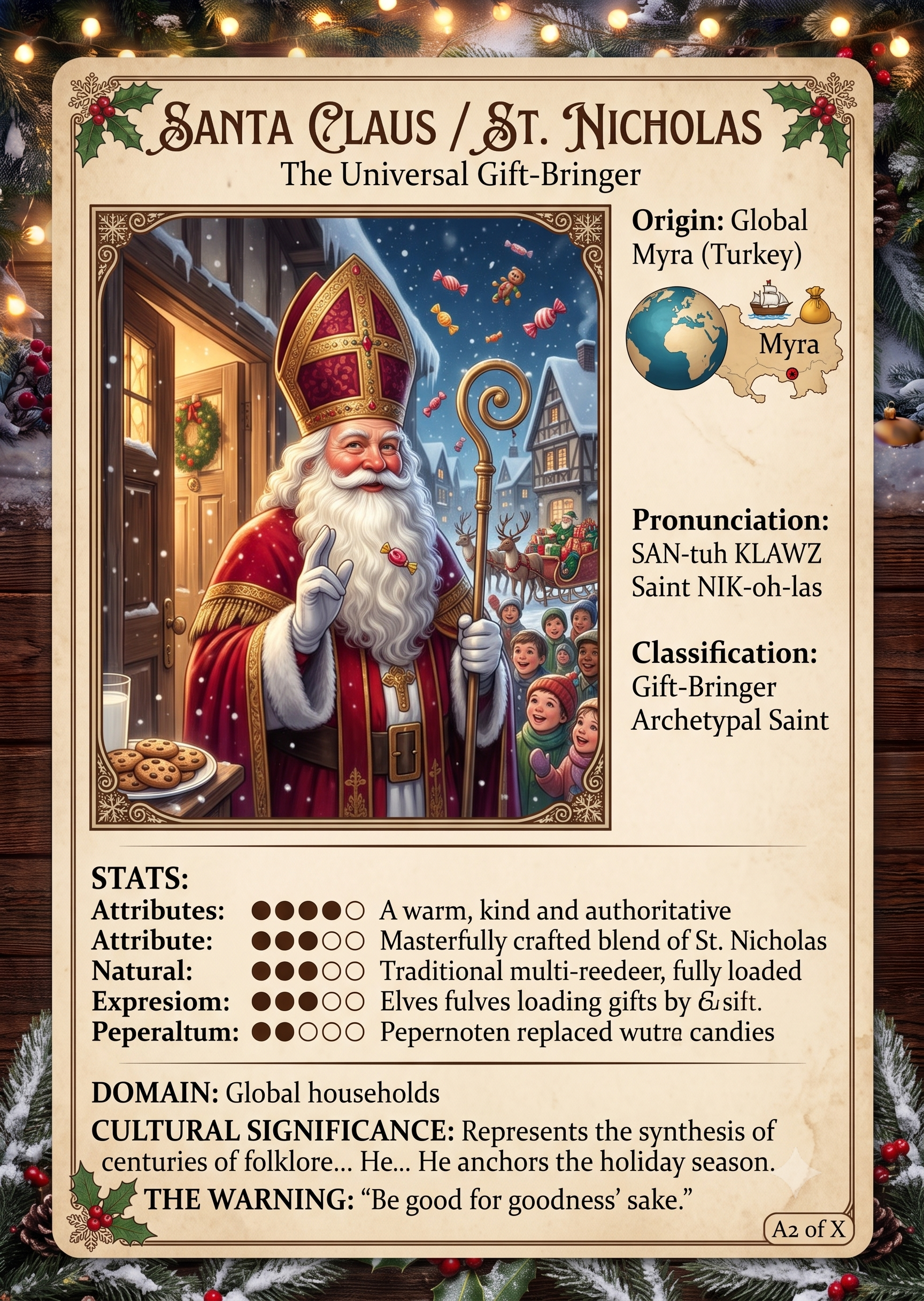
    1821. New York. A small book called The Children’s Friend prints eight hand-colored lithographs of a figure called Santeclaus, driving a sleigh behind a reindeer, arriving on Christmas Eve. He is in red. These are the earliest published pictures of Santa Claus in America, and he is already the color he is now.

    1863. Thomas Nast, the German-born political cartoonist, draws Santa for Harper’s Weekly. This first one is in stars and stripes, handing out gifts at a Union army camp, because it is the middle of the Civil War and Nast is doing propaganda. He will draw Santa about thirty times over the next twenty-three years.

    1868. The Sugar Plums ad above. Red.

    1881. Nast draws “Merry Old Santa Claus.” Round, white-bearded, fur-trimmed red suit, sack of toys. This is essentially the modern Santa, finished, fifty years early.

    1880s onward. Louis Prang, another German immigrant, sometimes called the father of the American Christmas card, is printing Santa in red at scale and mailing him into houses all over the country.

    1915 to the 1920s. White Rock, a beverage company, is running Santa in its ads. In color by the early twenties. Also red. Also not Coca-Cola.

    1931. Coca-Cola’s advertising man, Archie Lee, hires an illustrator named Haddon Sundblom. Sundblom paints Santa for Coke every year until 1964. The paintings are extraordinarily good. They are also arriving at a party that has been running for a hundred and ten years.

    Pre-Save the Album today!

    The company itself does not claim otherwise. In 2008 Phil Mooney, then the director of Coca-Cola’s archives, said plainly that Coke did not come up with the idea of putting Santa in red, and noted only that it has worked out nicely for them.

    So what did Coca-Cola actually do? Something real, and worth naming precisely: they standardized him and they exported him. Sundblom’s Santa is warm, specific, and repeated identically for thirty-three years, on a distribution network that reached most of the planet. Before Sundblom, Santa was red but he was also negotiable, drifting in size and temperament from artist to artist. After Sundblom, he was fixed. Coke did not paint the suit. Coke laminated it.

    Now the part that matters for this book.

    The myth is popular because it lets us off. If Coca-Cola built our Christmas, then the flatness of our Christmas is something that was done to us by a soda company, and we are victims of it, and we can enjoy being annoyed about it.

    The truth is worse. Go back and read what that 1821 Santa does. He gives an apple, or a tart, or a wooden gun, or a book, to good children. And to the children he finds “thankless to parents, liars, swearers,” he leaves a long black birchen rod, and the poem is explicit that the rod is for the parents to use.

    The first American Santa carried a switch. He is red, he comes on Christmas Eve, he judges you, and he arms your father. Nobody at Coca-Cola took that away. It drained out slowly over a century, in a thousand small decisions by illustrators and publishers and parents, all of them choosing the softer version, none of them wrong exactly, and the accumulated result is a figure who watches everything and does nothing.

    Coke did not sand the teeth off Santa Claus. We did that ourselves, and we did most of it before Coke was born.

    If this is the kind of thing you want a whole book of, the Kindle is live now.