Category: home

  • Welcome to Midnight Masquerade

    Welcome to Midnight Masquerade

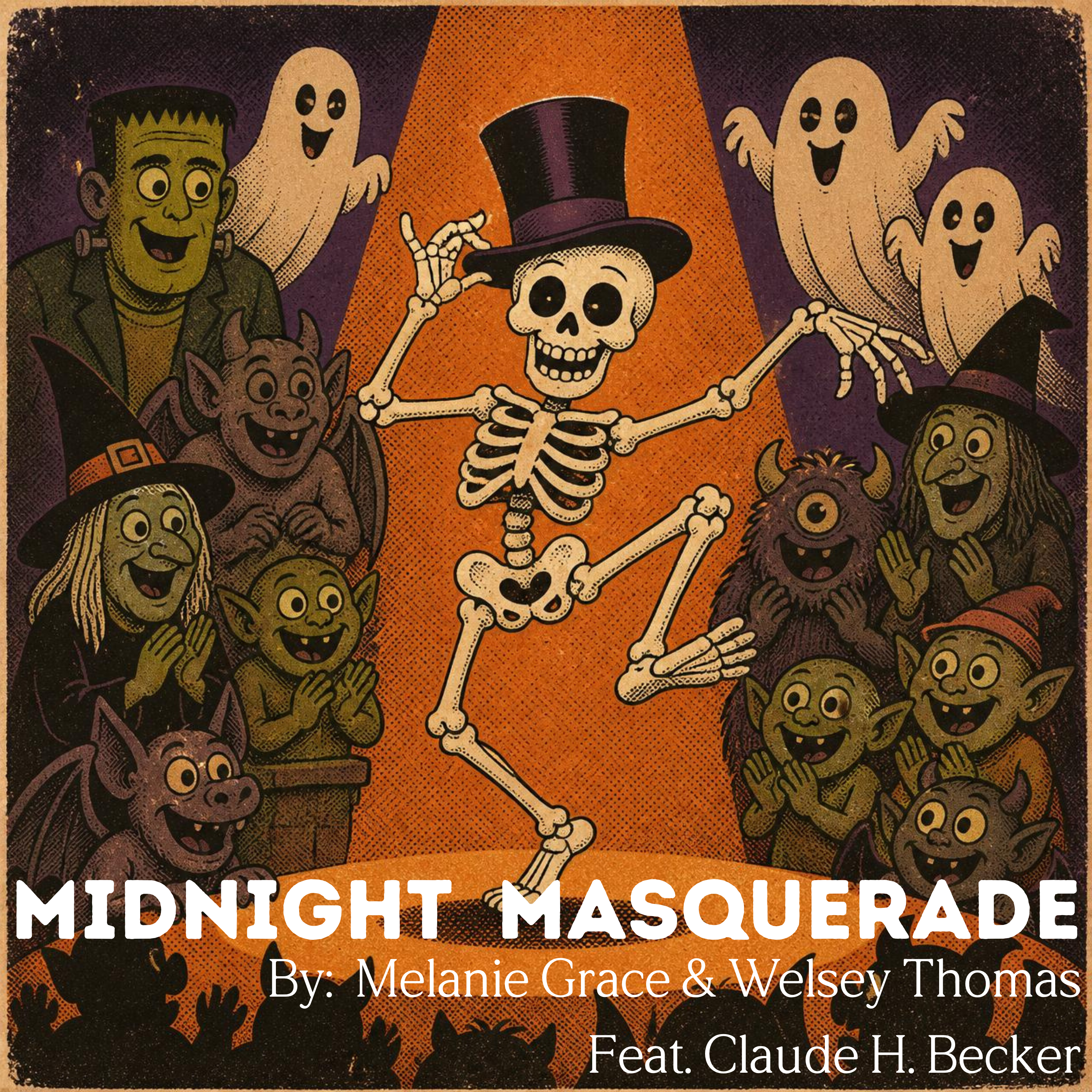
    Happy October, everyone. It is finally my favorite month, and I have something I have been dying to share with you. My new album is called Midnight Masquerade, and it is a whole Halloween record built for the entire family.

    Here is the idea that started it all. Picture a masquerade ball where every creature is invited. The skeletons show up first and take the floor. The witches waltz in. A carnival rolls through. Ghosts march past the windows. And by the end of the night, the party spills out onto your own street, where the neighbors are the strangest creatures of all. That is the album. It runs from a sunny afternoon of pumpkin carving all the way to after midnight, and it never stops being fun.

    I wrote this one to work on two levels at once. Little ones get farting goblins, a skeleton dance craze, and a headless horseman who only steals candy. Grown-ups get a gothic waltz, a haunted carnival, and a few songs with real chills under the costume. Nobody has to be left out of the party.

    All month I am going to post one blog a day. One for each song, and a handful of behind-the-scenes stories about the fun we had writing it. Come back every day and let us count down to Halloween together.

    Follow me so you never miss a new song or album. When you follow me on your streaming platform, every new release shows up for you the moment it drops:

    Get it here first by joining my email list


    PRE-SAVE on a Folklore Christmas today

    A circular illustration depicting a night scene with a full moon and snowy sky at the center, surrounded by various characters and mythical figures from folklore, including Krampus, witches, and elves, engaging in activities like cooking, carrying children, and interacting with animals.

    Why Pre-Saving A Folklore Christmas Means the World (And How It Helps You!)

    If you’ve ever wondered why artists are always asking you to pre-save their upcoming albums on Spotify, here’s the secret: it’s the single best way to make sure you don’t miss a beat, while giving independent music a massive boost!

    Here is what pre-saving actually does for you—and for the album:

    • It drops right into your library on launch day: The moment Midnight Masquerade goes live, Spotify will automatically add it straight to your Liked Songs and library. You won’t have to search for it, set a reminder, or worry about missing release day.
    • It feeds the Spotify algorithm: Algorithms pay close attention to pre-save numbers. A high pre-save count signals to Spotify that people are excited about the record, which helps push our spooky tracks onto official curated playlists, radio feeds, and recommendation charts for brand new listeners.
    • It helps independent music thrive: Every single pre-save gives independent artists a louder voice on major streaming platforms, helping us share these fun, family-friendly Halloween tunes far and wide.

    It only takes one click, but it makes a huge difference!

    Come say hi on socials!!!

    Instagram | YouTube | Facebook

    xoxo,

    Stylized handwritten text displaying the name 'Melanie Grace'.
  • The Songbook: every song waits at the back

    The Songbook: every song waits at the back

    There are no lyrics in the chapters.

    That was a decision, and it was not the original plan, and I want to explain it because the shape of the book depends on it.

    A Folklore Christmas started as an album. Twenty-four songs, one for nearly every creature, written over about two years. The book came second. It came because I kept finishing a song and realizing I had learned six things while writing it that would not fit inside three minutes, and it seemed a waste to throw them out.

    So the first draft of the book did the obvious thing. Each chapter ended with its song. Krampus chapter, Krampus lyric. Grýla chapter, Grýla lyric. It felt natural. It felt like a companion piece doing its job.

    It did not work, and the reason it did not work is worth saying out loud.

    A song and a source note are two different kinds of claim, and if you put them on facing pages, the reader stops being able to tell which is which.

    Here is the problem in miniature. The chapter on Frau Perchta tells you that church officials in Bavaria condemned the cult of Fraw Percht in 1468, and that Thomas Ebendorfer condemned the same practice in Vienna in 1439. Those are facts. They have citations. You can go check them, and I want you to.

    The song about Frau Perchta tells you what it is like to hear her at the door.

    The second thing is not a lesser thing. But it is not evidence, and I was putting it four inches away from the evidence, in the same typeface, under the same chapter heading, and the effect was that the whole chapter got softer. The song leaked into the history and made it feel like decoration. The history leaked into the song and made it feel like homework. Both got worse.

    Pre-Save the Album today!

    Worse than that, I noticed it was doing something dishonest. A reader who finished the Mari Lwyd chapter and immediately read a Mari Lwyd lyric would come away with an impression of ancient Celtic horse veneration that the actual documentary record does not support, and the lyric would have done that work, not the prose, and I would not have had to write a single false sentence to accomplish it. That is exactly the kind of thing this book exists to argue against. I was not going to do it by accident in my own margins.

    So I pulled all twenty-four out and put them at the back, together, as a Songbook.

    What happened next surprised me. The chapters got harder and cleaner. Without a song waiting at the end to supply the feeling, each chapter had to earn its own weight out of the material, and several of them turned out to be carrying less than I thought. Those got rewritten. The book is better because the songs left.

    And the songs got better too, or at least they got seen better. Read together, in order, at the back, they stop being twenty-four separate illustrations and become a thing with a shape: an album, which is what they always were. The Songbook opens with the warning and closes at Epiphany, and the arc that runs through it is not the same arc the chapters run. It is allowed to be its own argument now.

    Each lyric in the Songbook carries a line telling you which creature it belongs to, so you can go back if you want. Most people, I suspect, will not go back. They will read the chapters straight through and then read the Songbook straight through and let the two versions sit next to each other without resolving, which is the correct way to do it and which I could not have designed if I had tried.

    One of them, the twelfth, ends in the middle of a sentence, on an open quotation mark. That is not a typo. It has been flagged as a typo by three different people so far. I am leaving it.

    The Songbook runs at the back of every edition, print and Kindle both. The Kindle is out now; hardcover and paperback land October 1. The album follows on November 1, which is when the Songbook stops being a text and starts being what it is.

    Pre-Save the Album today!

  • September Is Almost Over and I Am Not Ready

    September Is Almost Over and I Am Not Ready

    Can we talk about September for a minute? Because September is almost over and I have complicated feelings about that.

    On one hand, October is coming and October is the fullest expression of everything fall is. The color peaks in October. The best hay rides and pumpkin patches and corn maze days are in October. The fireplaces start in October. The good Starbucks drinks are fully in rotation in October. October is fall at its most October, which is to say fall at its most itself, which is to say the best month of the year by a significant margin. I am genuinely excited for October.

    On the other hand, September. Beautiful, transitional, quietly incredible September. I am not ready to let it go.

    September was the month this year when Give Me Fall came out into the world. That fact alone makes it a significant September for me personally. I have been making music for years and I have released a lot of projects, but this one felt different from the moment I started writing it. It felt like the most complete expression of who I am as an artist and what I love as a human being. Fourteen songs about the season I have been waiting for all year. And September was the month it finally got to exist.

    I wrote about September in a song on the album called September Starts, which opens with this image: a chill in the air that wasn’t there last week. That is September. That is the essence of it. One morning everything is still summer and the next morning there is a chill that wasn’t there before, and something in you recognizes it before you can name it. September is the month the air begins to change.

    September is also the month people seem to come back to themselves. I wrote about this in a blog post earlier this month, the way September feels like a second New Year, the way the return of routine and rhythm and cooler air and the smell of something different gives people a feeling of renewal that January tries to offer and never quite delivers in the same way. I see it in the faces of people I pass in September. Something has settled. Something has arrived. The summer is behind them and they are glad.

    I am glad too. I am so glad. And a little wistful, the way you are always a little wistful about something beautiful that is almost over.

    But October is right there. And I have promised myself I am going to be fully inside it. No rushing toward what comes next, no thinking about the album I am making for winter, which I did mention is coming and is called A Folklore Christmas and is going to be something really special rooted in the old stories and folklore and Celtic tradition of the winter season. I am going to let October be October. I am going to be present to every leaf and every golden hour and every firepit night and every last dinner outside that I do not know is the last one until it is already over.

    That is the whole lesson of this album and of this season. You cannot hold onto it. But you can be awake inside it. You can choose, every single day, to pay attention to the beautiful life that is happening right in front of you.

    Thank you for spending September with me. Thank you for listening to Give Me Fall and for streaming and sharing and commenting and showing up. You make this whole creative life feel like the thing it was always meant to be.

    October tomorrow. Let’s go.

    Find Give Me Fall on Spotify, Apple Music, Amazon Music, Deezer, and Pandora. Please follow me so A Folklore Christmas finds you automatically when it releases. Come be part of this community on Instagram, Facebook, and YouTube. And join my email list here where I share everything first.

    Tell me in the comments: what was your favorite September moment this year? What are you most looking forward to in October? I want to hear all of it.

    See you in October, friends.

    Warmly, Melanie Grace


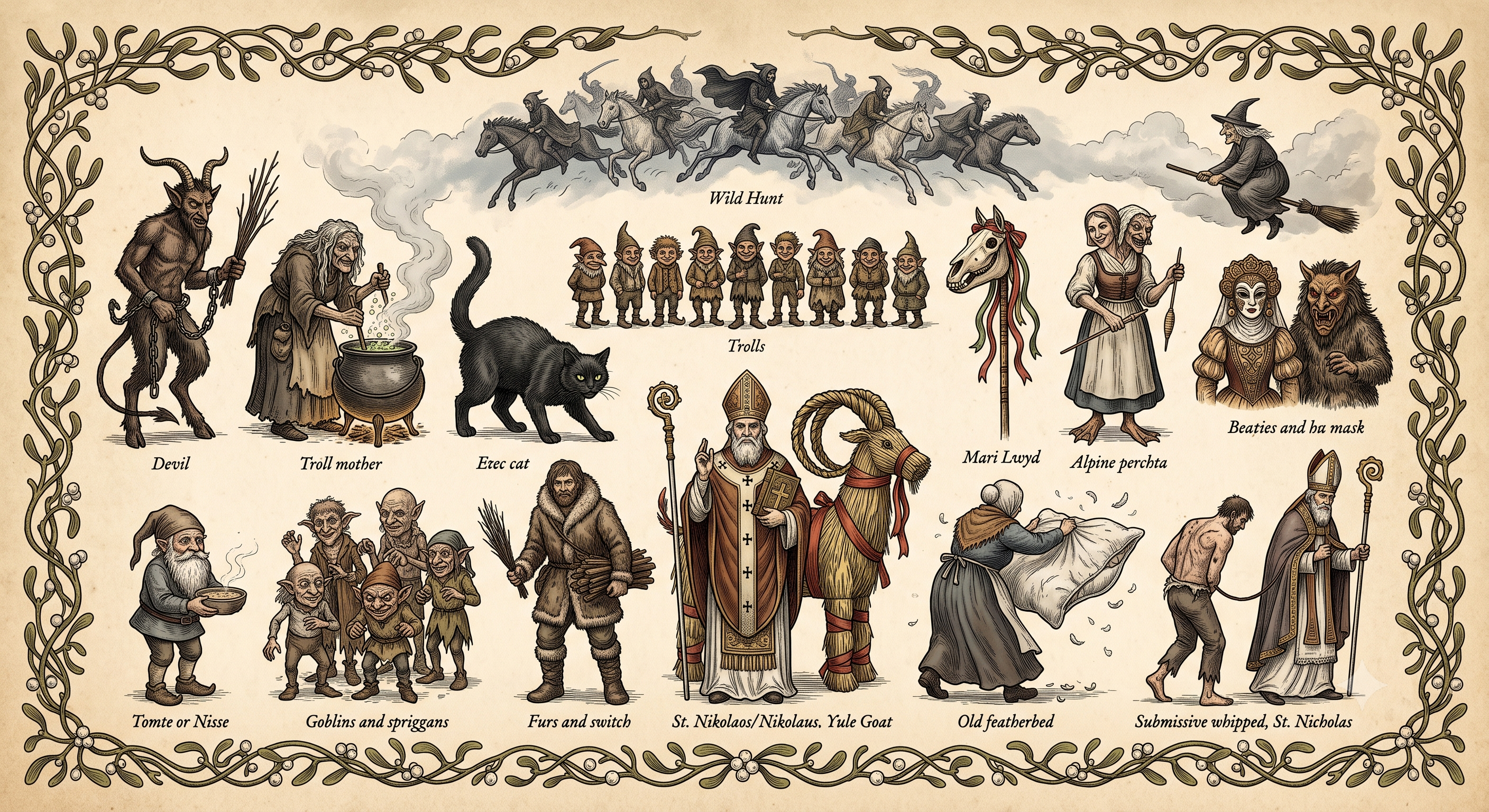
  • What Krampus was before the ugly sweaters

    What Krampus was before the ugly sweaters

    In 1506, the town of Zerbst in Germany staged its Corpus Christi procession, and someone wrote down who was in it.

    The script survives. It lists Saint Nicholas, in a bishop’s cope and mitre, staff in one hand, three gold balls in the other, his hand raised in blessing. A few lines later it lists the archangel Michael, elegantly turned out, a cross at his head. And it says what Michael is to do.

    He is to lead a devil on a chain.

    Pre-Save the Album today!

    That is 1506. A saint and a chained devil, walking in the same procession, on the same day, on purpose. Nobody in Zerbst thought this was transgressive. It was the program.

    I bring this up because of the other story, the one you have almost certainly been told: that Krampus is a survival from pre-Christian paganism, a horned god the Church could not stamp out, smuggled into Christmas in disguise. Britannica says a version of it. The Smithsonian has said a version of it. The version they say usually includes the detail that Krampus is the son of Hel, the Norse goddess of the dead.

    There is no source for that. Not a weak source. None. Krampus does not appear in any Old Norse text, and Old Norse was never spoken in Austria or Bavaria, which is where Krampus is actually from. The claim gets repeated because it got repeated, and it gets repeated because it sounds like the kind of thing that ought to be true.

    You can trace where it comes from. In March 1958 a folklorist named Maurice Bruce published a short piece called “The Krampus in Styria” in the journal Folklore, in which he announced that there was little doubt as to Krampus’s true identity, because in no other form was the regalia of the Horned God of the Witches so well preserved. He cited nothing. He did not need to, in his own mind, because he was working from Margaret Murray’s witch-cult hypothesis, which held that the early modern witch trials had been the suppression of a real surviving pagan religion. Historians now regard Murray’s thesis as pseudohistory. It rests on taking confessions extracted under torture at face value when they fit and discarding them when they do not.

    So Bruce built his Krampus on a foundation that has since been removed, and the building is still standing, held up by nothing but citation.

    When scholars actually went into the records, they found something else. In the 1980s the ethnologist Hans Schuhladen worked systematically through the historical documents and found no pagan origins at all. His earliest source is 1582, in the Bavarian town of Diessen, where men who had “hunted the Percht” were paid for it. Not ancient. Early modern, and Christian, and municipal enough to have an expense line.

    And the word Krampus is later still. Al Ridenour, whose 2016 book is the best thing written on this in English, points out that Krampus barely appears in print before the mid-1800s and only becomes the standard name for the figure with the boom in Krampus greeting cards around 1900. For centuries before that, the figure was called Percht, after Perchta, and Perchta is a couple of hundred years older than he is. The devil got famous. The witch was there first.

    Which leaves the question of where he actually comes from, and the answer is sitting in the Zerbst script.

    Look at how Krampus is drawn in the oldest images we have of him, the postcards of the 1890s and 1900s. Absurdly long tongue lolling out. Long pointed horns. Claws. Cloven hooves. Black all over. A tail. Chains. A birch rod.

    Now look at how the Devil is drawn in the Codex Gigas, in the Smithfield Decretals, in a hundred manuscripts of the High and Late Middle Ages. Long tongue. Horns. Claws. Hooves. Black. Tail. And in the mystery plays, Satan is chained by the archangel Michael and dragged off, and he is played for comedy, and audiences loved it, and the plays ran for centuries until the Reformation shut most of them down, except in the Catholic Alps, where they did not.

    Krampus is not an old god. Krampus is the medieval stage Devil, still in costume, still on his chain, who never went home after the play ended.

    And Saint Nicholas is holding the other end of the chain for a reason. The earliest surviving life of Nicholas, written sometime between 814 and 842, is full of exorcisms. He drives the demons out of the temple of Artemis at Ephesus. He is called the most active banisher of demons. A saint who has beaten a devil owns that devil. So the devil walks beside him, bound, doing the ugly half of the job the saint cannot be seen to do himself.

    That is a stranger and better story than “ancient horned god.” It means Krampus is not a pagan holdout at all. He is a Catholic holdout. He is the part of Christianity that was willing to look at a child and say: there are consequences, and here is what one looks like, and it has a tongue.

    The ugly sweaters can stay. But he was somebody first.

    Pre-Save the Album today!

  • The Faith Lesson Fall Keeps Teaching Me Every Single Year

    The Faith Lesson Fall Keeps Teaching Me Every Single Year

    I wrote a song called Let It Turn for my fall album Give Me Fall, and the central image of that song is the leaves releasing from the branch. Not because they are forced off. Not because something violent happens. But because it is time, and they know it is time, and they let go without argument and without grief and without trying to negotiate a few more weeks on the branch.

    I have been thinking about that image since I wrote the song and I cannot stop thinking about it now that the trees outside my window are actually doing it. Actually letting go. The whole thing is happening right now in real time and it is as beautiful and as convicting as it always is.

    Because here is the truth. I am not good at letting go.

    I am good at holding. I am good at managing and maintaining and keeping things in place. I am good at carrying things longer than I probably need to, longer than is good for me, longer than the season is asking me to. And then fall arrives and the leaves show me again what they know that I keep forgetting. That the releasing is not a failure. That the letting go is not a loss. That the most beautiful moment, the one where the colors are the richest and the light is the most extraordinary and everything looks like it was painted for a specific and intentional reason, that moment comes right before the letting go. The tree burns most beautifully right before it releases.

    I think about this in terms of seasons of life, not just seasons of weather. There are things I have held onto past the right time, ideas and expectations and versions of myself and versions of relationships, and the holding on has cost me the beauty that comes with the releasing. The tree does not become bare and then regret the summer. It becomes bare and it rests, and in the resting it prepares for what comes next. And what comes next is new growth and new green and an entirely new season of life.

    The song says: teach me how to let it turn, the way the leaves do without fear. That is still my prayer. I am still learning it. I think I will be learning it for a long time, probably for as long as the leaves keep showing me how it is done.

    There is also something in the timing of this lesson that I find deeply intentional. Fall arrives right before the seasons when we celebrate a baby being born in the most humble of circumstances, and then the turning of a new year, and then the resurrection of everything that seemed dead and gone. The church calendar and the natural calendar are doing the same thing. They are both asking us to let go of what has been so that what is coming can arrive.

    I have a project in the works for the winter season that I think is rooted in exactly this. The idea that the old stories, the ancient traditions, the folklore that has been carried through generations of people who also needed to believe that the darkness does not last, has something to say to us right now. A Folklore Christmas is what I am calling it, and it is something I am making with a great deal of prayer and a great deal of love for the season it belongs to. More details coming soon. Get on my email list here to be the first to hear.

    In the meantime, Give Me Fall is on all streaming platforms and the song Let It Turn is on there waiting for you specifically if any of this resonated. Find me on Spotify, Apple Music, Amazon Music, Deezer, and Pandora. Follow me so you never miss a new release. Come be part of this community on Instagram, Facebook, and YouTube.

    Tell me in the comments: what is fall teaching you this year? What are you learning to let turn? I would love to hear from you.

    Let it turn. Let it go gold. The best is still ahead.

    Warmly, Melanie Grace