Tag: worship music

  • From Church Choir to Indie Album: How Faith Shaped My Songwriting Voice

    From Church Choir to Indie Album: How Faith Shaped My Songwriting Voice

    How does faith influence songwriting?  Faith shapes songwriting by providing a framework for meaning, a vocabulary for transcendence, and a tradition of communal music that emphasizes songs serving a purpose larger than entertainment. Many of the most enduring songs across genres are rooted in a songwriter’s relationship with something larger than themselves.

    My First Musical Home

    I was a little girl standing in the soprano section next to women who had been singing in that same choir for decades, learning to blend my voice into something much larger than it could be alone, to listen as much as I sang, to lift a melody above a harmony and know intuitively when to carry and when to pull back. Church music gave me my first understanding that songs have a purpose that goes beyond entertainment or performance. They can carry someone through a grief they cannot name. They can open up a room in ways that words alone never could.

    That understanding has stayed with me through every kind of music I have made since then. Every album I have released in 2026, whether it is explicitly faith-based or not, carries that quality in it somewhere. The sincerity. The sense that a song is meant to land somewhere real in the listener and mean something when it does. That quality comes directly from years of making music in community, in worship, in service of something larger than the performance itself.

    A group of five musicians posed together in a room. Two women are standing, one holding a drink and another sitting on an amplifier with an acoustic guitar. A man sits in the background, and another man stands on the right holding a bass guitar. A teenager is sitting on the floor with a drumstick.

    How Does Faith Influence My Music?

    Faith influences my music on two distinct levels. The first is direct: albums like Chosen by Grace are explicitly about the experience of being held by grace, about reaching toward something larger than your own effort, about the profound relief of being loved without first having to earn it. Those songs are grounded in specific spiritual conviction and they do not pretend otherwise.

    The second level is more diffuse but equally present throughout my catalog. Faith shapes the way I understand what songs are fundamentally for. I believe music matters beyond entertainment. I believe a song can reach into a person and change something, or at minimum make them feel less alone in what they are carrying. That belief is entirely formed by years of making music in community contexts where the purpose of the song was always larger than the song itself.

    What Did Classical Training Give You as a Songwriter?

    Training as a first soprano gave me an understanding of how individual voices create together something that neither could achieve alone. It gave me ear training that is audible in how I approach song architecture. It gave me a high standard for what music can actually be when everyone involved commits completely to what they are making.

    I am still an active singer in my church community and it keeps me genuinely grounded in why music matters. On the days when the industry side of things feels loud and metrics-driven, singing in a room full of people who are simply trying to connect to something larger than themselves brings me back to the essential thing. The choir loft was the first room that shaped me as a musician. I am grateful for every room that has shaped me since.

  • New Beginnings: A Year-Long Journey Through Four Musical Expressions of One Unchanging Truth

    New Beginnings: A Year-Long Journey Through Four Musical Expressions of One Unchanging Truth

    New Beginnings: A Journey Complete

    We’ve journeyed together through four complete albums, eleven movements, and forty-four separate interpretations of the same fundamental spiritual truth: God is faithful, transformative, loving, healing, and eternal.

    From baroque majesty to Broadway emotion to singer/songwriter intimacy to alternative rock defiance, we’ve encountered one story told four ways.

    What We’ve Discovered Together

    Over these past weeks, we’ve encountered the same biblical passages and theological themes through four completely different artistic lenses:

    • Gratitude/Survival: From formal liturgical recognition to character awakening to intimate personal realization to defiant celebration
    • Transformation: From architectural baroque beauty to character-driven narrative to acoustic personal journey to explosive liberation
    • Joy: From trumpet fanfares to infectious ensemble to quiet small moments to fierce defiance
    • Hope: From formal duet harmony to relational partnership to intimate conversation to defiant solidarity
    • Healing: From tender baroque to character testimony to ongoing learning to proud testimony
    • Eternity: From grand finale chorus to communal kingdom vision to personal conviction to cosmic transcendence

    Each approach reached different people. Each spoke to different hearts.

    Why Four Volumes Matter

    In our culture, we often assume that there’s one “right” way to encounter truth. One musical genre. One artistic style. One expression of faith.

    But what if God delights in the diversity? What if His faithfulness doesn’t sound the way the previous generation expected it to sound? What if your particular musical language is exactly how God wants to speak to your soul?

    “New Beginnings: Four Styles, Same Message” suggests something radical: the gospel doesn’t need a single expression. It thrives in multiplicity.

    The classical musician encounters God’s faithfulness through baroque majesty.

    The theater lover encounters it through character-driven narrative.

    The acoustic seeker encounters it through intimate vulnerability.

    The alternative rock enthusiast encounters it through defiant transcendence.

    All four encounter the same God. All four discover the same truth. They just hear it in the language that speaks to their soul.

    What This Means for Your Faith

    As you finish this series, consider:

    Which version of each song resonated most deeply with you?

    Was it the baroque? The Broadway? The acoustic? The alternative rock?

    Or did you find that different versions spoke to you at different moments? That some days you needed formal beauty, other days relational testimony, still other days intimate vulnerability, and still other days defiant power?

    That’s not contradiction. That’s wholeness.

    Our faith isn’t meant to be one-dimensional. It’s meant to be rich, textured, approached from multiple angles.

    The Invitation Forward

    In 2026, I invite you to:

    Listen to all four volumes. Not just the one that initially appeals to you. Listen to all four and discover how four different musical languages celebrate the same God.

    Share with others. If you love the baroque, introduce a friend to the Broadway. If the acoustic version speaks to you, ask someone who loves classical music to listen with you. If you’re energized by alternative rock, invite someone who loves musical theatre to experience it with you.

    Notice the diversity. Pay attention to how the same theological truth transforms across genres. What does that teach you about God’s nature? About His multi-faceted character?

    Let your faith expand. If you’ve only ever encountered God’s faithfulness in one musical style, discovering it in three others might deepen your understanding, broaden your worship, expand your experience of the sacred.

    Celebrate the multiplicities. Recognize that God speaks every language, reaches every heart, and transforms through any artistic medium that carries truth.

    The Same Story, Forever Unfolding

    God’s faithfulness isn’t a story that gets old. It doesn’t exhaust itself.

    It emerges new every morning. It speaks in every language. It reaches every heart.

    This past month, we’ve journeyed through that faithfulness in four complete artistic expressions. But the invitation doesn’t end here.

    In your life, God’s story will continue unfolding—perhaps in ways you haven’t yet discovered. Perhaps in artistic expressions you haven’t yet encountered. Perhaps in communities you haven’t yet joined. Perhaps in your own voice, in your own music, in your own expression of truth.

    The same story keeps telling itself. Through Scripture. Through tradition. Through contemporary art. Through your life.

    Thank You for the Journey

    I’m genuinely grateful that you’ve journeyed through “New Beginnings: Four Styles, Same Message” with me. Whether you connected most deeply with the baroque, the Broadway, the acoustic, the alternative rock, or some combination of all four, you’ve been part of something genuinely unique.

    You’ve participated in a statement that faith thrives in diversity, that God’s truth speaks every language, that the gospel is both timeless and constantly fresh.

    You’ve discovered that the same message sounds completely different depending on the language, and that’s beautiful.

    What’s Next?

    As you step into 2026, I invite you to:

    • Download or stream all four volumes of “New Beginnings: A Spiritual Journey in Four Musical Languages”
    • Share your favorite version with someone whose musical taste differs from yours
    • Reflect on which version(s) resonate most deeply with your faith journey
    • Consider how encountering God’s faithfulness across artistic traditions might deepen your spiritual life
    • Join the conversation about what it means to experience faith in multiple languages, multiple genres, multiple expressions

    The story continues. The faithfulness endures. The music plays on.

    Thank you for listening. Thank you for believing. Thank you for being part of “New Beginnings: Four Styles, Same Message.”

    May your 2026 be filled with the discovery that God’s faithfulness really does sound beautiful in every language, speaks to every heart, and transforms through any artistic medium that carries truth.

    Welcome to new beginnings. Welcome to the fullness of God’s voice, speaking in the language that speaks to your soul.

    A promotional image for 'New Beginnings' featuring four musical volumes: Baroque, Broadway, Songwriter, and Alternative, with images of performances from each genre.
  • Morning Mercies: Why Every Day Is a Fresh Beginning in God’s Love

    Morning Mercies: Why Every Day Is a Fresh Beginning in God’s Love

    SPOTIFY • APPLE MUSIC • AMAZON MUSIC • DEEZER • PANDORA • YOUTUBE

    His Mercies Are New: The Revolutionary Practice of Beginning Again

    “Because of the Lord’s great love we are not consumed, for his compassions never fail. They are new every morning; great is your faithfulness.” (Lamentations 3:22-23)

    These verses come from a book of lamentation. From a place of profound grief. And yet, here, the writer discovers something radical:

    God’s mercy doesn’t run out. It doesn’t get exhausted. It’s new. Fresh. Available. Every. Single. Morning.

    This is revolutionary theology hiding in a book of mourning: you don’t earn tomorrow’s mercy by being good enough today. You receive it. As a gift. Renewed.

    The Baroque Version: “His Mercies Are New”

    The full choir enters, homophonic but rich. “His mercies never come to end, his faithfulness remains complete, morning by morning, new they send, their freshness makes our joy replete.”

    The language is formal, theological. The texture is communal. This isn’t one voice—it’s many voices discovering the same truth together.

    “Great is His faithfulness, so sure, great is His faithfulness to all.”

    There’s a polyphonic section in the middle where different voice parts weave together, creating internal conversation: different registers of humanity all discovering: yes, God’s mercies are new.

    Then the full choir returns: “Great is Thy faithfulness, Lord, unto me!”

    The baroque approach to Lamentations 3:22-23 is corporate affirmation. This is a worshiping community discovering together that each morning brings new mercy. This is formal celebration of the most intimate truth: you are not abandoned.

    The Broadway Version: “Every Morning Breaks Brand New”

    A soprano leads: “Every morning breaks brand new, every morning brings the news, that His mercies, they’re alive, that we’re meant to thrive!”

    There’s a spoken moment: “You know what I love about mornings? It’s the permission they give you to start over. Whatever yesterday held, whatever mistakes I made, the sun comes up and says: ‘You get another chance.’”

    This is the genius of the Broadway approach. It honors the exhaustion, the failures, the mistakes. And then it says: and yet, God gives you another chance. Every morning.

    The ensemble joins: “Great is His faithfulness, morning by morning, forever true!”

    There’s something profoundly comforting about the ensemble singing this together. It’s not just me discovering mercy is new. We’re all discovering it. Together.

    This is communal hope: I believe in morning mercies because I see others believing too.

    The Singer/Songwriter Version: “Every Day Is New”

    “Every day is new, every morning brings fresh grace, every day is new, you can start again, in this place.”

    The singer/songwriter approach is direct, almost simple. No complexity. Just voice and guitar affirming: yes, grace is fresh. Yes, you can begin again.

    “I didn’t believe that at first, I thought once you mess up, you’re marked… But I’m learning something different now: His mercies are new every single morning, not because I earned them, not because I finally got my act together, but because that’s who He is.”

    This is intimate theology. Not corporate wisdom. Personal discovery.

    The chorus—”Every day is new, every day is new, you can start again”—is almost a permission slip. A whisper in the darkness: it’s okay. Try again tomorrow.

    The Alternative Rock Version: “Morning Comes Again”

    An ethereal yet powerful voice opens: “The night was endless, I thought the breaking was forever. I thought the darkness had a claim on me. I thought I’d never get better.”

    The song is sparse and haunting. “Then morning came, soft and quiet, like a promise whispered in my ear, like a hand reaching through the night.”

    The chorus builds: “Morning comes again, morning comes again, and the darkness doesn’t get the last word. Morning comes again, morning comes again, I’m alive, I’m breathing, I’ve been heard.”

    The alternative rock approach combines ethereal vulnerability with quiet power. The night was real. The breaking was real. But morning is also real.

    “There’s a rhythm to the restoration, a pattern to the healing, every morning brings a gentle reckoning, every morning brings me back to feeling.”

    By the final chorus: “I’m alive, I’m breathing, I’m becoming, I’m a testament to the power of the morning. I’m proof that darkness doesn’t win. I’m proof that healing’s always dawning.”

    The Same Truth, Four Languages

    Lamentations 3:22-23 proclaims that God’s mercies are renewed each morning. The way we experience that renewal differs:

    • Baroque celebrates renewal as corporate, liturgical affirmation of faithfulness
    • Broadway celebrates renewal as permission to start over despite failures and mistakes
    • Singer/Songwriter celebrates renewal as intimate permission, a whisper that says: try again tomorrow
    • Alternative Rock celebrates renewal as ethereal certainty: darkness doesn’t win, morning always comes

    What This Means for Your Tomorrow

    Did you mess up today? Did you fail? Did you disappoint yourself?

    Lamentations 3:22-23 says: that doesn’t determine tomorrow’s mercy.

    The baroque version invites you to join a worshiping community in formal affirmation: we all discover together that mercy is renewed.

    The Broadway version invites you to accept the permission: whatever happened, the sun will come up and offer fresh grace.

    The singer/songwriter version invites you to believe the whisper: it’s okay. You can begin again.

    The alternative rock version invites you into quiet certainty: morning will come, darkness doesn’t win, healing is always dawning.

    The Mercies That Never Fail

    The most revolutionary truth of Scripture might be this: God doesn’t ration His mercy. He doesn’t wait to see if you’re good enough for tomorrow’s portion.

    He gives it. New. Fresh. Abundant. Every morning.

    In 2026, that might mean waking up to whichever version of “His Mercies Are New” / “Every Day Is New” speaks most deeply to your weary heart.

    All four offer the same gift: permission to begin again.

    Cover image for 'New Beginnings' by Melanie Grace featuring Claude H. Becker, showcasing different musical styles: Baroque, Broadway, Songwriter, and Alternative. The design includes festive elements and performances.
  • New Beginnings: One Spiritual Journey, Four Complete Albums, Endless Possibilities

    New Beginnings: One Spiritual Journey, Four Complete Albums, Endless Possibilities

    New Beginnings: One Message, Four Genres

    Music has an extraordinary power: it speaks directly to the soul in the language that soul understands. A classical musician experiences truth differently than a Broadway devotee, who experiences it completely differently than an indie music lover or an alternative rock enthusiast. Yet the deepest truths—transformation, survival, hope, healing, and transcendence—belong to all of us.

    This is the heart of “New Beginnings: Four Styles, Same Message.”

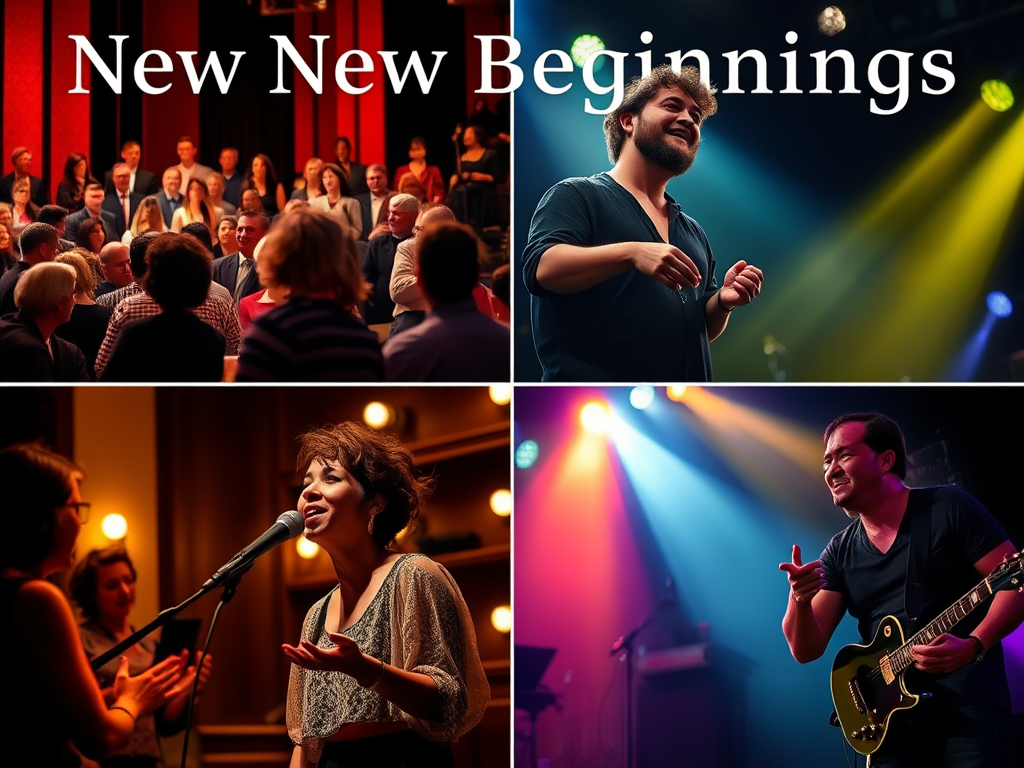
    Album cover for 'New Beginnings' by Melanie Grace featuring four music genres: Baroque, Broadway, Singer/Songwriter, and Alternative. The image includes a choir, a Broadway performance, a solo singer at a café, and an alternative rock band.

    One Spiritual Vision. Four Complete Albums.

    For January 2026, I’m releasing something unprecedented: a quadruple-album project exploring the same spiritual journey in four distinct musical languages. Not remixes. Not covers. Not adaptations. But four completely original albums, each with customized lyrics, each telling the same story in the idiom that speaks to a different soul.

    • Volume 1: Baroque Oratorio — Formal, liturgical, architecturally beautiful classical excellence
    • Volume 2: Broadway/Musical Theatre — Emotional, character-driven, narrative storytelling
    • Volume 3: Singer/Songwriter Acoustic — Intimate, vulnerable, acoustic authenticity
    • Volume 4: Alternative Rock/Indie — Defiant, survival-focused, ethereal yet powerful

    Each volume stands completely alone as a satisfying artistic and spiritual experience. Yet together, they create something revolutionary: a unified statement that God’s faithfulness speaks every language, reaches every heart, and transforms through any artistic medium.

    Why Four Volumes?

    The inspiration came from a simple realization: not everyone encounters God the same way, and not everyone encounters God through the same musical language.

    A devoted classical music lover may never pick up a contemporary musical theater album. A Broadway fan might dismiss baroque as inaccessible. An indie music listener might never explore either. And alternative rock fans? They’re often overlooked entirely in Christian music.

    But if we tell the same spiritual story in each of these languages—with equal theological depth and artistic excellence—something remarkable happens. Each person encounters profound truth in the idiom that speaks to their soul.

    The Theological Arc

    All four volumes follow the same six spiritual movements, but the emphasis and vocabulary shift with each genre:

    1. Gratitude/Survival — Recognizing what held us through the night
    2. Transformation/Reclamation — Understanding resurrection power and our authentic selves
    3. Joy/Defiant Celebration — Living in breakthrough despite circumstances
    4. Hope/Shared Strength — Trusting God’s plans with others
    5. Healing/Proud Testimony — Experiencing restoration and claiming our scars
    6. Eternity/Transcendence — Setting our hearts on eternal things breaking in now

    Whether you’re listening to a formal baroque chorus, a theatrical ensemble number, an intimate acoustic affirmation, or an explosive alternative rock anthem, you’re experiencing the same theological journey—just in the language that speaks to your heart.

    What Makes This Different

    This isn’t the same lyrics set to different music. This is four completely different sets of lyrics, each one speaking authentically in its genre’s vocabulary:

    • Baroque uses formal theological language and liturgical imagery
    • Broadway uses character-driven narrative and relational storytelling
    • Acoustic uses intimate, personal, confessional imagery
    • Alternative Rock uses survival, defiance, reclamation, and empowerment language

    This is a revolution in how we think about spiritual music. It’s saying: your genre, your language, your musical taste—all of it is welcome here. God’s faithfulness speaks your language.

    What to Expect in This Blog Series

    Over the coming weeks, I’ll be releasing 11 blog posts—one for each song in the project. Each post will:

    • Explore the song’s biblical foundation and theological themes
    • Show how each of the four genres approaches the same truth (using different lyrics)
    • Help you understand what makes baroque, Broadway, acoustic, and alternative rock styles distinct
    • Invite you into deeper spiritual reflection
    • Point you toward all four musical versions so you can experience the full diversity
    • Celebrate how the same message sounds radically different across genres

    By the end of this series, you’ll have encountered the same spiritual story through four completely different artistic lenses.

    An Invitation

    Whether you’re a classical music enthusiast, a Broadway devotee, an indie music lover, an alternative rock fan, or simply someone seeking spiritual depth in music, there’s a version of this project waiting for you.

    And if you’re adventurous, exploring all four versions will give you a richer, more complete picture of how God’s faithfulness sounds across artistic traditions and why diversity in how we experience and express faith is beautiful.

    Welcome to “New Beginnings: Four Styles, Same Message.”

    Let’s begin the journey together.