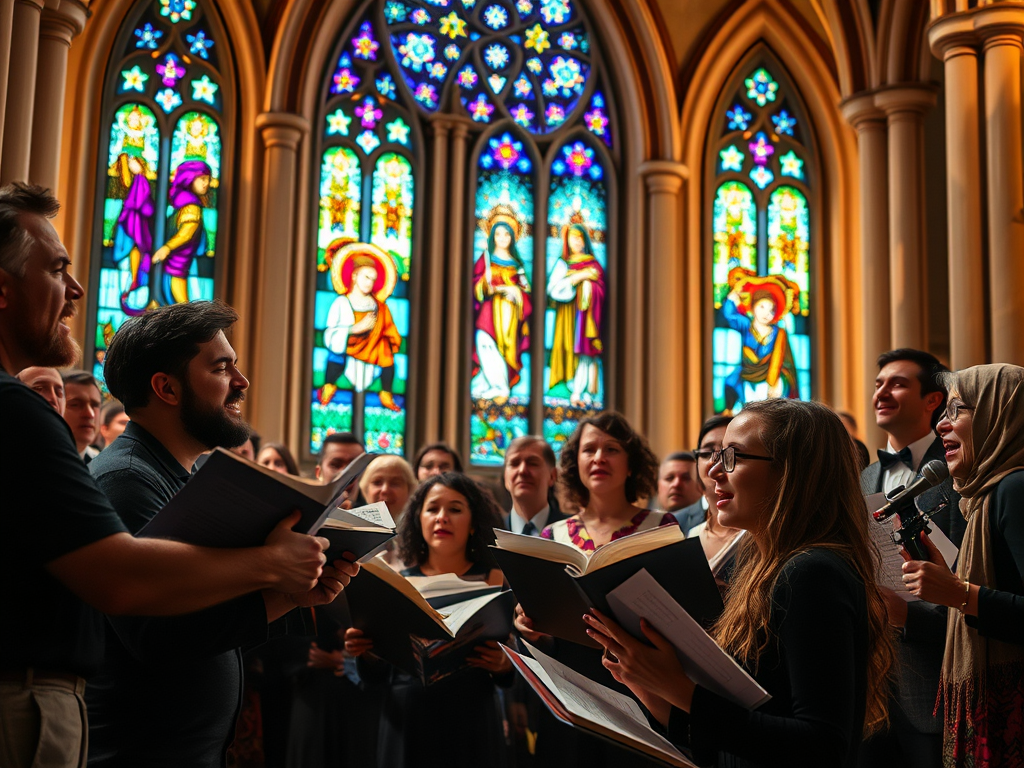
Why We Need New Sacred Oratorios
I grew up singing Handel. Singing Bach. Singing Vivaldi and Pergolesi and all the baroque masters. And I’m so grateful for that formation – those pieces shaped my understanding of worship, of beauty, of how music can carry theology.
But here’s what I kept wondering: why did we stop?
Why is the last great oratorio from 1741? Why are we still only singing pieces from the 1700s? Why haven’t we created NEW baroque music for our generation?
The Power of the Form
There’s something about the baroque oratorio that no other musical form can quite capture:
- Recitatives move the story forward – They’re like musical narration, advancing the plot
- Arias allow reflection – They let you sit with a truth, turn it over, feel its weight
- Choruses unite voices – They remind us we’re not alone in our worship
- Fugues and counterpoint show complexity – They mirror the intricate beauty of God’s plan
- The structure guides the listener – From beginning to end, you’re taken on a journey
Psalm 33:3 commands, “Sing to him a new song; play skillfully, and shout for joy.”
Psalm 40:3 promises, “He put a new song in my mouth, a hymn of praise to our God. Many will see and fear the Lord and put their trust in him.”
Isaiah 42:10 declares, “Sing to the Lord a new song, his praise from the ends of the earth, you who go down to the sea, and all that is in it, you islands, and all who live in them.”
Why Now?
We’re living in a time when:
- Attention spans are short
- Depth is rare
- Beauty is undervalued
- Tradition is dismissed as irrelevant
But the baroque oratorio offers:
- A complete narrative arc that holds attention
- Profound theological depth
- Stunning musical beauty
- A tradition that connects us to centuries of believers
What if we brought that to a new generation? What if young people today discovered that faith can be expressed through fugues and counterpoint, not just praise bands and pop choruses?
Both are valuable. Both are needed. But we’ve lost something precious when we abandoned the classical forms.
My Vision
I’m not trying to replace Handel’s Messiah. That would be impossible and foolish. Handel’s Messiah will endure forever, and rightly so.
But I believe there’s room for MORE. Room for new oratorios. Room for fresh expressions of timeless truth. Room for 21st-century believers to encounter Christ through 18th-century musical forms.
Colossians 3:16 encourages, “Let the message of Christ dwell among you richly as you teach and admonish one another with all wisdom through psalms, hymns, and songs from the Spirit, singing to God with gratitude in your hearts.”
Notice the variety: psalms, hymns, songs from the Spirit. We need ALL expressions of worship – contemporary AND classical, pop AND baroque, new AND ancient.
A Call to Churches
I’m asking worship leaders and music directors to consider: what if we performed this oratorio in Advent? What if we trained our choirs in baroque style again? What if we introduced our congregations to the beauty of classical sacred music through NEW pieces they can connect to?
“The Modern Messiah” tells the story they know – but in a form many have never experienced. It could be a bridge between the traditional and the contemporary, the ancient and the modern.
A Call to Musicians
If you’re a composer, a songwriter, a musician with classical training – don’t abandon those skills. Don’t think that sacred music means only contemporary worship. There’s still a place for baroque oratorios, classical masses, sacred cantatas.
The church needs your gifts. The next generation needs to hear the gospel in every musical form – including the ones we’ve neglected.
1 Corinthians 10:31 says, “So whether you eat or drink or whatever you do, do it all for the glory of God.” That includes composing fugues, writing counterpoint, creating baroque arias.
A Call to a New Generation
If you’ve never experienced a baroque oratorio, I invite you: listen to “The Modern Messiah.” Let yourself be taken on a journey from prophecy to resurrection. Let the counterpoint wash over you. Let the soloists tell the story. Let the choir’s “Hallelujah!” stir your soul.
You might discover that faith can be expressed through harpsichord and baroque trumpet just as powerfully as through electric guitar and drums.
And you might find yourself standing (like audiences have for 280+ years during the Hallelujah Chorus) in honor of the King of Kings.
My Personal Journey
From that first soprano in junior high, singing “Glo-o-o-o-oria” with my whole heart, to now creating a complete baroque oratorio – this has been a journey of coming home.
Home to the music that shaped me. Home to the tradition that formed me. Home to the beauty that pointed me to Christ.
And I’m bringing that home to you.
Claude H. Becker Lives On
My dad, whose name graces this album, loved beauty. He loved joy. He loved showing up in unexpected places (like those guest books!). And he loved Jesus.
I think he’d be proud of this project – not because it’s impressive musically, but because it points people to the One who matters.
Hebrews 12:1-2 reminds us, “Therefore, since we are surrounded by such a great cloud of witnesses, let us throw off everything that hinders and the sin that so easily entangles. And let us run with perseverance the race marked out for us, fixing our eyes on Jesus, the pioneer and perfecter of faith.”
Dad is part of that great cloud of witnesses now. And I believe he’s cheering us on – along with all the saints who’ve gone before – as we continue to create, to worship, to declare the glory of the Lamb.
The Story That Never Ends
“The Modern Messiah” tells the story from prophecy to resurrection. But the story doesn’t end there.
We’re still living in it. We’re between the “already” (He has come) and the “not yet” (He will come again).
And until He returns, we sing. We worship. We create. We tell the story in every way we can – including through baroque oratorios that connect us to centuries of believers who sang the same truths.
Revelation 22:17 invites, “The Spirit and the bride say, ‘Come!’ And let the one who hears say, ‘Come!’ Let the one who is thirsty come; and let the one who wishes take the free gift of the water of life.”
Revelation 22:20 responds, “He who testifies to these things says, ‘Yes, I am coming soon.’ Amen. Come, Lord Jesus.”
Final Invitation
Whether you’re a classical music lover or a contemporary worship enthusiast, whether you’ve sung in choirs or never opened your mouth in song, whether you’re a lifelong believer or just curious about faith – this oratorio is for you.
It’s an invitation to encounter Christ through beauty.
It’s a reminder that the old can be new again.
It’s a bridge between tradition and today.
It’s a declaration that Jesus is worthy of our absolute best – whether that’s pop worship or baroque counterpoint.
Most importantly, it’s worship. Pure, unashamed, exuberant worship of the Lamb who was slain and now reigns forever.
Psalm 150:6 commands, “Let everything that has breath praise the Lord. Praise the Lord.”
So let’s praise Him – with harpsichords and baroque trumpets, with fugues and counterpoint, with soprano arias and bass recitatives, with massive choruses and intimate solos.
Let’s praise Him with everything we’ve got.
From the Choir Loft to the Throne Room
I started in a choir loft, singing Handel’s words. Now I’ve written my own baroque oratorio, offering it back to the church and to the King.
And one day – one glorious day – I’ll join the ultimate choir. The one described in Revelation, where thousands upon thousands and ten thousand times ten thousand sing “Worthy is the Lamb!”
Until then, I’ll keep singing here. I’ll keep creating. I’ll keep pointing to Jesus through beauty and truth and music.
And I invite you to join me.
The Promise Kept. The Light Has Come. The Redeemer Lives. Worthy is the Lamb.
Hallelujah! Amen and Amen.
– Melanie Grace (Claude H. Becker)
Publishing Note:
Album Title: The Modern Messiah
Artist Name: Melanie Grace
Published Artist Credit: Claude H. Becker
Genre: Baroque Oratorio / Classical Sacred Music
Total Songs: 14
Album Length: 42-48 minutes
Musical Style: Complete baroque oratorio in the tradition of Handel’s Messiah, featuring SATB choir, baroque soloists (soprano, alto, tenor, bass), and full baroque orchestra (harpsichord, strings, oboe, baroque trumpet, timpani, organ). All original lyrics rooted in Scripture, following the three-part oratorio structure: Part I – The Promise (Prophecy & Birth), Part II – The Passion (Mission & Sacrifice), Part III – The Victory (Resurrection & Reign).
Blog Series Structure:
Blog 1: Introduction (Personal story, choir background, why create this)
Blogs 2-15: One blog per song in album order
Blog 16: Closing (Call to bring baroque to new generation)
In loving memory of Dad, who taught me to find joy in unexpected places and to never stop singing. This oratorio is my offering – to the church, to the next generation, and to the King of Kings who is worthy of all our praise. Until we sing together in heaven, I’ll keep singing here.