Category: Music

  • The darkness paradox: why sanitized holidays feel hollow

    The darkness paradox: why sanitized holidays feel hollow

    An Icelandic child puts a shoe on the windowsill on the night of December 12.

    Americans hear this and think of stockings. It is not the same gesture. The shoe is not a container for a gift. The shoe is submitted. Something comes down from the mountain in the night and looks at it and decides. In the morning there is a small treat, or there is a rotting potato, and the potato is a verdict.

    I want to make an argument about that potato, and I want to be careful about it, because the version of this argument you usually hear is not honest.

    Pre-Save the Album today!

    The dishonest version goes like this: children raised on scary folklore are less anxious, and here is a study. I looked for the study. I could not find one. What you find instead is a lot of people asserting it, usually citing each other. If someone has run a controlled comparison of anxiety outcomes between children raised with named monsters and children raised without, I have not located it, and I am not going to pretend otherwise in order to win a point. This book has enough true things in it that I do not need to borrow a false one.

    So here is the argument without the fake evidence.

    A potato in a shoe is a bounded event. It has a cause, which the child knows. It has a limit, which is that it is a potato and not a death. And it has a season, which ends. On January 6, the last of the Yule Lads goes back up the mountain, and the whole apparatus, the Lads and their mother and the Cat, packs up and leaves for eleven months. The dread has a start date and an end date and a specified escape.

    Compare that to the thing we replaced it with.

    The modern Christmas has no monsters, and it also has no exits. It is a season of mandatory joy, and mandatory joy is a trap, because the one thing a person cannot do on command is feel something. If you arrive at December with a dead parent, a bad year, a marriage that is ending, a diagnosis, you arrive at a holiday that has no language for you. It has only the assurance that this is the most wonderful time of the year, repeated at you in every public space, at volume, for six weeks.

    The old Christmas had language for you. It had an entire cast of characters whose whole function was to say: yes, the dark is real, the dark is out there right now, the dark has a name, and here is what we do about it. The Rauhnächte, the rough nights between Christmas and Epiphany, were understood across the German-speaking Alps as the time when the boundary was thin and the dead were moving. People did not experience that as a horror show. They experienced it as accurate. It matched what December actually feels like at that latitude, when the sun clears the ridge for four hours and then gives up.

    The paradox is this. A holiday that acknowledges the dark can hold more joy, not less, because the joy is not being asked to do a job it cannot do. It does not have to pretend. It does not have to be total. It only has to be the thing that happens after the Perchtenlauf comes through and drives the winter out, which is a much smaller and much more achievable claim.

    Whereas a holiday that has been scrubbed of everything difficult is a holiday with nothing to push against. You cannot have relief without something to be relieved of. You cannot have the return of the light if you never admitted it was gone. That is why the sanitized version rings hollow, and it is why so many people feel obscurely bad in December and cannot say why: they are being handed the resolution of a story whose first act has been deleted.

    I do not think we should bring back the belly-slitting. I want to be clear about that. Some of these traditions were cruel and the cruelty was not incidental.

    But I think we threw out the frame along with the knife, and the frame was the useful part. The frame said: the year is ending, it took things from you, name them, mark them, and then let the light come back. That is not a childish thing. That is close to the oldest thing we have.

    The book makes this argument twenty-three different ways, once per creature. It is on Kindle now, in print October 1.

  • Monday Mindset: Why Did I Let AI Sing My Songs?

    Monday Mindset: Why Did I Let AI Sing My Songs?

    You may have seen my new graphic floating around. Two lists. One says “I Wrote the Songs, AI Sang Them.” The other says “I Wrote the Songs, I Sang Them.” A few of you have asked about it, so let’s pull back the curtain, receipts and all.

    A smiling woman holding an acoustic guitar, wearing a denim jacket over a sparkly top and distressed jeans. Text overlay includes her name, 'Melanie Grace,' and lists song titles she wrote, along with music platform icons at the bottom.

    How Much Does It Cost to Professionally Record One Song?

    Let me show you what I actually paid as an independent artist. No estimates, no Fiverr browsing, just real numbers from my own recordings:

    • Pianist: $250 for one song
    • Additional instrumentalist: $150 to fill in the other instruments
    • Recording engineer: $100 per hour (I kept my booth time to a single hour)
    • Producer: $100 to $150 per hour, and a couple of my songs took him 3 hours each

    And here’s the part that still bothers me: I never received an itemized invoice for the producer’s hours. No breakdown, no time log. It was all based on “trust.” I was writing checks against a clock I couldn’t see.

    Add it up and one song could easily run $600 to $1,000 or more. An album? Multiply that by ten or twelve. For a homeschooling mom with a full-time job, that’s not a music budget. That’s a mortgage payment.

    What Does It Cost Just to Release the Music?

    Recording is only the beginning. Then you have to pay to put the songs out into the world.

    CD Baby charged me $19.99 per album just to distribute it. Want their $49.99 tier with a promotional “boost”? I’ll be honest with you: I have never seen or felt any boost from it, ever. Not one thing I could point to and say “that’s what I paid for.”

    And then there are the services that charge you just for the chance to be heard. Taxi charges a fee simply to submit your song for consideration. Not to place it. To submit it.

    How Much Do Independent Artists Actually Make From Streaming?

    Cents. Literal fractions of a cent per listen. In 2025, my total payout from CD Baby was $25. Twenty-five dollars. For the whole year. Against songs that cost hundreds of dollars each to record and $19.99 per album to release.

    You do the math, because I did, and it made me a little sick.

    Pay to record. Pay to release. Pay to submit. Then get paid pennies when people actually listen. From where I’m standing, the whole system feels like a racket built on the backs of independent artists. And for years, that math kept my songs in a notebook instead of in your ears.

    So I Made a Choice

    I stopped waiting. I write every single lyric myself, every story, every rhyme, every hook. Then I use Suno to produce and sing the songs I can’t afford to record professionally yet. (That’s my invite link, so full disclosure, I benefit if you join.) It’s not a shortcut on the songwriting. It’s a bridge over the one obstacle I couldn’t out-write: the cost of the studio.

    Three notebooks with colorful patterned covers arranged on a wooden surface.

    And I’m not hiding it. It’s right there on the graphic. I wrote the songs. AI sang them.

    Woman coding with holographic programming interfaces projected from multiple screens
    A woman works with holographic coding interfaces in a home office environment.

    Can AI Songs Be Sync Licensed? Here’s Where It Gets Maddening

    Now for the part that has me completely frustrated.

    Sync licensing, getting your songs placed in TV shows, films, and commercials, is one of the only ways independent artists earn real money from music. So you’d think finding an affordable way to finally produce my songs would open that door.

    Nope. The industry has wrapped AI-assisted music in yellow tape. Most sync libraries and licensing platforms won’t accept songs with AI vocals or AI production, no matter who wrote them.

    Think about what that means for someone like me. I couldn’t afford the studio, so the traditional door was closed. I found a way to produce my songs anyway, and now that door is closed too, for the exact songs I made because the first door was closed. The lyrics are 100 percent mine. The stories are mine. But because AI sang them, they’re locked out of the one revenue stream that could actually fund the professional re-recordings the industry says it wants.

    Pay to record, and you’re broke. Use AI instead, and you’re barred. It’s a catch-22 built for people with money, and it’s exactly why independent artists like me have to get creative and lean on listeners directly.

    Screenshot of a membership renewal page with payment options, including PayPal and credit card, showing a total order amount of $199.95 after applying a discount.

    The Songs AI Sang

    The Songs I Sang Myself

    Those four are me, my voice, no filter. They’re proof of where this whole thing is headed.

    Where This Is Going

    Since sync licensing has slammed its door, my path forward runs straight through you. Every stream, every download, every share, every Reel with one of my songs behind it goes toward one goal: getting back into a real studio and singing my heart out on every song I’ve written. The AI versions got my songs out of the notebook. Your listening is what carries them the rest of the way home.

    FAQ

    Did you really write all these songs? Yes. Every lyric is mine.

    How much did your songs cost to record? My professionally recorded songs ran roughly $600 to $1,000 each, plus $19.99 per album to distribute. My streaming royalties for all of 2025 were $25.

    Can AI-assisted songs be placed in TV and film? Right now, mostly no. Most sync libraries and licensing platforms reject songs with AI vocals or production, even when a human wrote every word.

    Why not just wait until you could afford the studio? Because songs don’t do anyone any good sitting in a drawer. I’d rather share them now and re-record later than never share them at all.

    Will you re-record the AI songs in your own voice? That’s the plan. That’s the whole point.

    🎧 Which song would you want to hear me re-record in my own voice first? Tell me in the comments.


    Stream on Spotify · Apple Music · Amazon · YouTube · Deezer · Pandora

  • Golden Sunsets of Fall: The Song About Paying Attention

    Golden Sunsets of Fall: The Song About Paying Attention

    Four o’clock in October. The sun starts going down and the whole sky does something that I do not have words adequate enough to describe. The clouds catch fire. Not metaphorically, literally. They turn the color of pumpkins and rust and amber and deep burning red, and the leaves on the trees are doing the exact same thing at the exact same moment, and the whole world for about forty-five minutes becomes one unified painting in the most impossible palette you have ever seen. The sky learned its colors from the maples. Or maybe the maples learned from the sky. Either way, in the late afternoon of an October day, they match.

    That moment is “Golden Sunsets of Fall.”

    This is Track 14 on Give Me Fall, my new album releasing August 31st, and it is the most visually cinematic thing I have written since I started making music. The whole song is built around seeing. Really seeing. The way the light changes, the way it hits everything differently at four o’clock in fall, the way it makes ordinary things look like something you would drive an hour to see in a gallery.

    The first verse opens on that specific October phenomenon. The sun clocks out an hour too soon. Four o’clock skies turning to gold. The clouds are wearing pumpkin and fire, every color the trees have ever told. That image, the clouds wearing pumpkin and fire, is the image I am most proud of on this entire album. Because that is exactly what it looks like. The clouds are dressed in fall. They have borrowed the color from the trees below and draped it across the sky and the whole thing is almost unbearably beautiful.

    The second verse brings the song inside while keeping the outside visible. You are pouring something warm and not yet looking, and the clouds outside are doing what the leaves do. Every red and amber, rust and bold, reflected back like the sky learned from the maples. And I don’t want this moment to grow old. There is something so specific and so true about catching someone you love in an unguarded moment while the whole world is on fire with October light behind them. That is the image that made me want to write this song.

    The pre-chorus is the philosophical heart of the whole record. Nothing gold was made to stay, so I’m holding on to today. That is a quiet conversation with Robert Frost’s “Nothing Gold Can Stay” and with every poet who has ever tried to write down October and found that words are almost but not quite enough. I am not trying to hold onto the golden hours. I know I cannot. I am just trying to be awake for them.

    The chorus is where the sky and the love and the presence all come together. Golden hours, sun goes down at five. Golden hours, keep me alive. Leaves catch fire and the clouds go slow. Big October sky all burning gold. You’re right here and that’s all I need to know. That last line is the whole album in seven words. You’re right here and that’s all I need to know.

    The bridge is the most direct invitation on the entire record. You can’t hold on to golden hours. They slip like leaves you meant to keep. The clouds will move and take the color with them and the sky will trade its fire for sleep. So put the phone down. Pull your chair in. Let the whole horizon do its thing. Stay awake while the light runs deep. Stay here with me. I wrote that bridge thinking about every time I have been somewhere beautiful and watched people photograph it instead of seeing it. The photograph is fine. But the being-there is the thing.

    This is also a deeply faith-rooted song for me. The idea that beauty is a gift that requires attention, that the golden hours are asking something of us, that showing up fully present to an October sky is a form of gratitude and even worship. I believe that. I wrote this song believing that.

    I wrote this album with Claude AI and Suno AI, and every word came from a real moment of standing in October light and not wanting it to end.

    Tell me in the comments: do you have a favorite fall sunset memory? A specific place or a specific evening that you carry with you? I want to hear it.

    Give Me Fall releases August 31st. Please follow me on Spotify, Apple Music, Amazon Music, Deezer, and Pandora. Come find me on Instagram, Facebook, and YouTube, and join my email list here.

    The light is going gold. And you are right here. Not missing a single minute of it. Golden hours with you.

    Warmly, Melanie Grace


  • Firepit Nights: The Song About the Thing I’ll Remember

    Firepit Nights: The Song About the Thing I’ll Remember

    Nobody planned it. That is the thing I want you to understand about the night this song came from. Nobody said, let us go outside and have a meaningful evening around the fire. Nobody made a reservation or set an agenda or decided in advance that this was going to be one of those nights. The chairs just got dragged out after dinner. The fire took a minute and then it caught. And the whole yard smelled like October and woodsmoke and us.

    And that was enough. That was more than enough.

    “Firepit Nights” is Track 12 on Give Me Fall, my new album releasing August 31st, and it is the song I am most protective of on the whole record. It is quiet in a way that most of my songs are not. It does not reach for anything grand. It simply tries to hold the ordinary beauty of an October evening outside, fire going, kids staying up past bedtime because nobody had the heart to say it was time to go in, conversation wandering where it wanted with no destination in mind.

    The first verse captures the specificity of how these evenings actually happen. Nobody said let’s do this. You just did. The fire took a minute then it caught right. And the whole yard smelled like October and woodsmoke and us. That last phrase is the one I wrote first. Woodsmoke and us. Like the two things are inseparable. Like October has absorbed the people in it.

    The second verse goes deeper. You poke the fire just to watch it open up. Somebody finds the marshmallows. The conversation wanders. And then there is this moment of looking around at everything you have built: this yard, these chairs, these people, this life. And something in me went completely quiet. The good kind of quiet. The kind that feels right. I think that quiet, that rare full stillness where you are not waiting for something better to start, is one of the most precious human experiences there is and it almost always happens in October around a fire.

    The chorus is the most direct this album gets about love. The stars are out and nobody’s checking the time. The kids are half asleep and you are half in my arms. And I am all the way in love with this life. That line, all the way in love with this life, surprised me when it came out. Because it is not just about a person. It is about the life you are building together. The yard and the chairs and the people and the fire and the October air and all of it together making something that is worth being all the way in love with.

    The bridge is the most personal thing on the album. This is the thing I will remember when the kids are grown and the yard is quiet. Not the big days, not the loud ones. But this fire, this night, this you. The way the light moved on your face. The way the cold came in around the edges. The way we didn’t need a single thing except exactly this. I believe with everything in me that it is the ordinary nights that become the sacred memories. Not the vacations or the milestones. The Tuesday firepit nights in October that nobody planned.

    This is a faith thing for me. I believe that God is in the ordinary moments as much as the extraordinary ones, maybe more. The still, quiet evenings where you are not performing or achieving or going anywhere, but simply being together in the middle of the life you were given, those are the holy places. Firepit nights are holy places.

    I wrote this album collaborating with Claude AI and using Suno AI for music production, which sampled my own voice. This song is the realest thing on this album and I hope it finds you on a night just like the one it came from.

    Tell me in the comments: what is your firepit night? What is the ordinary evening you will always remember? I genuinely want to know.

    Give Me Fall releases August 31st. Please follow me on Spotify, Apple Music, Amazon Music, Deezer, and Pandora so you are the first to hear every new release. Come find me on Instagram, Facebook, and YouTube and join my email list here.

    Don’t let the fire die down yet. Stay here with me. Firepit nights with you.

    Warmly, Melanie Grace


  • Hay Ride: The Song About Learning to Be Slow

    Hay Ride: The Song About Learning to Be Slow

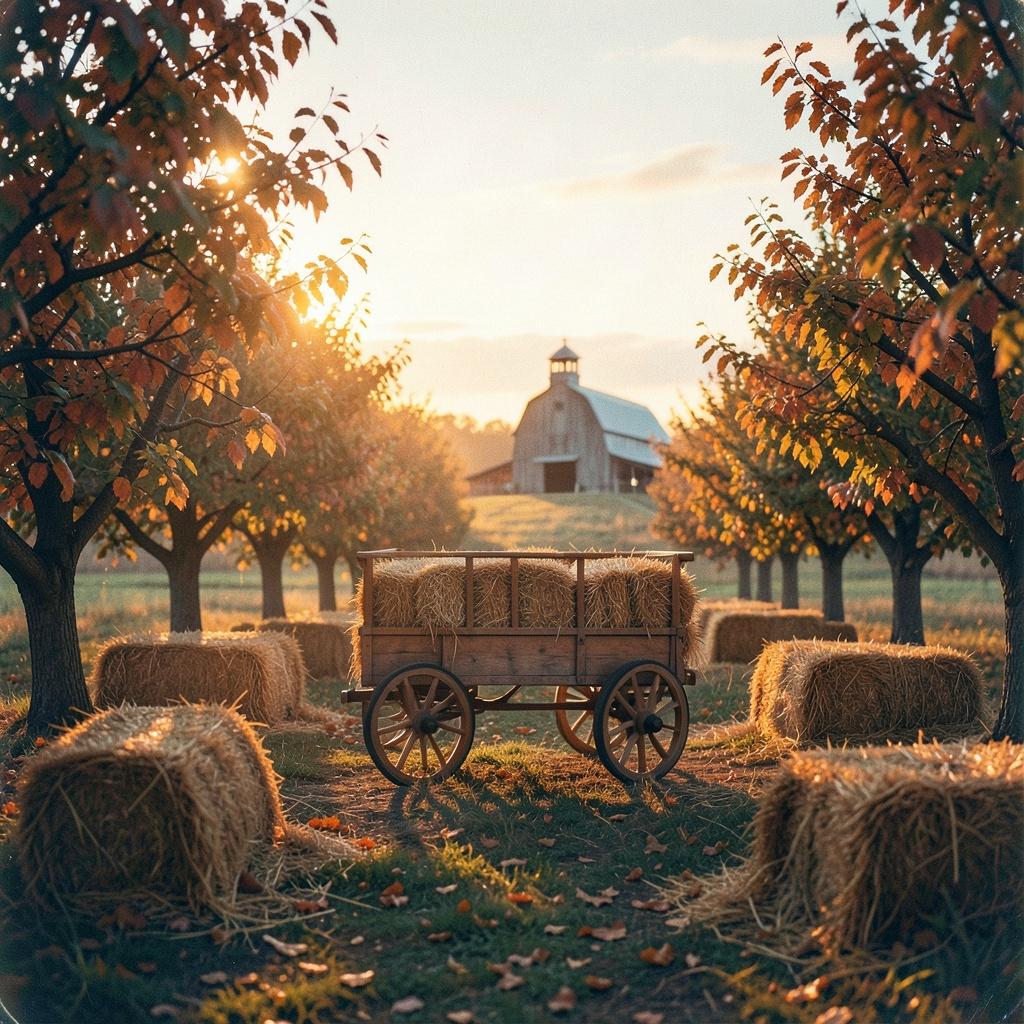
    I am not naturally a slow person. I am a list-maker, a planner, a let’s-go-while-we’re-going kind of person who finds stillness difficult even when she knows better. But there are certain fall experiences that are so inherently, stubbornly slow that even I cannot rush them. The hay ride is one of them. You cannot hurry a tractor through an orchard. You cannot check your phone and also fully experience the particular blue of an October sky above the apple trees. The hay ride will not let you be anywhere other than exactly where you are.

    That involuntary slowing down is what “Hay Ride” is about.

    This is Track 11 on Give Me Fall, my new album releasing August 31st, and it is the first song in the back half of the record where the energy truly settles. The album front is full of joy and motion and celebration. The back half is where we learn to be still. “Hay Ride” is the turning point, the moment where the wagon pulls out through the orchard rows and the world gets quiet and something important has a chance to be felt.

    The first verse captures the physical specificity of that moment perfectly, I hope. Straw bales on both sides and nowhere else to be. The tractor pulling you out through the rows of the orchard. And then the person beside you puts their arm around you like it was easy. Like it was always going to be this. Like they knew. That last line does something to me every time I sing it. Like they knew. The ease of someone who has found their place beside you. The complete natural comfort of it.

    The pre-chorus is where the song finds its thesis. I don’t need the destination. I just need the slow of it. The horses and the harvest air and you next to me in the middle of it. This is it. This is everything. I wrote those lines and then sat with them for a long time because I think they are true of so much more than a hay ride. I do not need the destination. I just need to be paying attention to where I already am.

    The chorus builds on that thesis with a contrast that I love. The whole wide world can keep on moving fast as it wants to go. But right here on this wagon with you, I am learning to be slow. That phrase, learning to be slow, is a confession. It is not something that comes naturally to me. It is something I am working on, something fall helps me practice every year. The hay ride is a curriculum.

    The third verse has the moment that wrecked me when I wrote it. We came back to the barn when the sun was nearly done. Somebody had cider waiting and the kids had had enough. You helped me down and held my hand a second longer than you had to. And I loved you for it so much. So much. You don’t even know. That extra second of holding on. That moment of not rushing. That is a whole language of love in a gesture that takes less than two seconds.

    The bridge strips everything down to its simplest form. Just this. Just now. Just you and me and straw and sky. Just your hand in mine. Just slow. The word just doing more work than almost any other word in the album.

    I wrote this album collaborating with Claude AI and using Suno AI for music production which sampled my own voice. This song in particular felt like it wrote itself because the memory it came from is so clear and so complete.

    Tell me in the comments: have you ever been on a hay ride? What is your equivalent of the hay ride, the thing in your life that makes you slow down without asking permission? I want to know.

    Give Me Fall releases August 31st. Please follow me on Spotify, Apple Music, Amazon Music, Deezer, and Pandora so this album finds you the day it drops. Come find me on Instagram, Facebook, and YouTube, and join my email list here.

    I am learning to be slow. Right here on this wagon with you. Just slow.

    Warmly, Melanie Grace