Tag: The Krampus and the Old

  • What Krampus was before the ugly sweaters

    What Krampus was before the ugly sweaters

    In 1506, the town of Zerbst in Germany staged its Corpus Christi procession, and someone wrote down who was in it.

    The script survives. It lists Saint Nicholas, in a bishop’s cope and mitre, staff in one hand, three gold balls in the other, his hand raised in blessing. A few lines later it lists the archangel Michael, elegantly turned out, a cross at his head. And it says what Michael is to do.

    He is to lead a devil on a chain.

    Pre-Save the Album today!

    That is 1506. A saint and a chained devil, walking in the same procession, on the same day, on purpose. Nobody in Zerbst thought this was transgressive. It was the program.

    I bring this up because of the other story, the one you have almost certainly been told: that Krampus is a survival from pre-Christian paganism, a horned god the Church could not stamp out, smuggled into Christmas in disguise. Britannica says a version of it. The Smithsonian has said a version of it. The version they say usually includes the detail that Krampus is the son of Hel, the Norse goddess of the dead.

    There is no source for that. Not a weak source. None. Krampus does not appear in any Old Norse text, and Old Norse was never spoken in Austria or Bavaria, which is where Krampus is actually from. The claim gets repeated because it got repeated, and it gets repeated because it sounds like the kind of thing that ought to be true.

    You can trace where it comes from. In March 1958 a folklorist named Maurice Bruce published a short piece called “The Krampus in Styria” in the journal Folklore, in which he announced that there was little doubt as to Krampus’s true identity, because in no other form was the regalia of the Horned God of the Witches so well preserved. He cited nothing. He did not need to, in his own mind, because he was working from Margaret Murray’s witch-cult hypothesis, which held that the early modern witch trials had been the suppression of a real surviving pagan religion. Historians now regard Murray’s thesis as pseudohistory. It rests on taking confessions extracted under torture at face value when they fit and discarding them when they do not.

    So Bruce built his Krampus on a foundation that has since been removed, and the building is still standing, held up by nothing but citation.

    When scholars actually went into the records, they found something else. In the 1980s the ethnologist Hans Schuhladen worked systematically through the historical documents and found no pagan origins at all. His earliest source is 1582, in the Bavarian town of Diessen, where men who had “hunted the Percht” were paid for it. Not ancient. Early modern, and Christian, and municipal enough to have an expense line.

    And the word Krampus is later still. Al Ridenour, whose 2016 book is the best thing written on this in English, points out that Krampus barely appears in print before the mid-1800s and only becomes the standard name for the figure with the boom in Krampus greeting cards around 1900. For centuries before that, the figure was called Percht, after Perchta, and Perchta is a couple of hundred years older than he is. The devil got famous. The witch was there first.

    Which leaves the question of where he actually comes from, and the answer is sitting in the Zerbst script.

    Look at how Krampus is drawn in the oldest images we have of him, the postcards of the 1890s and 1900s. Absurdly long tongue lolling out. Long pointed horns. Claws. Cloven hooves. Black all over. A tail. Chains. A birch rod.

    Now look at how the Devil is drawn in the Codex Gigas, in the Smithfield Decretals, in a hundred manuscripts of the High and Late Middle Ages. Long tongue. Horns. Claws. Hooves. Black. Tail. And in the mystery plays, Satan is chained by the archangel Michael and dragged off, and he is played for comedy, and audiences loved it, and the plays ran for centuries until the Reformation shut most of them down, except in the Catholic Alps, where they did not.

    Krampus is not an old god. Krampus is the medieval stage Devil, still in costume, still on his chain, who never went home after the play ended.

    And Saint Nicholas is holding the other end of the chain for a reason. The earliest surviving life of Nicholas, written sometime between 814 and 842, is full of exorcisms. He drives the demons out of the temple of Artemis at Ephesus. He is called the most active banisher of demons. A saint who has beaten a devil owns that devil. So the devil walks beside him, bound, doing the ugly half of the job the saint cannot be seen to do himself.

    That is a stranger and better story than “ancient horned god.” It means Krampus is not a pagan holdout at all. He is a Catholic holdout. He is the part of Christianity that was willing to look at a child and say: there are consequences, and here is what one looks like, and it has a tongue.

    The ugly sweaters can stay. But he was somebody first.

    Pre-Save the Album today!

  • The darkness paradox: why sanitized holidays feel hollow

    The darkness paradox: why sanitized holidays feel hollow

    An Icelandic child puts a shoe on the windowsill on the night of December 12.

    Americans hear this and think of stockings. It is not the same gesture. The shoe is not a container for a gift. The shoe is submitted. Something comes down from the mountain in the night and looks at it and decides. In the morning there is a small treat, or there is a rotting potato, and the potato is a verdict.

    I want to make an argument about that potato, and I want to be careful about it, because the version of this argument you usually hear is not honest.

    Pre-Save the Album today!

    The dishonest version goes like this: children raised on scary folklore are less anxious, and here is a study. I looked for the study. I could not find one. What you find instead is a lot of people asserting it, usually citing each other. If someone has run a controlled comparison of anxiety outcomes between children raised with named monsters and children raised without, I have not located it, and I am not going to pretend otherwise in order to win a point. This book has enough true things in it that I do not need to borrow a false one.

    So here is the argument without the fake evidence.

    A potato in a shoe is a bounded event. It has a cause, which the child knows. It has a limit, which is that it is a potato and not a death. And it has a season, which ends. On January 6, the last of the Yule Lads goes back up the mountain, and the whole apparatus, the Lads and their mother and the Cat, packs up and leaves for eleven months. The dread has a start date and an end date and a specified escape.

    Compare that to the thing we replaced it with.

    The modern Christmas has no monsters, and it also has no exits. It is a season of mandatory joy, and mandatory joy is a trap, because the one thing a person cannot do on command is feel something. If you arrive at December with a dead parent, a bad year, a marriage that is ending, a diagnosis, you arrive at a holiday that has no language for you. It has only the assurance that this is the most wonderful time of the year, repeated at you in every public space, at volume, for six weeks.

    The old Christmas had language for you. It had an entire cast of characters whose whole function was to say: yes, the dark is real, the dark is out there right now, the dark has a name, and here is what we do about it. The Rauhnächte, the rough nights between Christmas and Epiphany, were understood across the German-speaking Alps as the time when the boundary was thin and the dead were moving. People did not experience that as a horror show. They experienced it as accurate. It matched what December actually feels like at that latitude, when the sun clears the ridge for four hours and then gives up.

    The paradox is this. A holiday that acknowledges the dark can hold more joy, not less, because the joy is not being asked to do a job it cannot do. It does not have to pretend. It does not have to be total. It only has to be the thing that happens after the Perchtenlauf comes through and drives the winter out, which is a much smaller and much more achievable claim.

    Whereas a holiday that has been scrubbed of everything difficult is a holiday with nothing to push against. You cannot have relief without something to be relieved of. You cannot have the return of the light if you never admitted it was gone. That is why the sanitized version rings hollow, and it is why so many people feel obscurely bad in December and cannot say why: they are being handed the resolution of a story whose first act has been deleted.

    I do not think we should bring back the belly-slitting. I want to be clear about that. Some of these traditions were cruel and the cruelty was not incidental.

    But I think we threw out the frame along with the knife, and the frame was the useful part. The frame said: the year is ending, it took things from you, name them, mark them, and then let the light come back. That is not a childish thing. That is close to the oldest thing we have.

    The book makes this argument twenty-three different ways, once per creature. It is on Kindle now, in print October 1.

  • Why Christmas needed monsters

    Why Christmas needed monsters

    Frau Perchta carries a knife.

    Pre-Save the Album today!

    She comes on the Twelfth Night, in the Alpine regions, and she checks two things. She checks whether the house is clean and she checks whether the year’s spinning is finished. If a girl has spun her whole allotted portion of flax, Perchta may leave a small silver coin in a shoe. If not, Perchta opens the girl’s belly, takes out the stomach and the guts, and packs the space with straw and pebbles.

    That is the folklore. It is not a modern embellishment and it is not something a horror movie invented. Church officials in Bavaria were condemning the cult of Fraw Percht in 1468, and Thomas Ebendorfer had condemned the same practice in Vienna in 1439, and the reason they were condemning it is that people were doing it: leaving food and drink out for her on the night she came, hoping for a good year.

    The question worth asking is not why a culture invented something so ugly. The question is what it was for.

    Start with the spinning.

    In a household economy before industrial textiles, wool and flax were not a hobby. They were the difference between having clothes and not having clothes, in a place where not having clothes in February was a way of dying. The spinning had to be done, and it had to be done by a specific date, and it had to be done by the women and girls of the house, and there was no manager, no schedule, no consequence available except the one the family could invent.

    So the family invented Perchta.

    She is not arbitrary. That is the thing everyone misses about her. She has a rule, the rule is knowable, and the rule is survivable. Finish the flax. Clean the house. Eat the fish and the gruel on her night and nothing else. Do those things and she leaves a coin. A child could hold all of that in her head. A child could act on it.

    Now look at what she replaced. Without Perchta, a girl in a Tyrolean farmhouse in 1500 still has to spin the flax, and she still freezes if she does not, and the danger is exactly as real. The difference is that the danger has no face, no name, no date, and no method. It is just the vague, unbounded dread of a world that might kill you for reasons you cannot enumerate.

    Perchta takes that formless thing and gives it a nose, a foot, a knife, and a deadline.

    This is the pattern under nearly every figure in this book. The Yule Cat eats children who did not receive new clothes for Christmas, which sounds absurd until you understand that new clothes at Christmas meant the household had done its wool work, and that a household that had not done its wool work was in genuine trouble. The Cat is the wool quota, made visible. Krampus comes with Saint Nicholas because a saint who only gives is a saint who cannot enforce anything. The Kallikantzaroi come up from below during the twelve days, when the sun is lowest and the world is at its least reliable, and they go back down when the light returns.

    None of these creatures is a decoration bolted onto a nice holiday. They are the load-bearing part. Take them out and the holiday is still standing, but it is not carrying anything.

    And that is more or less what we did. Over about a century and a half, in most of the Western world, we removed the punishing figures one by one and kept the giving ones, and we told ourselves this was progress. In some ways it plainly was. The 1821 Santa handed out a birch rod for parents to beat children with, and I am not arguing for that.

    But notice what got left behind along with the rod. The specificity. The rules a child could actually learn. The idea that Christmas is a reckoning as well as a reward, that the year is being counted, that something is owed. We kept the watching, in fact. We just took away the consequence. That is what the Elf on the Shelf is: surveillance without judgment, an eye with nothing behind it.

    Perchta had a knife. That is horrible. But Perchta also told you exactly what to do to avoid it, and if you did it, she left a coin, and that was the end of the matter until next year.

    There is a kind of mercy in a monster with rules.

    Twenty-three of them are in the book. The Kindle is available now; print lands October 1.

  • Before Santa, there were the others

    Before Santa, there were the others

    In 1411, a poet in South Tyrol named Hans Vintler finished a long book of moral instruction called Die Pluemen der Tugent, The Flowers of Virtue. It is a dull book, mostly. It is a list of things you should not do. But one of its illustrations is not dull at all. It shows a figure with an iron nose.

    Pre-Save the Album today!

    Look closer and the figure is not a demon. It is a person. It is a person in a mask, dressed up, playing the part of Percht.

    That picture is the earliest image we have of anyone impersonating a Christmas monster. It is four hundred years older than the first American drawing of Santa Claus. Somebody in the Alps was already pulling a mask over his face in midwinter and walking into a neighbor’s house to frighten the children, and he was doing it while Gutenberg was still a boy.

    This is the part of Christmas nobody tells you about, and it is the reason I wrote a book.

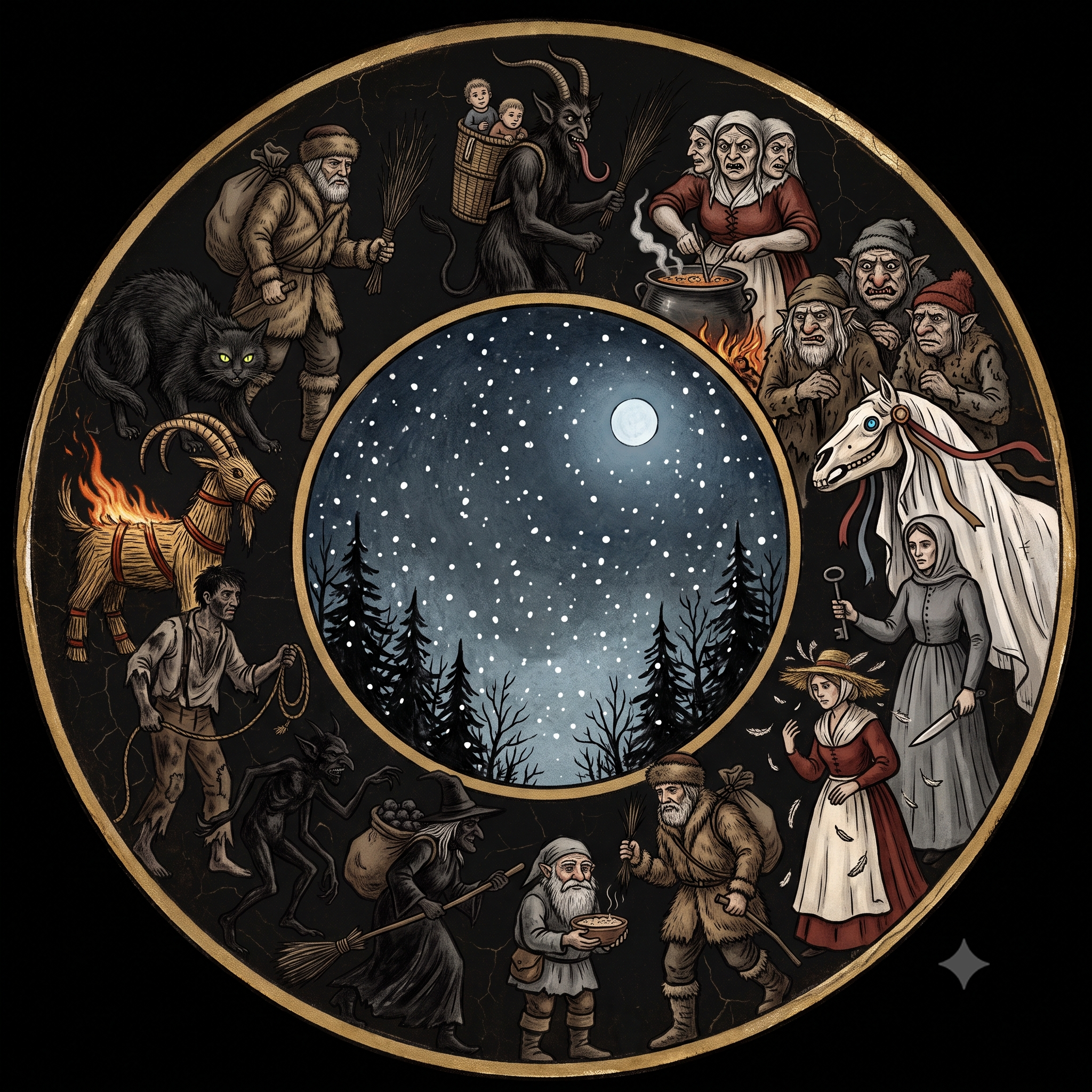
    A Folklore Christmas: The Monsters, Witches, and Demons Behind Christmas comes out in hardcover and paperback on October 1. It is twenty-three chapters, one creature to a chapter. Krampus in Austria. La Befana in Italy. The Kallikantzaroi coming up through the floor in Greece. Grýla in her cave in Iceland with thirteen sons and a cat the size of a house. Frau Perchta with her knife. Frau Holle shaking out the snow. The Mari Lwyd, a horse’s skull on a pole, at your door on New Year’s Eve, demanding you out-rhyme it or let it in. The Wild Hunt overhead. Belsnickel. The Tomte. Père Fouettard. The Gävle Goat, which is a modern tradition and burns down most years anyway.

    They are not decorations. Each of them did a job.

    The job was mostly this: winter used to kill people. Not metaphorically. In the parts of Europe these stories come from, the dark months were the season when the food ran out, when the cold got in, when a child who wandered off did not come back. Every one of these figures is a way of saying something true about that danger to someone too small to be told plainly. Grýla eats the naughty ones. The Yule Cat eats the ones without new clothes, which meant the ones whose families had not done the autumn wool work, which meant the ones who were going to freeze. The Cat is not a fairy tale. The Cat is a labor policy with teeth.

    We kept Christmas. We threw the monsters out. And the argument of this book, which I will spend the next month making and which I will not pretend is neutral, is that we lost something real when we did it.

    Not because darkness is fun. Because a holiday that only knows how to say joy has no way to hold anyone who is not feeling it. The old Christmas had a place for the fear, the debt, the missing chair at the table, the dark outside the window. It gave those things a name and a face and a date on the calendar, and then, on Epiphany, it sent them back up the mountain for a year. That is not a bleak tradition. That is a functional one.

    There is one more thing worth saying before October.

    The first American Santa Claus we have any picture of appeared in New York in 1821, in a small book called The Children’s Friend. He drives a sleigh, he comes on Christmas Eve, he is dressed in red. He also leaves, for the children he finds “in manners crude, in temper haughty,” a long black birchen rod, for their parents to use on them.

    That is the founding document of the American Santa. He was carrying a switch before Coca-Cola existed. Everything soft about him came later, and it came from us.

    I will be posting twice a week from now until release. Some of it is folklore. Some of it is going to be me taking apart stories you have heard your whole life and probably repeated, including the one about the red suit, which is not true, and which I will get to on the fifteenth.

    The Kindle edition is out now if you would rather not wait for October.