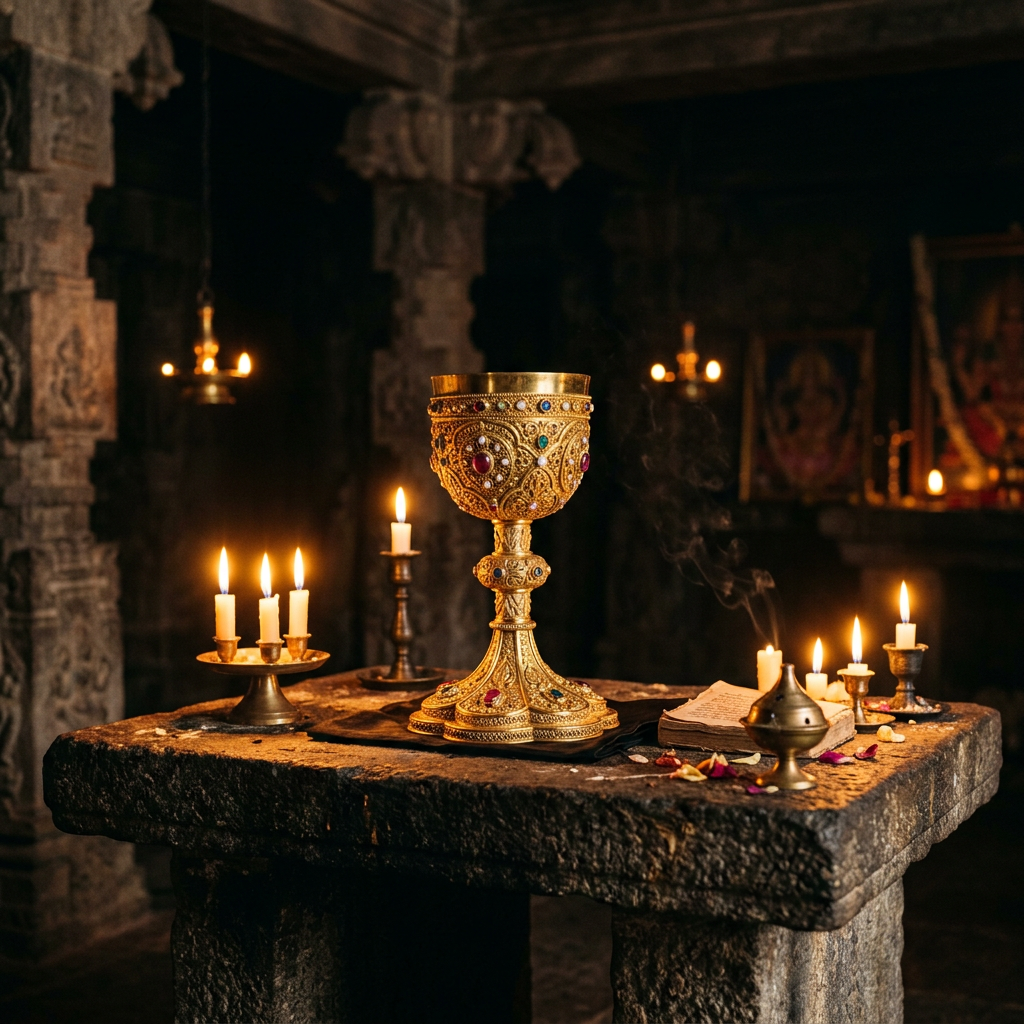
In a show full of big moments — a city burning, harps hung in willow trees, a hand writing on a palace wall — one of the most important objects in “Bring Us Home” is small enough to hold in one hand. Today I want to talk about the golden temple cup, and why it became one of the most important through-lines in the entire musical.
Where it comes from
When Jerusalem fell and the Temple was destroyed, the Babylonians didn’t just burn the building — they looted it. Sacred vessels, gold cups used in Temple worship, were carried off to Babylon as spoils of war. This is historically documented (2 Kings 25, and referenced again in Daniel 5), and it’s not a small detail. These weren’t just “nice things.” They were sacred — set apart for the worship of God, and nothing else.
For seventy years, those cups sat in Babylon. Not destroyed. Not returned. Just… taken. Repurposed. Sitting in a palace that had no idea — or didn’t care — what they actually were.
The moment they’re defiled
The cup becomes central to the story’s climax. At Belshazzar’s feast, in a fit of drunken arrogance, the king orders those very temple vessels brought out so his court can drink from them — as a way of mocking the God of the people he conquered. He hands one directly to Aviva, wine spilling over its sacred engraving, and demands she sing for his entertainment using the cup as a prop.
That’s the moment everything turns. Aviva doesn’t drink from it. She doesn’t perform with it. She sets it down — deliberately, reverently — on a pedestal, and gives the king something he didn’t ask for.
From defilement to rescue
When the writing appears on the wall and the palace begins to fall apart in chaos, Daniel turns to Aviva and says something simple but enormous: “Take the cup. Take it home.”
She does. She snatches it to her chest as the palace collapses around her, and it travels with her — through the escape, across the desert, all the way to the ruins of Jerusalem.
Why this object matters so much to me
Here’s what I love about using the cup as a through-line: it’s not a person, so it can’t change its mind, make a choice, or have an arc the way a character does. But it carries the whole emotional journey of the story anyway — just by what happens around it.
It starts as something sacred. It gets stolen, displaced, and defiled — used for the exact opposite of what it was made for. And then, in the hands of someone who refuses to let that be the end of its story, it gets carried home and restored to what it was always meant to be.
If that sounds like it might be a picture of something bigger than a cup… yeah. That’s the idea.
Past and future, side by side
In the finale, when the exiles finally reach the ruins of Jerusalem, Aviva sets two things down on the bare temple floor: the harp that’s hung silent in the willows for seventy years, and the rescued golden cup.
Past and future. The thing that was kept silent, and the thing that was almost lost — both finally home, both finally able to be what they were always meant to be.
I don’t think I’ve ever written a “prop” that meant this much to me.
I’d love to hear from you
💬 Comment below — is there something in your own life — an object, a tradition, a piece of your story — that got “displaced” for a season before finding its way back to where it belonged?
📱 Follow me on Instagram and Facebook at @TheMelanieGrace for more behind-the-scenes on the symbols woven through this show.
💌 Sign up for my email list for the full story behind every song and every detail.
🎧 Follow me on Spotify, Apple Music, Amazon Music, and YouTube Music so you’re there for the finale the moment it releases.
Tomorrow, I want to take you behind the curtain on the research side of this project — the real dates, the real history, and how I made sure “Bring Us Home” stayed faithful to Scripture.