Tag: Psalm 137

  • Free Bible Study Guides for “Bring Us Home”: Dig Into the Scripture Behind the Songs

    Free Bible Study Guides for “Bring Us Home”: Dig Into the Scripture Behind the Songs

    If you’ve been following along with my “Bring Us Home” series, you already know this musical isn’t just inspired by Scripture: it’s built on it. Every song, every character, every scene maps back to real passages: Psalm 137, Daniel, Jeremiah, Ezekiel, Ezra. And the more I worked on this project, the more I realized I didn’t want to keep all of that research to myself.

    So I made something for you.

    What I made

    I’ve put together a set of Bible study guides that walk through the scriptural foundation of “Bring Us Home”: the same passages that shaped Aviva’s journey, Miryam’s lullaby, Saba Elan’s vow, Daniel’s faithfulness, and the fall of Babylon itself. These aren’t just “here’s a verse, here’s a song.” They’re meant to be something you can actually sit with. Read. Reflect on. Maybe even work through with a small group, a journal, or just a quiet morning and a cup of coffee.

    My hope is that these guides do for you what writing this musical did for me: turn a story you might think you already know into something that feels personal again.

    What’s inside

    The guides walk through the heart of the story’s scriptural roots, including:

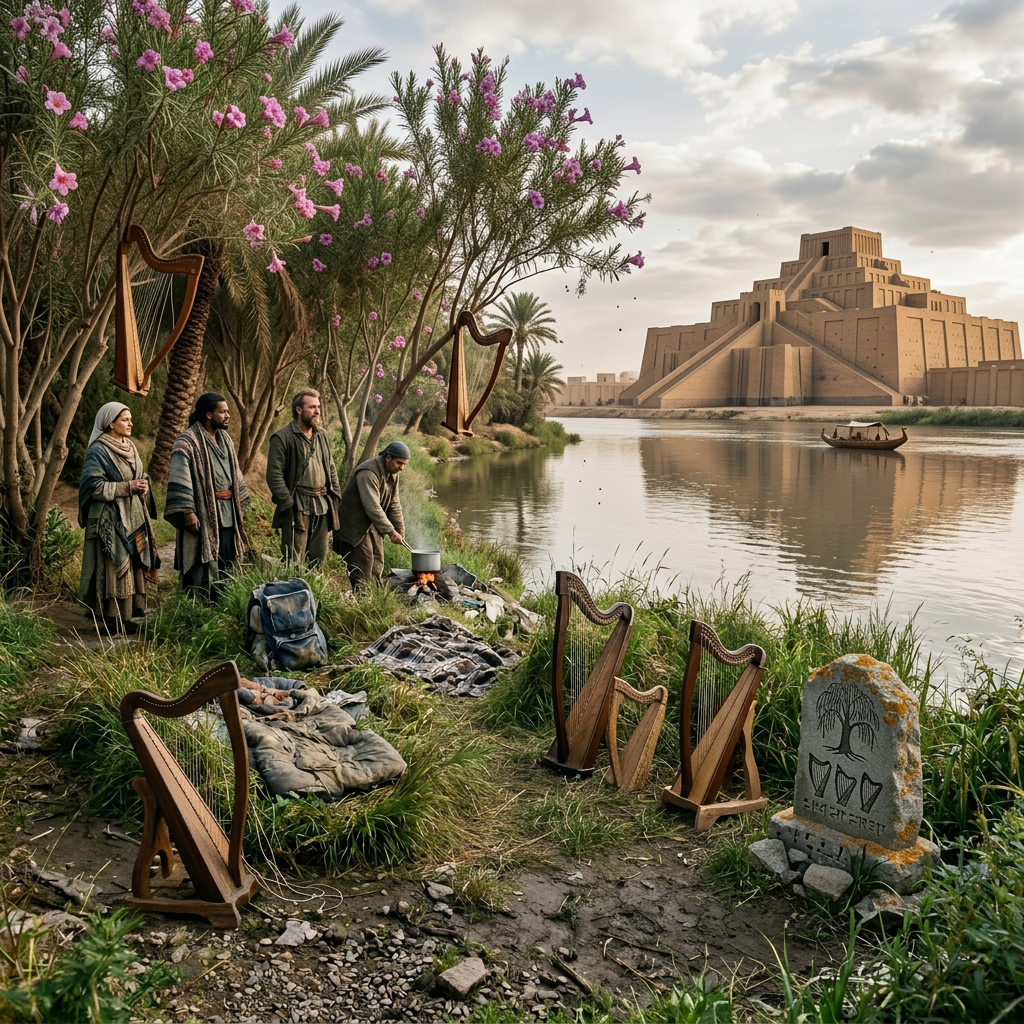
    • Psalm 137: the rivers of Babylon, the harps in the willows, and the question that gives this whole project its emotional center: “How shall we sing the Lord’s song in a strange land?”
    • Jeremiah 29: the seventy years of exile, and God’s surprising instructions to His people to build homes and plant gardens in the very place that took everything from them
    • Daniel 1, 5, and 9: Daniel’s faithfulness across decades in a foreign court, the feast, the writing on the wall, and his prayer for his people’s return
    • Ezekiel 37: the valley of dry bones, and what it means to ask “can this live again?” before you see the answer
    • Ezra 1–3: the decree of Cyrus, the journey home, and the bittersweet mix of weeping and rejoicing as the temple foundation was laid

    Each guide ties these passages back to the story and characters of “Bring Us Home,” so as the music releases, you’ll have a deeper well to draw from than just the songs themselves.

    How this came together

    I’ll be honest: putting these together was its own project. I had so much research spread across so many documents by the time the musical’s script was finished, and pulling it all into something organized enough to actually study took real work. I had a lot of help along the way (including AI tools helping me catch duplicates and organize everything into something coherent), but the heart of it, the “why does this passage matter” part, is all me. This grew straight out of months of sitting with these chapters myself.

    How to get them

    These guides are completely free. I just ask that you sign up so I can send them straight to you (and so you’ll be the first to know when new ones are added as more of “Bring Us Home” releases).

    πŸ‘‰ Click here to download the Bible study guides

    Let’s go deeper together

    Whether you’re someone who’s walked through Scripture your whole life, or someone who’s just curious because a song caught your attention, these guides are for you. My hope is that they help “Bring Us Home” become more than something you listen to. I want it to be something that sends you back to the Word with fresh eyes.

    πŸ’¬ Comment below: which passage are you most excited to dig into? Psalm 137? The writing on the wall in Daniel 5? Ezekiel’s dry bones?

    πŸ“± Follow me on Instagram and Facebook at @TheMelanieGrace for updates as new guides and new music drop.

    πŸ’Œ Download the Bible study guides here and join my email list: you’ll get these guides plus first access to everything coming next.

    🎧 Follow me on Spotify, Apple Music, Amazon Music, and YouTube Music so every song from “Bring Us Home” reaches you the moment it’s released.

    This story started with Scripture. I hope these guides help it lead you right back there.


  • Behind the Song: “By the Willows”

    Behind the Song: “By the Willows”

    Today’s “Behind the Song” post is about one of the most directly biblical moments in the entire show, a song built almost entirely on a single, devastating verse: Psalm 137:4. “How shall we sing the Lord’s song in a strange land?”

    The setup

    By the time this song happens, the exiles have settled into life by the river. Saba Elan has already hung his harp in the willows, and others have followed: the trees are heavy with silent instruments. It’s become part of daily life. Survival. Threadbare dignity.

    Then the overseers show up, bored and cruel, looking for entertainment. They’ve heard the music of Judah is the finest in the east, and they want a show. “Sing us one. Entertain your hosts.”

    Silence.

    What this song actually dramatizes

    This is Psalm 137:1–4, almost beat for beat. The captors demand songs of Zion as mockery: not worship, entertainment. And the response from the exiles isn’t argument, isn’t pleading. It’s refusal. Total, collective silence.

    Saba Elan stands. He doesn’t shout. He doesn’t even speak. He just rises (an old man, but with enormous gravity) and looks at the overseer. And that look becomes a wall.

    Why silence is the loudest thing in the show

    I think a lot about how we usually write “strength” in stories: usually it’s a speech, a fight, a big declaration. But Psalm 137 gives us something different: a refusal to perform. The exiles’ sacred songs were not party tricks. They weren’t going to hand over the most holy thing they had left (their worship) to be used as a joke for the people who destroyed their home.

    That’s not passivity. That’s the most active thing they could do.

    When I was writing this scene, I kept coming back to the question: what does it cost to say nothing? For Saba Elan and the others, it could cost everything: the overseers have soldiers, and the exiles have nothing. But they say nothing anyway. And the overseers, for the first time in the show, back down.

    How this connects to Saba Elan’s vow

    This song is really the proof of the vow Saba Elan made when he hung his harp in the willows. He said he wouldn’t play for Babylon, not for gold, not for safety. This is the moment that vow gets tested, not by a temptation, but by a threat. And he holds.

    It’s also the moment that sets up something important later: when young Aviva, watching all this, asks her grandfather afterward why he wouldn’t sing when he has “the most beautiful harp of anyone,” he gives her the same vow: that harp comes down on one day. The day we go home. That’s the line that becomes her whole inheritance.

    Why I wrote it for male voices

    In the show, this song is led by Saba Elan and the male exiles, with Aviva’s voice (as a child) coming in above them at the very end, right before the moment where her own singing accidentally stops a soldier in his tracks.

    I wanted the bulk of this song to feel like a wall: low, unified, immovable. Then Aviva’s voice cutting through it, small and clear, does double duty: it’s beautiful, and it’s the moment that marks her as someone Babylon will notice. The same voice that protects the camp also puts a target on her future.

    The hardest part to get right

    Honestly? The hardest part of writing this song was resisting the urge to make it bigger. My instinct as a writer is often to build to a swell, a big emotional release. But this moment isn’t about release. It’s about holding. The power of “By the Willows” is in what doesn’t happen. No one breaks. No one sings for the king. The tension just… sits there, until the overseers can’t stand it anymore and leave.

    Writing restraint into a song is so much harder than writing a climax. But I think it’s exactly right for this moment.

    Your turn

    πŸ’¬ Comment below: have you ever experienced a moment where saying nothing was the strongest thing you could do?

    πŸ“± Follow me on Instagram and Facebook at @TheMelanieGrace for the next “Behind the Song” post.

    πŸ’Œ Sign up for my email list to hear this one with the full story behind it.

    🎧 Follow me on Spotify, Apple Music, Amazon Music, and YouTube Music so “By the Willows” reaches you on release day.

    Tomorrow: “Can These Dry Bones Live?” The moment this whole show turns from grief into hope.


  • Behind the Song: “Hush Now (The River Lullaby)”

    Behind the Song: “Hush Now (The River Lullaby)”

    Today kicks off a “Behind the Song” series where I take you deeper into specific songs from “Bring Us Home”: how they came together, what they’re built on, and why they mean so much to me. First up: the song that threads through the entire show, “Hush Now (The River Lullaby).”

    Where it sits in the story

    Miryam sings this to baby Aviva early in Act One, by the riverbank, not long after the exiles arrive in Babylon. It’s a quiet moment (just a mother and a newborn) right after the harps have been hung in the willows, right after Saba Elan has made his vow.

    Musically and emotionally, it’s the calm after the storm of the opening. But it’s also where the entire emotional engine of the show gets installed.

    What the song actually is

    On the surface, it’s a lullaby: a mother describing a golden city to her child. Doves in the morning. A temple full of singing. Gates and gold and light.

    But underneath, it’s an act of defiance disguised as comfort. Miryam isn’t just soothing a baby to sleep. She’s making a decision: if Jerusalem can’t exist in stone right now, it’s going to exist in memory, and if her own memory eventually fades, it’s going to live on in her daughter.

    That’s why I think of this as the most quietly subversive song in the whole show. It looks like tenderness. It is tenderness. But it’s also resistance.

    The grounding in Scripture

    This song draws on Psalm 137:5–6 (the commitment to remember Jerusalem above everything else) and on Jeremiah 25:11–12 and 29:10, which is where we get the seventy-year timeline. That’s actually really important here: the lullaby only needs to exist because of how long the exile is going to last. If it were five years, you wouldn’t need to teach a baby a song about home. They’d just go home themselves, with their own memories intact.

    Because it’s seventy years, Miryam has to plant something that can survive generations. That’s what this song is for.

    The lullaby’s three lives

    Here’s the part of this song that I think is the most special, structurally: it doesn’t just appear once. It appears three times across the whole show, and each time it means something different.

    First time: whole and hopeful. Miryam sings it to baby Aviva. It’s a gift. A whole homeland, folded into something small enough for a child to hold.

    Second time: broken. Later, in the palace, Aviva tries to hum it to herself (almost as a comfort, almost without thinking) and she can’t finish it. The next line is just… gone. This is one of the quietest, scariest moments in the whole show for me. Nobody took the song from her. Comfort just let her set it down, one note at a time, until it wasn’t there anymore.

    Third time: completed across generations. Near the end, Miryam (now too frail to make the journey home) sings the lullaby one more time, and falters. And Aviva finishes it for her. The roles reverse completely. The one who was taught the song becomes the one who carries it forward.

    That arc (whole, broken, completed) is, to me, the emotional spine of the entire musical. Everything else hangs on it.

    Why I wrote it as a lullaby and not an anthem

    I wanted this song to feel small and intimate, not grand. A lullaby is private. It’s one voice, usually, sung quietly, often in the dark. And I think that’s exactly right for what this song is actually doing: it’s not a public declaration of faith. It’s the quiet, unglamorous, repetitive work of remembering, done one bedtime at a time, for years, by someone nobody’s watching.

    That’s how most legacies actually get passed down, honestly. Not through speeches. Through the small, repeated things.

    The Suno side of this one

    Without giving away too much of tomorrow’s post (which is all about my AI process!), this was one of the songs where getting the vocal performance right mattered enormously, because the same melody has to carry three completely different emotional weights across the show: hope, fear, and resolution. Getting Suno to understand that “the same song” needed to sound different each time it returned was its own little project.

    Tell me what you think

    πŸ’¬ Comment below: do you have a song, a poem, or a story that’s been “passed down” in your family, something small that carries something much bigger?

    πŸ“± Follow me on Instagram and Facebook at @TheMelanieGrace for more “Behind the Song” posts this week.

    πŸ’Œ Sign up for my email list to hear this one first.

    🎧 Follow me on Spotify, Apple Music, Amazon Music, and YouTube Music so “Hush Now” reaches you the moment it’s released.

    Tomorrow: “By the Willows,” and the act of defiance hiding inside total silence.


  • From 597 BCE to 538 BCE: My Research Process for “Bring Us Home”

    From 597 BCE to 538 BCE: My Research Process for “Bring Us Home”

    I’ve shared a lot about the characters and themes of “Bring Us Home” this week. Today I want to pull back the curtain on something different: the actual historical research that grounds this whole musical. Because while every song is original, every single one of them is built on real history and real Scripture, and getting that right mattered a lot to me.

    The conquest wasn’t one event: it was two

    One of the first things I had to really understand was that the fall of Jerusalem didn’t happen all at once. It happened in stages, under King Nebuchadnezzar II.

    The first siege came in 597 BCE, after King Jehoiakim of Judah rebelled against Babylon. Jerusalem surrendered on March 16, 597 BCE. Nebuchadnezzar plundered the city and the Temple, and took King Jehoiachin, the royal court, and thousands of skilled workers and prominent citizens into exile, then installed Zedekiah as a puppet king.

    Then, about a decade later, Zedekiah made his own fatal mistake: he revolted, seeking an alliance with Egypt. Nebuchadnezzar came back, and this time there was no mercy. A brutal, two-year siege followed, with catastrophic famine inside the city walls. In 587 or 586 BCE, the walls were breached. Solomon’s Temple was burned to the ground. The city walls were torn down. Zedekiah was captured. This was the real end of the Kingdom of Judah, and it’s what triggered the main wave of the Babylonian captivity.

    Why this two-stage history matters for the story

    This is actually really important for “Bring Us Home,” because it explains why some characters in the show remember Jerusalem and others don’t.

    Saba Elan and young Miryam are present for the final destruction: the burning of the Temple, the actual fall. They carry first-hand memory. But Aviva is born decades later, deep into the exile. By the time she exists, Jerusalem has been gone for so long that for her, it’s not a memory. It’s only ever been a song.

    That gap (between people who lived it and people who only inherited it) is the entire emotional engine of this show. And it’s not artistic license. It’s just… how long seventy years actually is.

    The end of the exile, and why the dates matter for the finale

    Babylonian dominance lasted until 539 BCE, when the Neo-Babylonian Empire fell to Cyrus the Great of Persia. That’s the night dramatized in Daniel 5, the writing on the wall, Belshazzar’s feast.

    Then, in 538 BCE, Cyrus issued his decree allowing the exiled Judeans to return home and rebuild the Temple.

    Here’s the detail that genuinely gave me chills when I found it: Belshazzar’s feast (539 BCE) and Cyrus’s decree (538 BCE) happen close together, historically. Which means it’s entirely plausible for one person (someone born near the end of the exile) to be present at the fall of Babylon and on the road home within roughly a year or two of each other.

    That’s not a dramatic shortcut. That’s just… what actually happened. And it’s why Aviva’s story can hold both of those massive moments without stretching history past where it can bear weight.

    The “70 years” isn’t poetic: it’s load-bearing

    Jeremiah 25 and 29 specifically name seventy years as the length of the exile. That number isn’t just a nice round figure for a song. It’s the actual reason a character like Aviva can exist at all. Seventy years is long enough that an entire generation could be born, raised, and grown into adulthood inside the exile, with no living memory of what was lost.

    Once I understood that, a lot of decisions about the show’s structure became obvious. Of course there are “Stayers” and a “Remnant” when Cyrus’s decree comes. Of course some of the elders, like Miryam, don’t survive to make the journey home. Seventy years does that to people.

    Where Ezra comes in

    The book of Ezra gave me the back half of the story: the actual mechanics of the return. Ezra 1 records Cyrus’s decree. Ezra 2 lists the people who actually went up, and notably, not everyone did. Ezra 3 describes the rebuilding of the temple foundation, with weeping and shouting mixed together at the same time.

    That detail (weeping and shouting, together, at the same moment) became one of the emotional anchors for the finale. Coming home isn’t simple. It’s grief and joy tangled together, because the people coming home aren’t the same people who left.

    Compressing without distorting

    I’ll be honest with you: “Bring Us Home” does compress some of this timeline for the sake of the story. Real history spans decades; the show spans roughly the length of one musical’s two acts. But every compression is built on real anchor points: 597 BCE, 587/586 BCE, 539 BCE, 538 BCE. Nothing in the show happens that couldn’t have happened, historically, to a real family living through this era.

    That mattered to me. I wanted this to be a story that could make someone feel the exile, but I never wanted it to be a story a historian would wince at.

    Want to nerd out with me?

    πŸ’¬ Comment below: did any of these dates or details surprise you? I’d love to know which part of this history was new to you.

    πŸ“± Follow me on Instagram and Facebook at @TheMelanieGrace for more behind-the-scenes on how this show came together.

    πŸ’Œ Sign up for my email list: I’m sharing even more research detail with subscribers.

    🎧 Follow me on Spotify, Apple Music, Amazon Music, and YouTube Music so every song from “Bring Us Home” reaches you.

    Starting tomorrow, I’m doing a “Behind the Song” deep-dive series, starting with the lullaby that ties the whole show together.


  • Saba Elan and the Harp in the Willows

    Saba Elan and the Harp in the Willows

    So far you’ve met Aviva and her mother Miryam. Today I want you to meet the man whose vow set the whole emotional spine of “Bring Us Home” in motion: Aviva’s grandfather, Saba Elan.

    Who is Saba Elan?

    Before the exile, Saba Elan was the chief harpist of the Temple in Jerusalem. For forty years, he played beneath the singers in the temple courts, including, in the show’s opening moments, his own daughter Miryam, when she was just a teenager. He’s gruff. He’s proud. And underneath all of that, he’s tender in a way he’d never admit to out loud.

    When the city falls, he’s the one who grabs Miryam’s hand and tells her, as soldiers close in, “They can take the city. They cannot take what you carry in here.”

    That line is basically Saba Elan’s entire character in one sentence.

    The vow

    When the exiles arrive at the riverbank in Babylon, Saba Elan does something that becomes one of the central images of the whole show. He unwraps the harp he carried all the way from Jerusalem (the same harp from the Temple) and he hangs it in the willow trees.

    And he makes a vow: he will not play it. Not for gold. Not for safety. Not to entertain his captors. Not one note. Not until the day they go home.

    One by one, other exiles follow him, hanging their own instruments in the willows, until the trees are heavy with silent harps and lyres. It’s one image, but it does so much work: it’s grief and protest and worship all at once.

    “By the Willows”

    This is Saba Elan’s signature song, and it’s drawn almost directly from Psalm 137. The overseers mock the exiles, demanding they sing “songs of Zion” for entertainment, and the elders respond with total silence. Saba Elan stands, says nothing, and simply looks at the man demanding a performance. That silence becomes the most powerful thing in the scene.

    I love writing moments where the most dramatic choice a character makes is to do nothing. Saba Elan’s silence isn’t weakness. It’s the loudest thing in the room.

    The promise to a sleeping baby

    There’s a quieter scene (one of my favorites in the entire show) where Saba Elan sits by the fire with baby Aviva. He’s gruff with Miryam, as always, but the moment the baby’s hand closes around his finger, something in him cracks open. He makes her a promise: that harp comes down on one day, and one day only, the day they go home. And when that day comes, he’s going to teach her every song Babylon tried to make them forget.

    He thinks she’s asleep. He says it anyway. That’s Saba Elan.

    When the vow finally gets kept (sort of)

    I don’t want to spoil too much here, because there’s a moment near the end of the show involving Saba Elan, that harp, and Aviva that genuinely gets me every time I work on it. Let’s just say: keeping a vow for seventy years doesn’t always mean you’re the one who gets to finish it. Sometimes keeping the vow is passing it on.

    I’ll save the rest for the “Behind the Song” post on this one.

    Tell me about your “Saba Elan”

    πŸ’¬ Comment below: do you have someone in your life (a grandparent, an elder, a mentor) who held onto something on principle for years, even when it cost them?

    πŸ“± Follow me on Instagram and Facebook at @TheMelanieGrace for the next character reveal.

    πŸ’Œ Sign up for my email list for the deeper story behind every song.

    🎧 Follow me on Spotify, Apple Music, Amazon Music, and YouTube Music so “By the Willows” reaches you the moment it drops.

    Tomorrow: the one character in this story drawn straight from Scripture, Daniel.