Tag: Mixtape Mindset

  • The Album Every Month Goal: An Honest Mid-August Check-In

    The Album Every Month Goal: An Honest Mid-August Check-In

    My big 2026 goal was to release one album every month. Let us check in honestly on how that is going.

    January through August: on track. Eight full months of brand-new music. From Through It All in the early year to Quilt Anthems in July, Bring Us Home, and now Mixtape Mindset landing in August, every single month has brought something new to the surface.

    What still lies ahead is just as ambitious: Crisp Fall Air in September, the Halloween album with my son in October, the Christmas Folklore Album in November, and the untitled holiday album plus a New Year’s Eve and New Year’s Day release in December.

    Here is what nobody tells you about releasing music every month: it requires a very specific relationship with the creative process. You cannot wait for inspiration to strike when you feel like it. You have to show up and find it. You cannot second-guess endlessly or get stuck tweaking a single mix for six months. You have to make the call, finish the work, and move forward. You have to trust that the next album is already inside you before you have even finished the current one.

    This musical commitment does not exist in a vacuum, either. Sitting alongside my monthly releases is my commitment to write and publish a daily blog post every single day of the year.

    At first, balancing continuous music production with a daily publishing habit felt like a massive mountain to climb. What I have realized over these past eight months is that the two habits feed each other. Writing daily keeps my storytelling instincts sharp and prevents creative stagnation. By the time I sit down to work on music, the ideas are already flowing because the creative pump has been primed all morning.

    It has been one of the most creatively demanding and creatively rewarding years of my life. Both things are completely true at the exact same time.

    If you have been listening, if you have streamed even one of these albums or shared a song with a friend, thank you. Every play, every save, and every add to a personal playlist keeps this engine running. You are a real part of why this is working.

    Stream Mixtape Mindset on Spotify. Join my email list for upcoming release announcements and behind-the-scenes updates!
  • My Process: How Claude and I Write Songs Together

    My Process: How Claude and I Write Songs Together

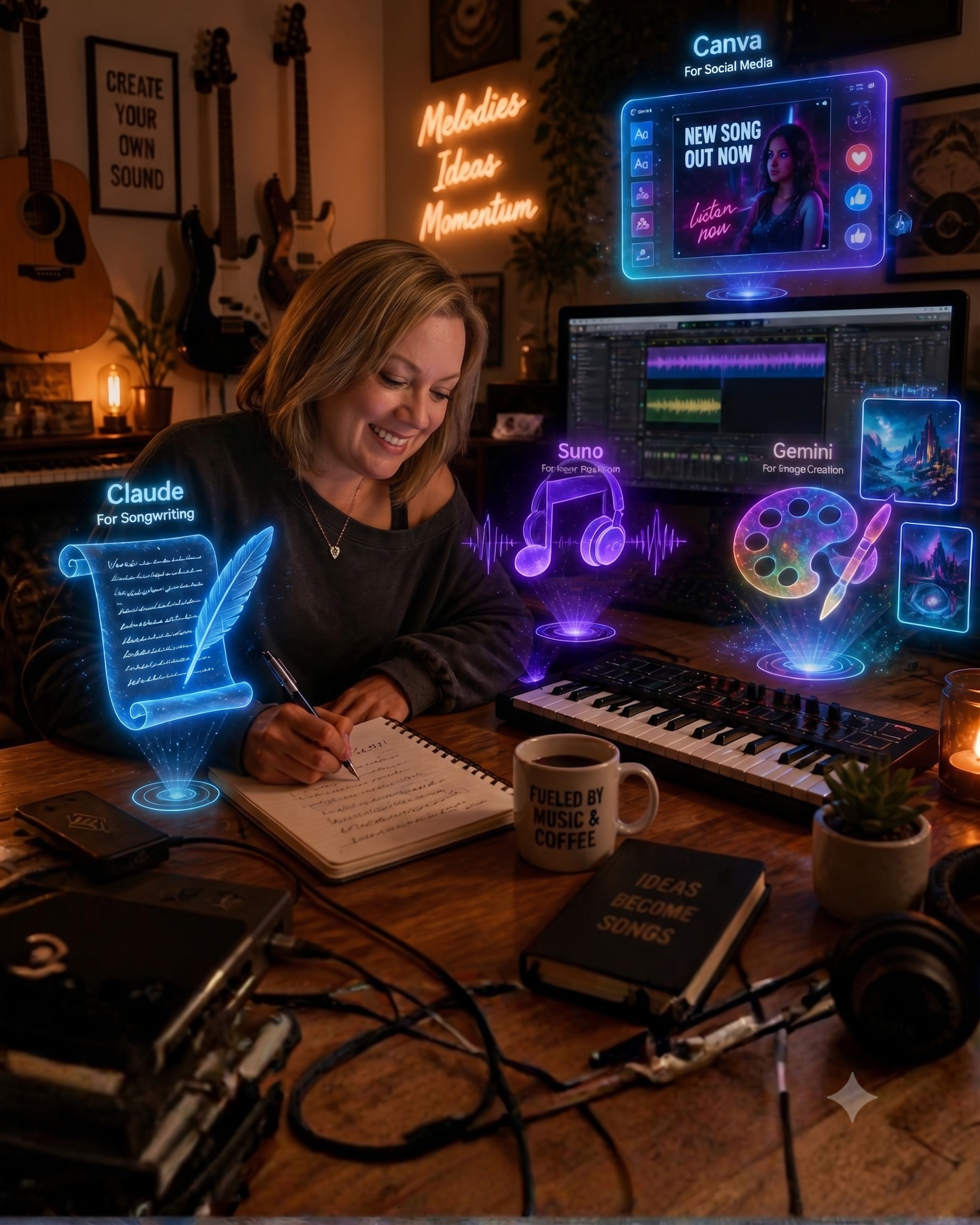
    Since I talk about collaborating with AI pretty openly, I want to give you a real behind-the-scenes look at how it actually works. People often imagine AI creation as pressing a single button and having a finished, polished track handed back to you.

    The reality is much more active, hands-on, and—honestly—time-intensive. It is a constant loop of refining, tweaking, and iterating.

    1. The Spark: Old Notebooks & Human Emotion

    It always starts with me—and usually with years of physical notebooks filled with scribbled lines, half-finished ideas, and memories. I bring the original concept, the emotional core, or a rough first verse.

    What I need in the room isn’t an automated replacement for a writer; I need a creative sounding board to help me develop those old ideas and push past my initial clichés.

    2. Crafting Lyrical Truth with Claude

    That’s where Claude comes in as my songwriting partner. I’ll open a session with a clear prompt or feed in a draft from my notebook, like:

    “I’m writing a song about the old Blockbuster ritual. It’s warm, nostalgic, and slightly bittersweet. The chorus needs to feel anthemic. Here’s a rough pre-chorus I drafted…”

    From there, we workshop in real time. Claude offers options, and my job is to curate, edit, and steer:

    • “Okay fine, kid, get the good backpack” came directly out of this back-and-forth. The line started off too sentimental, so I kept pushing the prompts toward the raw, true moment—that exact second your resistance as a parent completely collapses just looking at your kid’s face.

    We iterate line by line, paragraph by paragraph, until every word feels grounded, authentic, and true to my voice.

    3. Bringing the Sound to Life with Suno

    Once the lyrics are locked, I take them into Suno for music production. This is where the marathon of iteration really begins.

    Finding the right arrangement, tempo, vocal timbre, and emotional cadence isn’t a quick upload. It takes endless generations, adjusting genre tags, shifting structure cues, and testing different arrangements to get the track to sound like what I hear in my head.

    4. Visuals & Storytelling: Gemini & Canva

    A song doesn’t stop at the audio—it needs a visual world to live in.

    • Gemini for Image Creation: I use Gemini to build out the visual mood, album concepts, and imagery. Getting the exact right tone, lighting, and feel means writing, rewriting, and tweaking image prompts over and over.
    • Canva for Social Media: Once the artwork and imagery are created, I move into Canva to design cover art, promotional graphics, and social content to share the story behind each track.

    The Real Work is in the Iteration

    If there’s one takeaway, it’s that using these tools doesn’t mean skipping the effort—it means spending so much time changing things, testing variations, discarding what doesn’t work, and polishing what does.

    All twelve songs on Mixtape Mindset were built this way: notebooks full of history, a stack of AI tools working together, endless hours of iteration, and a human heart guiding every choice.


    Listen Now

    Stream on Spotify and Apple Music!

  • Why Nostalgia Music Matters More Than People Think

    Why Nostalgia Music Matters More Than People Think

    Nostalgia music sometimes gets dismissed as backward-looking or shallow. I want to make the case that done right it’s neither of those things.

    Nostalgia music, done honestly, is archaeology.

    When I write about payphones and mixtapes and Saturday morning cartoons, I’m not trying to go back. I know we can’t go back. What I’m doing is excavating something true about who we were, what we valued, how we connected, and holding it up to the light so we can see it clearly.

    The mixtape song isn’t about cassette tapes. It’s about effort and intention in relationships. The payphone song isn’t about payphones. It’s about the assumption that help is publicly available to anyone who needs it. Seven Digits isn’t about memorization. It’s about who you held close enough to carry inside you.

    The 90s are the specific. The meaning is universal.

    That’s why Mixtape Mindset resonates with people who weren’t even born in the 90s. Because everyone has had an era. Everyone has a time when things felt connected in a particular way that later changed. This album is my era. But the feeling is yours too.

    Stream on Spotify and Apple Music!

  • For the Moms: You Are the Hero of This Album

    For the Moms: You Are the Hero of This Album

    I want to speak directly to the moms today.

    You. The one who spent $200 at Target on supplies and got home and realized she forgot the two things she actually needed. The one who has eaten a cold lunch every day for a decade because by the time everyone else is fed there’s nothing warm left. The one who did a little dance in the driveway and then stood at the window twenty minutes later already missing them.

    Mixtape Mindset has songs for you. The Most Wonderful Time of the Year. Cart Full of Crayons. Too Much Togetherness. I Can’t Believe I Missed This. Songs that live in the specific, unrepeatable, hilarious, gut-wrenching experience of raising children and loving them so much it occasionally makes you insane.

    I wrote these songs because I have lived them. And I wanted other moms to hear them and feel: someone gets it. Someone wrote the actual song about the actual experience. Not a greeting card version. The real one.

    You are doing something extraordinary every single day. The ordinary moments, the crumbs and shoes and lost socks and snack negotiations, those are the extraordinary. And they deserve music.

    Here it is. It’s yours.

    Stream on Spotify. Share with every mom you know. Follow me on Instagram!

  • How I Write Songs That Sound Like Memories

    How I Write Songs That Sound Like Memories

    I get asked a lot: how do you write a song that feels like a memory rather than just a song about a memory?

    There’s a real difference. A song about a memory describes it from the outside. “I remember when we had payphones. That was a long time ago.” Fine. Technically accurate. Emotionally hollow.

    A song that feels like a memory puts you inside it. It uses sensory detail. The smell of newsprint. The click-click-clack of a VHS rewind machine. The weight of a laminated Blockbuster card in your pocket. The specific feeling of glitter gel pens rolling down a hall.

    Specificity is the time machine. The more precise the detail, the more powerfully it triggers the listener’s own version of that memory. “Glitter gel pens rolling down the hall” doesn’t just describe a folder. It puts you in a specific hallway with a specific smell and suddenly you’re eleven again.

    That’s the whole goal of Mixtape Mindset. Not to describe the 90s. To put you back inside it, even for three minutes.

    Working with Claude on these lyrics helped enormously. We pushed each other toward specificity constantly. The first draft is always more general. Revision is always about finding the detail that unlocks the door.

    Stream Mixtape Mindset on Spotify! Sign up for my email list!