Tag: God’s faithfulness

  • New Beginnings: A Year-Long Journey Through Four Musical Expressions of One Unchanging Truth

    New Beginnings: A Year-Long Journey Through Four Musical Expressions of One Unchanging Truth

    New Beginnings: A Journey Complete

    We’ve journeyed together through four complete albums, eleven movements, and forty-four separate interpretations of the same fundamental spiritual truth: God is faithful, transformative, loving, healing, and eternal.

    From baroque majesty to Broadway emotion to singer/songwriter intimacy to alternative rock defiance, we’ve encountered one story told four ways.

    What We’ve Discovered Together

    Over these past weeks, we’ve encountered the same biblical passages and theological themes through four completely different artistic lenses:

    • Gratitude/Survival: From formal liturgical recognition to character awakening to intimate personal realization to defiant celebration
    • Transformation: From architectural baroque beauty to character-driven narrative to acoustic personal journey to explosive liberation
    • Joy: From trumpet fanfares to infectious ensemble to quiet small moments to fierce defiance
    • Hope: From formal duet harmony to relational partnership to intimate conversation to defiant solidarity
    • Healing: From tender baroque to character testimony to ongoing learning to proud testimony
    • Eternity: From grand finale chorus to communal kingdom vision to personal conviction to cosmic transcendence

    Each approach reached different people. Each spoke to different hearts.

    Why Four Volumes Matter

    In our culture, we often assume that there’s one “right” way to encounter truth. One musical genre. One artistic style. One expression of faith.

    But what if God delights in the diversity? What if His faithfulness doesn’t sound the way the previous generation expected it to sound? What if your particular musical language is exactly how God wants to speak to your soul?

    “New Beginnings: Four Styles, Same Message” suggests something radical: the gospel doesn’t need a single expression. It thrives in multiplicity.

    The classical musician encounters God’s faithfulness through baroque majesty.

    The theater lover encounters it through character-driven narrative.

    The acoustic seeker encounters it through intimate vulnerability.

    The alternative rock enthusiast encounters it through defiant transcendence.

    All four encounter the same God. All four discover the same truth. They just hear it in the language that speaks to their soul.

    What This Means for Your Faith

    As you finish this series, consider:

    Which version of each song resonated most deeply with you?

    Was it the baroque? The Broadway? The acoustic? The alternative rock?

    Or did you find that different versions spoke to you at different moments? That some days you needed formal beauty, other days relational testimony, still other days intimate vulnerability, and still other days defiant power?

    That’s not contradiction. That’s wholeness.

    Our faith isn’t meant to be one-dimensional. It’s meant to be rich, textured, approached from multiple angles.

    The Invitation Forward

    In 2026, I invite you to:

    Listen to all four volumes. Not just the one that initially appeals to you. Listen to all four and discover how four different musical languages celebrate the same God.

    Share with others. If you love the baroque, introduce a friend to the Broadway. If the acoustic version speaks to you, ask someone who loves classical music to listen with you. If you’re energized by alternative rock, invite someone who loves musical theatre to experience it with you.

    Notice the diversity. Pay attention to how the same theological truth transforms across genres. What does that teach you about God’s nature? About His multi-faceted character?

    Let your faith expand. If you’ve only ever encountered God’s faithfulness in one musical style, discovering it in three others might deepen your understanding, broaden your worship, expand your experience of the sacred.

    Celebrate the multiplicities. Recognize that God speaks every language, reaches every heart, and transforms through any artistic medium that carries truth.

    The Same Story, Forever Unfolding

    God’s faithfulness isn’t a story that gets old. It doesn’t exhaust itself.

    It emerges new every morning. It speaks in every language. It reaches every heart.

    This past month, we’ve journeyed through that faithfulness in four complete artistic expressions. But the invitation doesn’t end here.

    In your life, God’s story will continue unfolding—perhaps in ways you haven’t yet discovered. Perhaps in artistic expressions you haven’t yet encountered. Perhaps in communities you haven’t yet joined. Perhaps in your own voice, in your own music, in your own expression of truth.

    The same story keeps telling itself. Through Scripture. Through tradition. Through contemporary art. Through your life.

    Thank You for the Journey

    I’m genuinely grateful that you’ve journeyed through “New Beginnings: Four Styles, Same Message” with me. Whether you connected most deeply with the baroque, the Broadway, the acoustic, the alternative rock, or some combination of all four, you’ve been part of something genuinely unique.

    You’ve participated in a statement that faith thrives in diversity, that God’s truth speaks every language, that the gospel is both timeless and constantly fresh.

    You’ve discovered that the same message sounds completely different depending on the language, and that’s beautiful.

    What’s Next?

    As you step into 2026, I invite you to:

    • Download or stream all four volumes of “New Beginnings: A Spiritual Journey in Four Musical Languages”
    • Share your favorite version with someone whose musical taste differs from yours
    • Reflect on which version(s) resonate most deeply with your faith journey
    • Consider how encountering God’s faithfulness across artistic traditions might deepen your spiritual life
    • Join the conversation about what it means to experience faith in multiple languages, multiple genres, multiple expressions

    The story continues. The faithfulness endures. The music plays on.

    Thank you for listening. Thank you for believing. Thank you for being part of “New Beginnings: Four Styles, Same Message.”

    May your 2026 be filled with the discovery that God’s faithfulness really does sound beautiful in every language, speaks to every heart, and transforms through any artistic medium that carries truth.

    Welcome to new beginnings. Welcome to the fullness of God’s voice, speaking in the language that speaks to your soul.


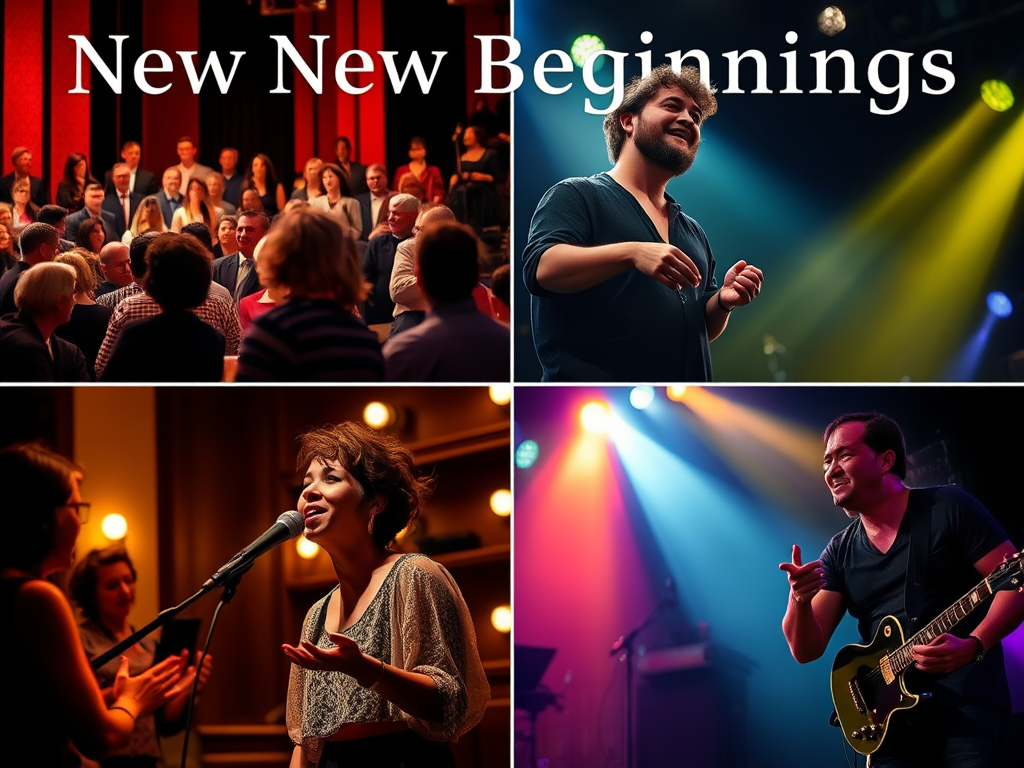
    A promotional image for 'New Beginnings' featuring four musical volumes: Baroque, Broadway, Songwriter, and Alternative, with images of performances from each genre.
  • Reflection and Mercy: How Doubt Meets Faith Across Four Different Genres

    Reflection and Mercy: How Doubt Meets Faith Across Four Different Genres

     • SPOTIFY • APPLE MUSIC • AMAZON MUSIC • DEEZER • PANDORA • YOUTUBE

    What Held Us: When Faithfulness Feels Like a Surprise

    The end of one year and the beginning of another invites reflection. We look back and ask: Where was God in this year? How was He faithful? What didn’t make sense then that makes sense now?

    Lamentations 3:22-23 offers a surprising answer from a surprising place: “Because of the Lord’s great love we are not consumed, for his compassions never fail. They are new every morning; great is your faithfulness.”

    Lamentations. A book of mourning and wrestling with God. Yet here, in the midst of genuine grief and doubt, the writer discovers something radical: God’s mercy didn’t disappear. It renewed itself every single morning, even when the writer couldn’t see it.

    The Baroque Version: “The Year Now Past”

    In a quiet sanctuary, a single soprano voice begins. The harpsichord is sparse, almost lonely. She reflects formally on the year: swift, filled with seasons, marked by questions. “How swift the turning of the year. What goodness have we witnessed here?”

    But then something shifts. Her voice gains strength. The oboe enters—not with fanfare, but with gentle accompaniment. She realizes: “His mercies never fail.” The music modulates from minor to major, from introspection to affirmation.

    The baroque approach honors both the weight and the wonder. It gives time and space to sit with the difficulty (“What goodness have we witnessed?”) before arriving at the deeper truth (“His mercies are new”). This is formal theology expressed musically: the human soul wrestling with God’s nature, articulating doubt before faith.

    The Broadway Version: “The Weight I’m Carrying”

    Now a character steps forward on a stage. They’re tired. Real. They speak directly to the audience: “I’ve been carrying this year like a stone.”

    This Broadway character doesn’t hide their struggle. They admit failures. They confess expectations unmet. But then—the turning point—they remember: “He whispers in the dark: ‘I haven’t left you.’”

    The Broadway approach is relational and real. It insists that before we can celebrate faithfulness, we must name the struggle. The spoken dialogue in the middle is pure character revelation. This is theology that meets you where you are: exhausted, doubting, carrying stones. And then it invites you to lay them down.

    The Singer/Songwriter Version: “Doubt’s Whisper”

    “I’m not supposed to say this, but I’m gonna say it anyway.” These opening lines are pure singer/songwriter honesty. The artist admits: I don’t know if I believe half of what I claim. I doubt. Deeply.

    With minimal accompaniment, just voice and guitar, the song unfolds like a late-night confession. There are doubts. Big ones. The year was hard. But then—and this is where the magic happens—the artist hears a whisper: “Your doubts don’t disqualify you.”

    The singer/songwriter approach to Lamentations 3:22-23 refuses to pretend faith is simple. It honors the complexity: doubt and faith coexisting. Questions and trust in the same breath. The repeated realization—”Mercies, I’m learning about mercies”—becomes almost a mantra. A permission slip to acknowledge struggle while also acknowledging love.

    The Alternative Rock Version: “What Held Me”

    An ethereal yet powerful voice opens quietly: “In the darkness, there was something. I couldn’t name it, couldn’t see it, but it held me, held me, held me.”

    The alternative rock approach is defiant introspection. The year was brutal. The breaking was real. “My mind was breaking, my heart was shaking, everything I built was crumbling to dust.”

    But then: “Morning came again, and it was fresh, like the darkness never happened.” The song builds from sparse vulnerability to fuller power. The repeated refrain—”What held me? What held me?”—is a question being asked with increasing certainty. Something did hold. Something is real.

    The alternative rock approach honors both the weight of the year and the mysterious grace that sustained through it. It’s ethereal because grace is hard to explain. It’s powerful because surviving requires strength.

    The Same Truth, Four Languages

    All four versions articulate the same truth: even in difficulty, even in doubt, God’s mercy is real and renewed. But they reach different listeners:

    • Baroque speaks to those who need formal, theological beauty to process their year
    • Broadway speaks to those who need relational honesty and character-driven storytelling
    • Singer/Songwriter speaks to those who need to feel personally known in their specific struggle
    • Alternative Rock speaks to those who need to acknowledge the battle while also acknowledging the mysterious grace that sustained them

    What This Means for Your Reflection

    As you close this year and open the next, Lamentations 3 asks: Have you noticed God’s faithfulness?

    Not in the big, obvious ways necessarily. But in the morning mercies? In the fact that despite doubt, you’re still here? Still believing, even if it’s “just barely”?

    Perhaps the baroque version invites you into contemplative review—formally acknowledging both the weight and wonder.

    Perhaps the Broadway version invites you to name your struggle honestly before celebrating God’s faithfulness.

    Perhaps the singer/songwriter version invites you to admit that doubt and faith coexist, and both are welcome.

    Perhaps the alternative rock version invites you to acknowledge the battle while also acknowledging the mystery of grace that held you.

    The Mercy That Never Ends

    Lamentations teaches us something counterintuitive: the book of deepest grief contains one of the Bible’s brightest affirmations of God’s faithfulness. The darkest book of Scripture proclaims one of its brightest truths.

    Your year—with all its difficulty, doubt, and complexity—is held in that same reality. God’s mercies are new. Not because everything went well. But because He is faithful, regardless.

    A collage of four performance scenes representing different musical styles: Baroque choir, a Broadway stage with performers, a solo singer-songwriter at a microphone, and a lively alternative rock band. The title 'New Beginnings' is prominently displayed, along with the artist's name, Melanie Grace, and featured artist Claude H. Becker.
  • New Beginnings: One Spiritual Journey, Four Complete Albums, Endless Possibilities

    New Beginnings: One Spiritual Journey, Four Complete Albums, Endless Possibilities

    New Beginnings: One Message, Four Genres

    Music has an extraordinary power: it speaks directly to the soul in the language that soul understands. A classical musician experiences truth differently than a Broadway devotee, who experiences it completely differently than an indie music lover or an alternative rock enthusiast. Yet the deepest truths—transformation, survival, hope, healing, and transcendence—belong to all of us.

    This is the heart of “New Beginnings: Four Styles, Same Message.”

    Album cover for 'New Beginnings' by Melanie Grace featuring four music genres: Baroque, Broadway, Singer/Songwriter, and Alternative. The image includes a choir, a Broadway performance, a solo singer at a café, and an alternative rock band.

    One Spiritual Vision. Four Complete Albums.

    For January 2026, I’m releasing something unprecedented: a quadruple-album project exploring the same spiritual journey in four distinct musical languages. Not remixes. Not covers. Not adaptations. But four completely original albums, each with customized lyrics, each telling the same story in the idiom that speaks to a different soul.

    • Volume 1: Baroque Oratorio — Formal, liturgical, architecturally beautiful classical excellence
    • Volume 2: Broadway/Musical Theatre — Emotional, character-driven, narrative storytelling
    • Volume 3: Singer/Songwriter Acoustic — Intimate, vulnerable, acoustic authenticity
    • Volume 4: Alternative Rock/Indie — Defiant, survival-focused, ethereal yet powerful

    Each volume stands completely alone as a satisfying artistic and spiritual experience. Yet together, they create something revolutionary: a unified statement that God’s faithfulness speaks every language, reaches every heart, and transforms through any artistic medium.

    Why Four Volumes?

    The inspiration came from a simple realization: not everyone encounters God the same way, and not everyone encounters God through the same musical language.

    A devoted classical music lover may never pick up a contemporary musical theater album. A Broadway fan might dismiss baroque as inaccessible. An indie music listener might never explore either. And alternative rock fans? They’re often overlooked entirely in Christian music.

    But if we tell the same spiritual story in each of these languages—with equal theological depth and artistic excellence—something remarkable happens. Each person encounters profound truth in the idiom that speaks to their soul.

    The Theological Arc

    All four volumes follow the same six spiritual movements, but the emphasis and vocabulary shift with each genre:

    1. Gratitude/Survival — Recognizing what held us through the night
    2. Transformation/Reclamation — Understanding resurrection power and our authentic selves
    3. Joy/Defiant Celebration — Living in breakthrough despite circumstances
    4. Hope/Shared Strength — Trusting God’s plans with others
    5. Healing/Proud Testimony — Experiencing restoration and claiming our scars
    6. Eternity/Transcendence — Setting our hearts on eternal things breaking in now

    Whether you’re listening to a formal baroque chorus, a theatrical ensemble number, an intimate acoustic affirmation, or an explosive alternative rock anthem, you’re experiencing the same theological journey—just in the language that speaks to your heart.

    What Makes This Different

    This isn’t the same lyrics set to different music. This is four completely different sets of lyrics, each one speaking authentically in its genre’s vocabulary:

    • Baroque uses formal theological language and liturgical imagery
    • Broadway uses character-driven narrative and relational storytelling
    • Acoustic uses intimate, personal, confessional imagery
    • Alternative Rock uses survival, defiance, reclamation, and empowerment language

    This is a revolution in how we think about spiritual music. It’s saying: your genre, your language, your musical taste—all of it is welcome here. God’s faithfulness speaks your language.

    What to Expect in This Blog Series

    Over the coming weeks, I’ll be releasing 11 blog posts—one for each song in the project. Each post will:

    • Explore the song’s biblical foundation and theological themes
    • Show how each of the four genres approaches the same truth (using different lyrics)
    • Help you understand what makes baroque, Broadway, acoustic, and alternative rock styles distinct
    • Invite you into deeper spiritual reflection
    • Point you toward all four musical versions so you can experience the full diversity
    • Celebrate how the same message sounds radically different across genres

    By the end of this series, you’ll have encountered the same spiritual story through four completely different artistic lenses.

    An Invitation

    Whether you’re a classical music enthusiast, a Broadway devotee, an indie music lover, an alternative rock fan, or simply someone seeking spiritual depth in music, there’s a version of this project waiting for you.

    And if you’re adventurous, exploring all four versions will give you a richer, more complete picture of how God’s faithfulness sounds across artistic traditions and why diversity in how we experience and express faith is beautiful.

    Welcome to “New Beginnings: Four Styles, Same Message.”

    Let’s begin the journey together.

  • SONG 4 – The Promise Kept

    SONG 4 – The Promise Kept

    SPOTIFY • APPLE MUSIC • AMAZON MUSIC • DEEZER • PANDORA • YOUTUBE

    (Prophecy Fulfilled)

    When God Keeps His Word

    “The Promise Kept” is the heart of Part I – the moment when all those prophecies, all that preparation, all that waiting comes to fruition. This is the longest, most complex piece in the oratorio, featuring multiple soloists, recitatives, arias, and full chorus in baroque splendor.

    The Biblical Foundation

    This piece weaves together multiple prophecies:

    Isaiah 7:14 – “Therefore the Lord himself will give you a sign: The virgin will conceive and give birth to a son, and will call him Immanuel.”

    Micah 5:2 – “But you, Bethlehem Ephrathah, though you are small among the clans of Judah, out of you will come for me one who will be ruler over Israel, whose origins are from of old, from ancient times.”

    Isaiah 9:6 – “For to us a child is born, to us a son is given, and the government will be on his shoulders. And he will be called Wonderful Counselor, Mighty God, Everlasting Father, Prince of Peace.”

    Matthew 1:22-23 shows fulfillment: “All this took place to fulfill what the Lord had said through the prophet: ‘The virgin will conceive and give birth to a son, and they will call him Immanuel’ (which means ‘God with us’).”

    The Oratorio Structure

    This piece follows the traditional oratorio format:

    Soprano Recitative: “For generations long they waited, through trials, through sorrows unabated. The prophets spoke of days to come, when God would send His only Son.”

    Soprano Aria: Elaborate baroque ornamentation on “Behold, the virgin shall conceive, Emmanuel shall be His name.”

    Tenor Recitative: About Bethlehem and the ruler who would come.

    Tenor Aria: With baroque trumpet obbligato (a solo instrument accompanying the voice).

    Alto Recitative and Call-Response: The alto sings lines from Isaiah, and the choir responds “The promise kept!”

    Grand Chorus: Full SATB choir with complete baroque orchestra in massive counterpoint.

    Final Amen: Traditional baroque sustained notes building to climax.

    My Baroque Training

    When I sang in choir, we learned that recitatives move the story forward while arias allow you to sit with an emotion or theological truth. It’s brilliant dramatic structure – action, then reflection, action, then reflection.

    And that final “Amen”? I remember holding those notes until my lungs burned, the sound building and building as more voices joined. There’s something transcendent about a baroque Amen – it’s not just “so be it,” it’s “YES AND AMEN, FOREVER!”

    The Theology

    2 Corinthians 1:20 declares, “For no matter how many promises God has made, they are ‘Yes’ in Christ. And so through him the ‘Amen’ is spoken by us to the glory of God.”

    Every promise God made in the Old Testament found its fulfillment in Jesus. He IS the virgin-born Immanuel. He IS the ruler from Bethlehem. He IS the Wonderful Counselor, Mighty God, Everlasting Father, Prince of Peace.

    Numbers 23:19 assures us, “God is not human, that he should lie, not a human being, that he should change his mind. Does he speak and then not act? Does he promise and not fulfill?”

    Why This Matters Today

    If God kept His promise about the first coming, we can trust His promise about the second coming. If He fulfilled prophecies spoken centuries before, He’ll fulfill the promises He’s spoken to you.

    Hebrews 10:23 encourages us, “Let us hold unswervingly to the hope we profess, for he who promised is faithful.”

    The promise was kept then. It will be kept again.


    Publishing Note:

    Album Title: The Modern Messiah
    Artist Name: Melanie Grace
    Published Artist Credit: Claude H. Becker
    Genre: Baroque Oratorio / Classical Sacred Music
    Total Songs: 14
    Album Length: 42-48 minutes

    Musical Style: Complete baroque oratorio in the tradition of Handel’s Messiah, featuring SATB choir, baroque soloists (soprano, alto, tenor, bass), and full baroque orchestra (harpsichord, strings, oboe, baroque trumpet, timpani, organ). All original lyrics rooted in Scripture, following the three-part oratorio structure: Part I – The Promise (Prophecy & Birth), Part II – The Passion (Mission & Sacrifice), Part III – The Victory (Resurrection & Reign).

    Blog Series Structure:

    Blog 1: Introduction (Personal story, choir background, why create this)

    Blogs 2-15: One blog per song in album order

    Blog 16: Closing (Call to bring baroque to new generation)

    In loving memory of Dad, who taught me to find joy in unexpected places and to never stop singing. This oratorio is my offering – to the church, to the next generation, and to the King of Kings who is worthy of all our praise. Until we sing together in heaven, I’ll keep singing here.

  • “The Promise Kept” – When Prophecy Becomes Reality

    “The Promise Kept” – When Prophecy Becomes Reality

    The Longest Wait

    Imagine waiting 400 years. Four centuries of silence from God. No prophets, no new revelation, just the echoes of ancient promises and the ache of hope deferred.

    That’s where Israel was when Jesus arrived. Generations had prayed the promises, studied the prophecies, and watched the horizon for the Messiah. Isaiah spoke of a virgin birth. Micah pinpointed Bethlehem. Malachi promised a messenger to prepare the way.

    But would God really keep His word?

    Writing “The Promise Kept”

    This song had to open the album because it opens the story. Before we celebrate the birth, we need to feel the weight of the wait. The longing. The faith required to believe in promises spoken centuries before.

    I wanted to capture that moment right before everything changes—when heaven is holding its breath, when the stage is set, when “the time has come.” The lyrics deliberately reference specific prophecies: Isaiah’s virgin birth, Micah’s humble town, the prophetic voices that painted a picture of a coming King.

    The bridge asks, “Can you hear it? Something’s changing. Can you feel it? Hope is waking.” Because that’s what Advent is—holy anticipation. The world was about to discover that when God makes a promise, He keeps it.

    The Theology

    God’s faithfulness isn’t just a nice attribute—it’s foundational to our faith. Numbers 23:19 declares, “God is not human, that he should lie, not a human being, that he should change his mind. Does he speak and then not act? Does he promise and not fulfill?”

    If He kept His promise about the first coming, we can trust His promise about the second. Every prophecy fulfilled in Christ’s birth is evidence that we can trust every promise yet to come. Isaiah 7:14 prophesied, “Therefore the Lord himself will give you a sign: The virgin will conceive and give birth to a son, and will call him Immanuel.” Micah 5:2 specified Bethlehem: “But you, Bethlehem Ephrathah, though you are small among the clans of Judah, out of you will come for me one who will be ruler over Israel.”

    2 Corinthians 1:20 reminds us, “For no matter how many promises God has made, they are ‘Yes’ in Christ.”

    Musical Journey

    “The Promise Kept” starts quiet and builds. Piano and strings create that sense of waiting, of something brewing beneath the surface. By the final chorus, it explodes into triumph—because the wait is over. The promise is kept. Emmanuel has come.

    This is where our Christmas story begins: not with a baby in a manger, but with a faithful God who never forgets His word.

    What promises are you waiting for God to keep? Let this song remind you: He is faithful.