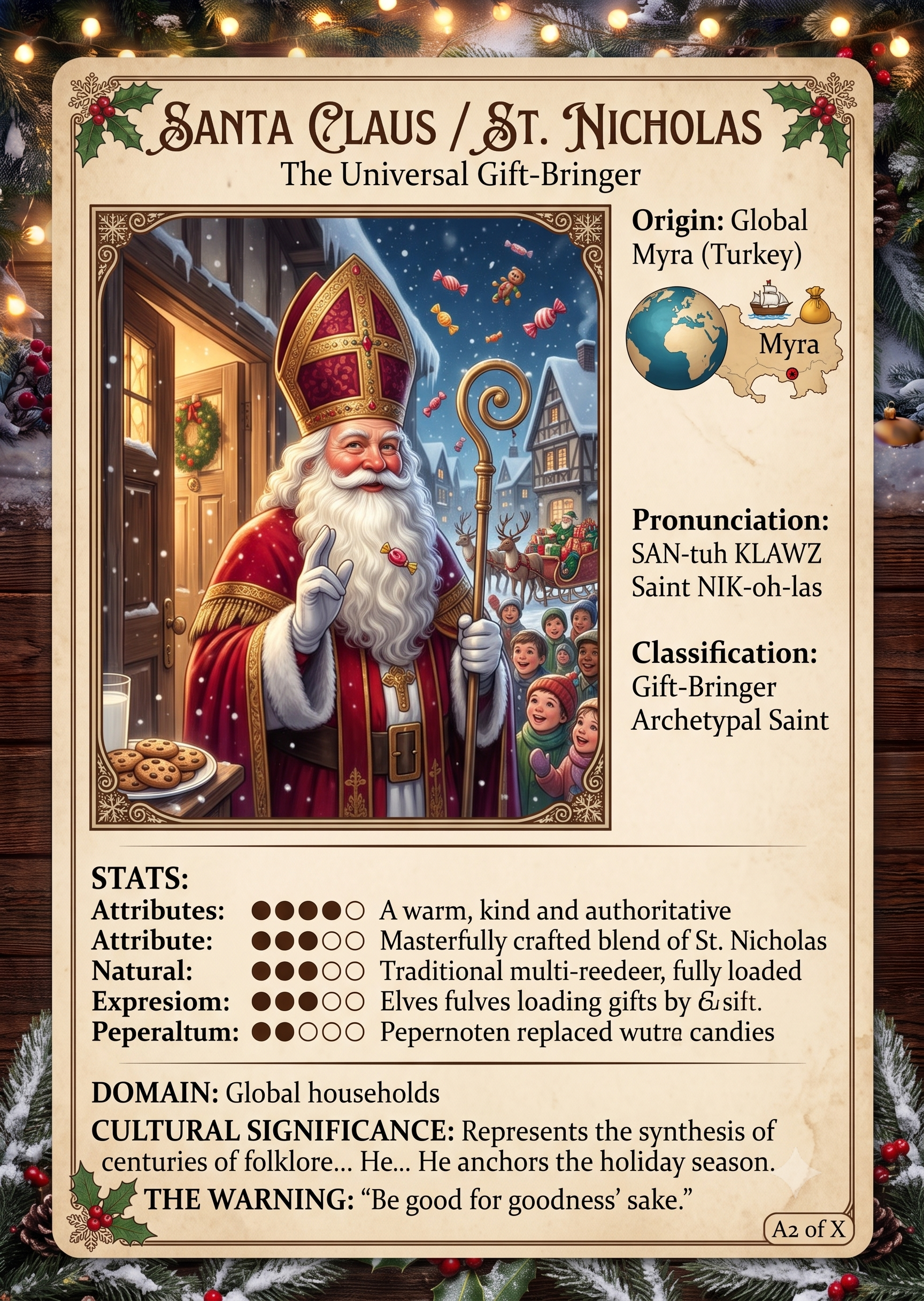
In 1868, the United States Confection Company of New York ran an advertisement for a product called Sugar Plums. The ad has a Santa Claus in it. He is wearing red.
Coca-Cola would not be invented for another eighteen years.
That is the whole refutation, and I could stop there, but the true story is better than the false one, so let us do the true one.
The claim you have heard is that Coca-Cola dressed Santa Claus in red in the 1930s to match the company’s branding, and that before that he wore green, or brown, or whatever the teller prefers. It is repeated every December by people who consider themselves too smart to be fooled by advertising, which is the joke, because the claim is itself the thing they are congratulating themselves for seeing through.
Here is the actual sequence.
1821. New York. A small book called The Children’s Friend prints eight hand-colored lithographs of a figure called Santeclaus, driving a sleigh behind a reindeer, arriving on Christmas Eve. He is in red. These are the earliest published pictures of Santa Claus in America, and he is already the color he is now.
1863. Thomas Nast, the German-born political cartoonist, draws Santa for Harper’s Weekly. This first one is in stars and stripes, handing out gifts at a Union army camp, because it is the middle of the Civil War and Nast is doing propaganda. He will draw Santa about thirty times over the next twenty-three years.
1868. The Sugar Plums ad above. Red.
1881. Nast draws “Merry Old Santa Claus.” Round, white-bearded, fur-trimmed red suit, sack of toys. This is essentially the modern Santa, finished, fifty years early.
1880s onward. Louis Prang, another German immigrant, sometimes called the father of the American Christmas card, is printing Santa in red at scale and mailing him into houses all over the country.
1915 to the 1920s. White Rock, a beverage company, is running Santa in its ads. In color by the early twenties. Also red. Also not Coca-Cola.
1931. Coca-Cola’s advertising man, Archie Lee, hires an illustrator named Haddon Sundblom. Sundblom paints Santa for Coke every year until 1964. The paintings are extraordinarily good. They are also arriving at a party that has been running for a hundred and ten years.
The company itself does not claim otherwise. In 2008 Phil Mooney, then the director of Coca-Cola’s archives, said plainly that Coke did not come up with the idea of putting Santa in red, and noted only that it has worked out nicely for them.
So what did Coca-Cola actually do? Something real, and worth naming precisely: they standardized him and they exported him. Sundblom’s Santa is warm, specific, and repeated identically for thirty-three years, on a distribution network that reached most of the planet. Before Sundblom, Santa was red but he was also negotiable, drifting in size and temperament from artist to artist. After Sundblom, he was fixed. Coke did not paint the suit. Coke laminated it.
Now the part that matters for this book.
The myth is popular because it lets us off. If Coca-Cola built our Christmas, then the flatness of our Christmas is something that was done to us by a soda company, and we are victims of it, and we can enjoy being annoyed about it.
The truth is worse. Go back and read what that 1821 Santa does. He gives an apple, or a tart, or a wooden gun, or a book, to good children. And to the children he finds “thankless to parents, liars, swearers,” he leaves a long black birchen rod, and the poem is explicit that the rod is for the parents to use.
The first American Santa carried a switch. He is red, he comes on Christmas Eve, he judges you, and he arms your father. Nobody at Coca-Cola took that away. It drained out slowly over a century, in a thousand small decisions by illustrators and publishers and parents, all of them choosing the softer version, none of them wrong exactly, and the accumulated result is a figure who watches everything and does nothing.
Coke did not sand the teeth off Santa Claus. We did that ourselves, and we did most of it before Coke was born.
If this is the kind of thing you want a whole book of, the Kindle is live now.
