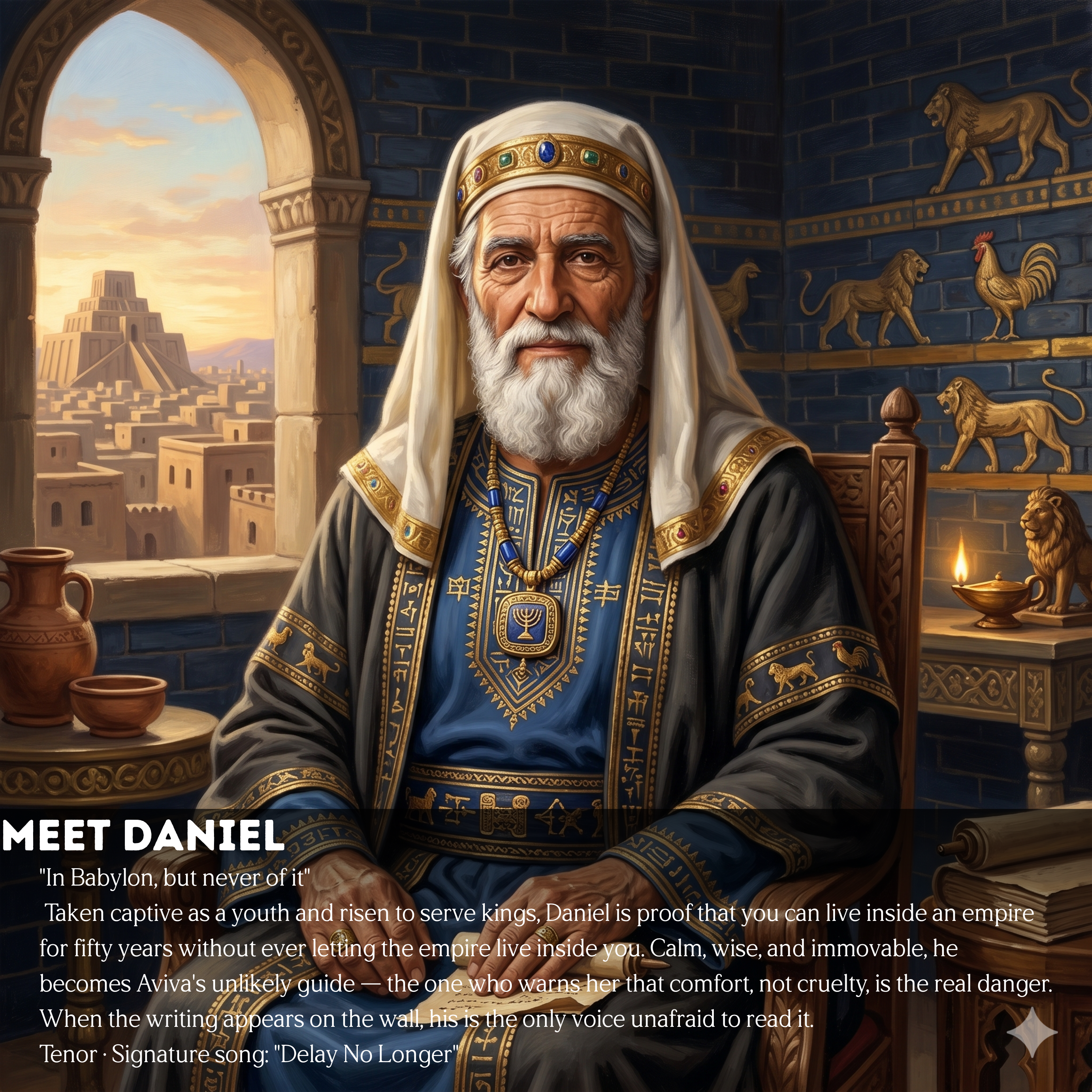
This week I’ve been introducing you to the cast of “Bring Us Home” — and today’s character is a little different from the others, because he’s the one principal in this whole show drawn directly from Scripture rather than invented. Meet Daniel.
A real biblical figure, fifty years into the story
Daniel was taken to Babylon as a youth, in one of the earliest waves of deportation — decades before Aviva is even born. By the time we meet him in “Bring Us Home,” he’s an old man. Seventy years old, give or take. He’s served in the Babylonian court under multiple kings. He’s seen empires rise. He’s about to watch one fall.
And through all of it, he’s held onto something most people in his position would have quietly let go of a long time ago.
“I have never once let Babylon serve in me”
There’s a line I wrote for Daniel that I think is the truest thing about him: “I serve in Babylon. I have never once let Babylon serve in me.”
He’s not bitter about his circumstances. He’s not pretending the last fifty years didn’t happen. He wears the robes. He holds the position. But there’s “an ocean,” as he puts it, between serving in a place and belonging to it — and that ocean is the only thing that’s kept his soul alive.
This is why Daniel becomes Aviva’s guide when she’s brought into the palace. He’s not warning her from a safe distance. He’s lived inside the exact tension she’s about to face — for fifty years — and he’s still standing.
“The song under the song”
When Daniel meets Aviva in the palace, he gives her advice that I think about a lot: “It costs you nothing to wear their gold. But do not let them buy the one thing you brought in through that gate. The song under the song. Do you understand me?”
He won’t just hand her the answer, either — and that’s deliberate. He tells her if he hands it to her, it stays his. She has to find it herself, or it won’t hold when the weight comes.
That’s such a real picture of discipleship, honestly. The people who’ve walked the road longest don’t always rescue you from the test. Sometimes the most loving thing they can do is make sure you’re equipped to walk through it yourself.
His signature song: “Delay No Longer”
Daniel’s song draws from Daniel 5 and Daniel 9 — moments of crisis and prayer near the end of his life. It’s a driving, urgent tenor solo, and it’s positioned right before Belshazzar’s feast — Daniel on his knees in faith, while across the stage, the king he serves is reaching for a wine cup in fear. Same night. Same approaching doom. Two completely different responses.
Why Daniel isn’t the lead
I get asked sometimes why a show about the exile wouldn’t center on Daniel — his story is so well-known, so dramatic. But “Bring Us Home” isn’t trying to retell the book of Daniel. It’s about the everyday people — the refugees, the musicians, the families by the riverbank who didn’t live in the palace.
Daniel’s story is essential to this show, but it’s not the center of it. He’s the elder statesman who shows up at exactly the right moment to guide the next generation — which, honestly, might be the most faithful way to honor who he actually was.
The moment everyone remembers
I don’t want to give too much away here — there’s a whole “Behind the Song” post coming on this — but I’ll just say: when the writing appears on the wall at Belshazzar’s feast, and nobody in that entire palace can read it… Daniel is the only one who can. And the only one who will.
Join the conversation
💬 Comment below — how do you live “in” a place — a job, a season, a culture — without letting it change who you are at the core? I’d love to hear how you navigate that.
📱 Follow me on Instagram and Facebook at @TheMelanieGrace for the next reveal.
💌 Sign up for my email list for the deeper story behind every character and song.
🎧 Follow me on Spotify, Apple Music, Amazon Music, and YouTube Music so “Delay No Longer” reaches you the moment it’s released.
Tomorrow, meet the king at the center of the empire — Belshazzar, and the almost-romance between Aviva and a young Babylonian musician named Nabu is coming up right after that.
And a girl born in captivity, who has never seen her homeland, is about to break your heart.
Okay. I need to tell you about the thing I’ve been quietly losing my mind over.
You know that feeling when an idea grabs you by the collar and won’t let go until you write it down? That’s been my whole month. It started with a simple question I asked myself one afternoon: what would it take to write a song as devastating as “Deliver Us” from The Prince of Egypt? You know the one. The opening number. The mothers, the river, the baby, the cry of an entire enslaved people set to music so big it rearranges your ribcage.
I didn’t expect that one question to turn into a full original biblical musical. But here we are. Twelve songs. A complete two-act book. A cast of characters I now love like family. And honestly? I think it might be the most important thing I’ve ever made.
So pour yourself some coffee. This is a long one. I want to tell you the whole story.
The story nobody has dared to tell
Here’s what got me. We have Prince of Egypt for Moses. We have Joseph and the Amazing Technicolor Dreamcoat. And right now, as I write this, a crowd-funded animated musical called David has shattered box-office records and just landed on Netflix — proof that the world is starving for these stories told with real heart and real music. People showed up in droves. Families. Skeptics. Everybody.
But there’s one massive biblical epic that nobody has touched. One of the most pivotal events in the entire Old Testament, and somehow no one has set it to music for the screen or the stage.
The Babylonian Exile.
The fall of Jerusalem. The long march into captivity. Seventy years of a people trying to remember who they are while living inside the most dazzling, seductive empire on earth. And it’s practically begging to be a musical, because the source material literally hands you the premise. Psalm 137 — “By the rivers of Babylon, there we sat down and wept” — is a song about whether you can even sing anymore when everything you love has been taken. The captors demand a song of Zion. The exiles hang their harps in the willow trees and refuse. The whole thing is about music as survival.
I read that and thought: how has no one done this? So I did it. It’s called Bring Us Home, and I cannot wait for you to hear it.
Meet Aviva (you’re going to fall in love with her)
Every epic needs a heart, and mine is a girl named Aviva.
Here’s the thing that wrecked me when I figured out her character: the exile lasted seventy years. That’s long enough that a whole generation was born in Babylon. So my heroine has never seen Jerusalem. Not once. Everything she knows about her homeland comes from one place — her mother’s lullabies. A golden city she’s only ever met inside a song.
And that gave me the question that the entire musical hangs on, the one I genuinely can’t stop thinking about:
How do you ache for a home you’ve never seen?
Because isn’t that all of us? Haven’t you ever felt homesick for somewhere you’ve never been? That ache for a place you can’t quite name? That’s what I wanted to put into these songs. That’s the feeling I chase every single time I sit down to write — I want to make you feel something real, something you didn’t have words for until the melody handed them to you. Aviva is how I did it this time.
The prophecies that give me chills
I’m a stickler for getting the Bible right, so I dug deep — and the prophecies woven through this period are unbelievable. This is the stuff that makes the hair on my arms stand up.
There’s the writing on the wall — the actual origin of that phrase we still use today. King Belshazzar throws a drunken feast, drinks from the sacred cups looted from the temple, and a disembodied hand writes four words of doom on the palace wall: Mene, Mene, Tekel, Upharsin. Numbered. Weighed. Divided. That very night, the empire falls. I put those real ancient words into the song as whispers under the chorus, and chills — every time.
There’s Ezekiel’s valley of dry bones — a vision of a dead, scattered nation breathing again — which becomes the moment my whole show turns from grief to hope.
And here’s my favorite: the prophet Isaiah named Cyrus, the king who would set the exiles free, by name — generations before he was born. And when Cyrus finally issued his decree to let them go home? Here’s the part most people don’t know: most of them chose to stay. Seventy years of comfort had made Babylon feel like home. The real enemy was never cruelty. It was comfort. (That tension became one of my favorite songs — a debate between the ones who stay and the ones who go.)
I’m telling you, you cannot make this stuff up. History wrote a better screenplay than any of us could.
Yes, I used AI — and I’m proud of it
You know me. I’m always honest about my process. I built this using AI as my creative partner — for brainstorming, for workshopping lyrics, for shaping the story, for crafting the production prompts that bring these songs to life. I’m a songwriter and a lyricist, and AI is the collaborator that lets one independent artist build something that used to take a whole studio and a fat Hollywood budget.
I genuinely believe this is the future for indie creators like me — and I’d rather be transparent and excited about it than pretend. The heart is mine. The faith is mine. The voice is mine. The tools just help me get it out of my head and into your ears faster.
This is the dream
I’ll be real with you: I want this to be big. I’m not embarrassed to say it. I want Bring Us Home on a stage. I want it in your earbuds. I want a kid somewhere to belt these songs in their bedroom the way I belted “Deliver Us.” I want this to be the new Prince of Egypt — the untold epic that finally gets told.
Big dreams for an independent artist working out of Southern California, I know. But every big thing started as somebody refusing to let go of an idea that grabbed them by the collar.
So here’s where you come in — and this part actually matters to me:
Hit follow on me on Spotify, Apple Music, Amazon Music, and YouTube Music right now. When you follow (not just save a song — follow), the platforms tell you the second I release something new, so you’ll never miss a track from this album as it rolls out. That following number is also how independent artists like me get noticed, so it genuinely helps more than you know.
Drop me a comment and tell me: which Bible story do you think Hollywood has been ignoring? I read every single one, and you might just hand me my next project.
Follow me on Instagram and Facebook @TheMelanieGrace to watch this whole thing come together behind the scenes.
And sign up for my email list so you’re first in line when Bring Us Home drops. No spam, just music, heart, and the occasional happy ramble like this one.
We hung our harps in the willow trees for a long time. But the day is finally here to take them down.
Let’s go home. 🎵
Bring Us Homethemelaniegrace
Why Must I Weepthemelaniegrace
We Are Homethemelaniegrace
Two Riversthemelaniegrace
The Writing on the Wallthemelaniegrace
The Shaking Throne
The Gold of Babylon
The Brick and the River
Hush Now (The River Lullaby)themelaniegrace
Hush Now (Reprise — Miryam's Farewell)
Can These Dry Bones Live?
By The Willows
WHY isn’t this about Daniel:
The Book of Daniel is a massive, incredible part of the exile history. Daniel, Shadrach, Meshach, and Abednego’s lives in the Babylonian court are legendary, and the historical details in that book are fascinating.
The reason Daniel isn’t the main character of this specific story isn’t because I think he’s unimportant—it’s because Bring Us Home is focused on a very specific, beautiful verse in Psalm 137: ‘By the rivers of Babylon, there we sat down… We hanged our harps upon the willows.’ > Daniel’s story is about a statesman, a prophet, and a government official navigating the highest halls of imperial power. My story is about the everyday refugees and musicians down by the riverbanks—the people who didn’t live in the palace, but who had to figure out how to keep their faith and identity alive through worship and song while grieving for a home they lost.
To me, being biblically accurate means capturing the heart of the exile: the agonizing ache for Jerusalem, the temptation to completely assimilate into Babylonian culture (which is exactly what Aviva faces in the palace, just like the pressures Daniel faced), and the miracle of God keeping His promise to bring them back after seventy years.
By focusing on Miryam and Aviva, I can show the audience the generational handoff of faith. Miryam represents the generation that remembered the Temple; Aviva represents the generation born in captivity who had to learn to love a homeland they’d never seen. That is a deeply biblical, historical reality for thousands of families who lived through those seventy years.
Think of it like the movie The Prince of Egypt. It focuses heavily on Moses and Rameses to tell a powerful, cinematic story about the Exodus, but it leaves out a lot of the structural details, genealogies, and smaller events found in the text of Exodus. It doesn’t mean the filmmakers didn’t care about the Bible; it means they were using the art of theater to make the audience feel the massive emotional weight of slavery and deliverance.
That’s exactly what I’m doing with Bring Us Home. I want people who watch this to leave with a profound, tearful appreciation for how resilient the faith of the Jewish people was, and how God brought them back. I am honoring the scripture by making people feel it, not just read it.