Tag: Daniel 5

  • Free Bible Study Guides for “Bring Us Home” — Dig Into the Scripture Behind the Songs

    Free Bible Study Guides for “Bring Us Home” — Dig Into the Scripture Behind the Songs

    If you’ve been following along with my “Bring Us Home” series, you already know this musical isn’t just inspired by Scripture — it’s built on it. Every song, every character, every scene maps back to real passages: Psalm 137, Daniel, Jeremiah, Ezekiel, Ezra. And the more I worked on this project, the more I realized I didn’t want to keep all of that research to myself.

    So I made something for you.

    What I made

    I’ve put together a set of Bible study guides that walk through the scriptural foundation of “Bring Us Home” — the same passages that shaped Aviva’s journey, Miryam’s lullaby, Saba Elan’s vow, Daniel’s faithfulness, and the fall of Babylon itself. These aren’t just “here’s a verse, here’s a song” — they’re meant to be something you can actually sit with. Read. Reflect on. Maybe even work through with a small group, a journal, or just a quiet morning and a cup of coffee.

    My hope is that these guides do for you what writing this musical did for me: turn a story you might think you already know into something that feels personal again.

    What’s inside

    The guides walk through the heart of the story’s scriptural roots, including:

    • Psalm 137 — the rivers of Babylon, the harps in the willows, and the question that gives this whole project its emotional center: “How shall we sing the Lord’s song in a strange land?”
    • Jeremiah 29 — the seventy years of exile, and God’s surprising instructions to His people to build homes and plant gardens in the very place that took everything from them
    • Daniel 1, 5, and 9 — Daniel’s faithfulness across decades in a foreign court, the feast, the writing on the wall, and his prayer for his people’s return
    • Ezekiel 37 — the valley of dry bones, and what it means to ask “can this live again?” before you see the answer
    • Ezra 1–3 — the decree of Cyrus, the journey home, and the bittersweet mix of weeping and rejoicing as the temple foundation was laid

    Each guide ties these passages back to the story and characters of “Bring Us Home” — so as the music releases, you’ll have a deeper well to draw from than just the songs themselves.

    How this came together

    I’ll be honest — putting these together was its own project. I had so much research spread across so many documents by the time the musical’s script was finished, and pulling it all into something organized enough to actually study took real work. I had a lot of help along the way (including AI tools helping me catch duplicates and organize everything into something coherent) — but the heart of it, the “why does this passage matter” part, is all me. This grew straight out of months of sitting with these chapters myself.

    How to get them

    These guides are completely free — I just ask that you sign up so I can send them straight to you (and so you’ll be the first to know when new ones are added as more of “Bring Us Home” releases).

    👉 Click here to download the Bible study guides

    Let’s go deeper together

    Whether you’re someone who’s walked through Scripture your whole life, or someone who’s just curious because a song caught your attention — these guides are for you. My hope is that they help “Bring Us Home” become more than something you listen to. I want it to be something that sends you back to the Word with fresh eyes.

    💬 Comment below — which passage are you most excited to dig into? Psalm 137? The writing on the wall in Daniel 5? Ezekiel’s dry bones?

    📱 Follow me on Instagram and Facebook at @TheMelanieGrace for updates as new guides and new music drop.

    💌 Download the Bible study guides here and join my email list — you’ll get these guides plus first access to everything coming next.

    🎧 Follow me on Spotify, Apple Music, Amazon Music, and YouTube Music so every song from “Bring Us Home” reaches you the moment it’s released.

    This story started with Scripture. I hope these guides help it lead you right back there.

  • The Golden Cup — A Small Object That Carries the Whole Story

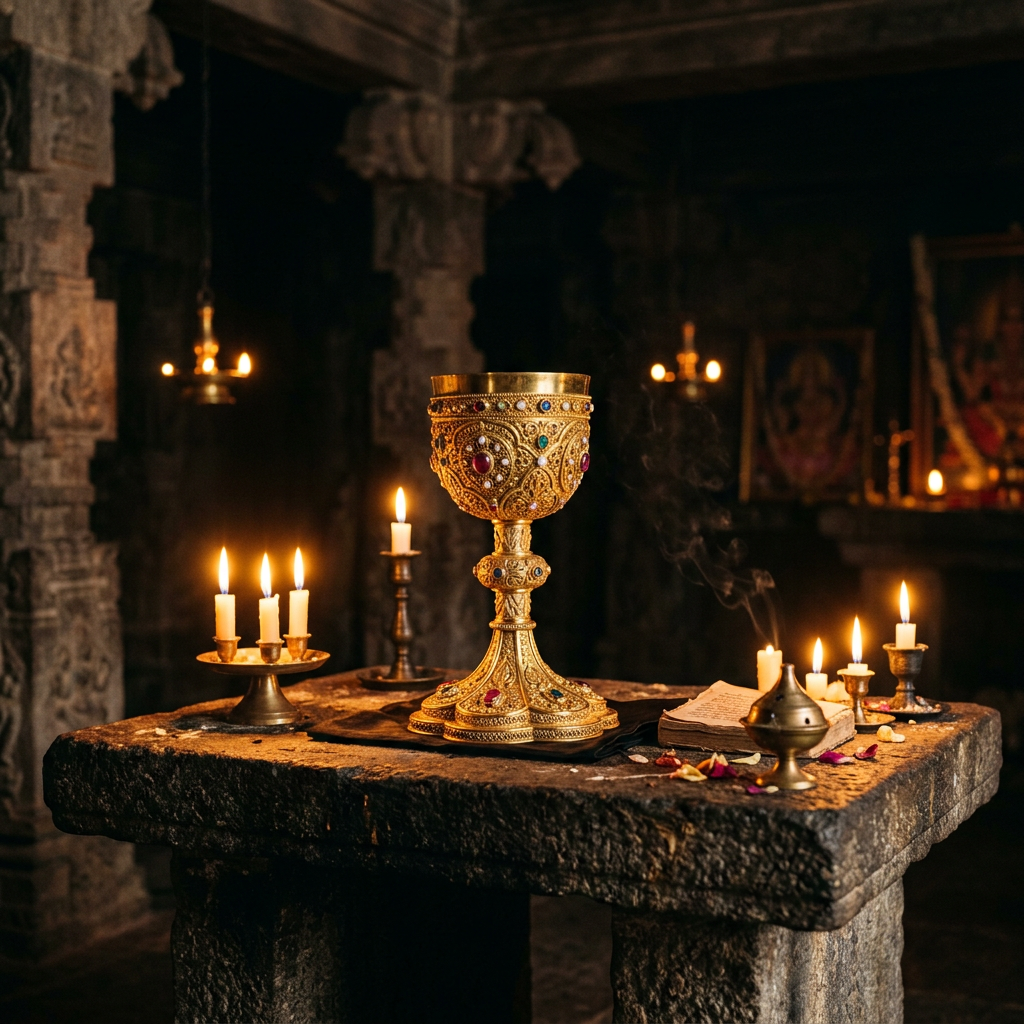
    The Golden Cup — A Small Object That Carries the Whole Story

    In a show full of big moments — a city burning, harps hung in willow trees, a hand writing on a palace wall — one of the most important objects in “Bring Us Home” is small enough to hold in one hand. Today I want to talk about the golden temple cup, and why it became one of the most important through-lines in the entire musical.

    Where it comes from

    When Jerusalem fell and the Temple was destroyed, the Babylonians didn’t just burn the building — they looted it. Sacred vessels, gold cups used in Temple worship, were carried off to Babylon as spoils of war. This is historically documented (2 Kings 25, and referenced again in Daniel 5), and it’s not a small detail. These weren’t just “nice things.” They were sacred — set apart for the worship of God, and nothing else.

    For seventy years, those cups sat in Babylon. Not destroyed. Not returned. Just… taken. Repurposed. Sitting in a palace that had no idea — or didn’t care — what they actually were.

    The moment they’re defiled

    The cup becomes central to the story’s climax. At Belshazzar’s feast, in a fit of drunken arrogance, the king orders those very temple vessels brought out so his court can drink from them — as a way of mocking the God of the people he conquered. He hands one directly to Aviva, wine spilling over its sacred engraving, and demands she sing for his entertainment using the cup as a prop.

    That’s the moment everything turns. Aviva doesn’t drink from it. She doesn’t perform with it. She sets it down — deliberately, reverently — on a pedestal, and gives the king something he didn’t ask for.

    From defilement to rescue

    When the writing appears on the wall and the palace begins to fall apart in chaos, Daniel turns to Aviva and says something simple but enormous: “Take the cup. Take it home.”

    She does. She snatches it to her chest as the palace collapses around her, and it travels with her — through the escape, across the desert, all the way to the ruins of Jerusalem.

    Why this object matters so much to me

    Here’s what I love about using the cup as a through-line: it’s not a person, so it can’t change its mind, make a choice, or have an arc the way a character does. But it carries the whole emotional journey of the story anyway — just by what happens around it.

    It starts as something sacred. It gets stolen, displaced, and defiled — used for the exact opposite of what it was made for. And then, in the hands of someone who refuses to let that be the end of its story, it gets carried home and restored to what it was always meant to be.

    If that sounds like it might be a picture of something bigger than a cup… yeah. That’s the idea.

    Past and future, side by side

    In the finale, when the exiles finally reach the ruins of Jerusalem, Aviva sets two things down on the bare temple floor: the harp that’s hung silent in the willows for seventy years, and the rescued golden cup.

    Past and future. The thing that was kept silent, and the thing that was almost lost — both finally home, both finally able to be what they were always meant to be.

    I don’t think I’ve ever written a “prop” that meant this much to me.

    I’d love to hear from you

    💬 Comment below — is there something in your own life — an object, a tradition, a piece of your story — that got “displaced” for a season before finding its way back to where it belonged?

    📱 Follow me on Instagram and Facebook at @TheMelanieGrace for more behind-the-scenes on the symbols woven through this show.

    💌 Sign up for my email list for the full story behind every song and every detail.

    🎧 Follow me on Spotify, Apple Music, Amazon Music, and YouTube Music so you’re there for the finale the moment it releases.

    Tomorrow, I want to take you behind the curtain on the research side of this project — the real dates, the real history, and how I made sure “Bring Us Home” stayed faithful to Scripture.


  • Belshazzar and “The Writing on the Wall”

    Belshazzar and “The Writing on the Wall”

    Today I want to introduce you to the character at the center of one of the most famous moments in the entire Bible — and one of the biggest scenes in “Bring Us Home.” Meet King Belshazzar.

    A king who collects beautiful things

    Belshazzar rules the golden heart of the world. Charismatic, brilliant, beautiful — and underneath all of that swagger, he’s terrified. He can feel his empire slipping. The Persian army is at the walls, and he knows it, even if he won’t say it out loud.

    When he hears about a girl from the river camps whose voice made a hardened soldier weep, he doesn’t send for her out of cruelty. He sends for her because he collects beautiful things — and he wants to add her voice to his collection.

    His first real scene with Aviva is almost playful — he’s charmed when she refuses to sing for him. He laughs. He’s delighted. And then he does something that I think defines his whole character: he opens his arms to his glittering court and says, essentially, look what you’ve been missing while you cried over a pile of rubble.

    “Gold of Babylon”

    That’s the moment that becomes his big number with Aviva — “Gold of Babylon.” It’s the seduction of the empire, in full force. By the end of it, Aviva is dressed in gold, dazzled despite herself. It’s Act One’s finale, and it’s meant to leave the audience a little uneasy — has she just lost something she doesn’t even realize yet?

    The night everything changes

    Here’s where the history gets real. According to Daniel 5, Belshazzar threw a massive feast — and in a moment of drunken arrogance, ordered the sacred gold vessels looted from Jerusalem’s Temple to be brought out so his court could drink from them. He wanted to prove, in front of everyone, that his gods — and his power — were greater than the God of the people he’d conquered.

    In “Bring Us Home,” this is the moment Belshazzar forces Aviva to perform. He hands her one of the looted temple cups — wine spilling over its sacred engraving — and demands she sing “one of those famous, mournful, tear-soaked songs of Zion” for his amusement.

    And Aviva — after everything, after the gold, after almost forgetting the lullaby entirely — sets the cup down. Deliberately. Reverently. And gives him judgment instead of a lullaby.

    The hand on the wall

    What happens next is drawn almost word-for-word from Daniel 5. A deafening crack of thunder. The music stops. And on the wall, in front of the entire court, a disembodied hand begins tracing glowing letters:

    MENE MENE TEKEL UPHARSIN

    None of Belshazzar’s wise men can read it. He’s terrified — offering a third of his kingdom to anyone who can interpret it. And then Daniel steps forward.

    “You don’t need an astrologer, Belshazzar. You need a mirror.”

    The interpretation is devastating in its simplicity: God has numbered the days of his kingdom and brought it to an end. He’s been weighed in the balance and found lacking. His kingdom is being given to the Medes and Persians. That night.

    According to Scripture — and according to the show — Babylon fell that very night.

    A villain you almost understand

    I didn’t want Belshazzar to just be “evil.” I wanted him to be a man who could feel the ground shifting under his empire and responded the only way he knew how — by throwing the biggest, loudest, most defiant party he could, as if volume could drown out the truth.

    His desecration of the temple vessels isn’t really arrogance, in the end. It’s panic dressed up as power. And I think that’s a very human thing — when we sense something is ending, sometimes our instinct is to grab the most sacred thing nearby and treat it like it doesn’t matter, just to prove to ourselves that we’re still the ones in control.

    He wasn’t.

    What this scene means to me

    This is, historically and dramatically, the peak of the whole show — the moment everything Aviva has carried (the lullaby, the defiance, the song under the song Daniel told her about) comes together in one act of courage. And it’s the moment the empire that seemed unshakable… wasn’t.

    Let’s talk about it

    💬 Comment below — every empire in history has eventually fallen. Why do you think it’s so hard for people in power to see it coming?

    📱 Follow me on Instagram and Facebook at @TheMelanieGrace for more on this scene and the song that comes from it.

    💌 Sign up for my email list for the full “Behind the Song” breakdown of “The Writing on the Wall.”

    🎧 Follow me on Spotify, Apple Music, Amazon Music, and YouTube Music so this one finds you the moment it drops.

    Tomorrow: the golden cup itself — the small object that ties this entire story together, from the Temple to the feast to the road home.


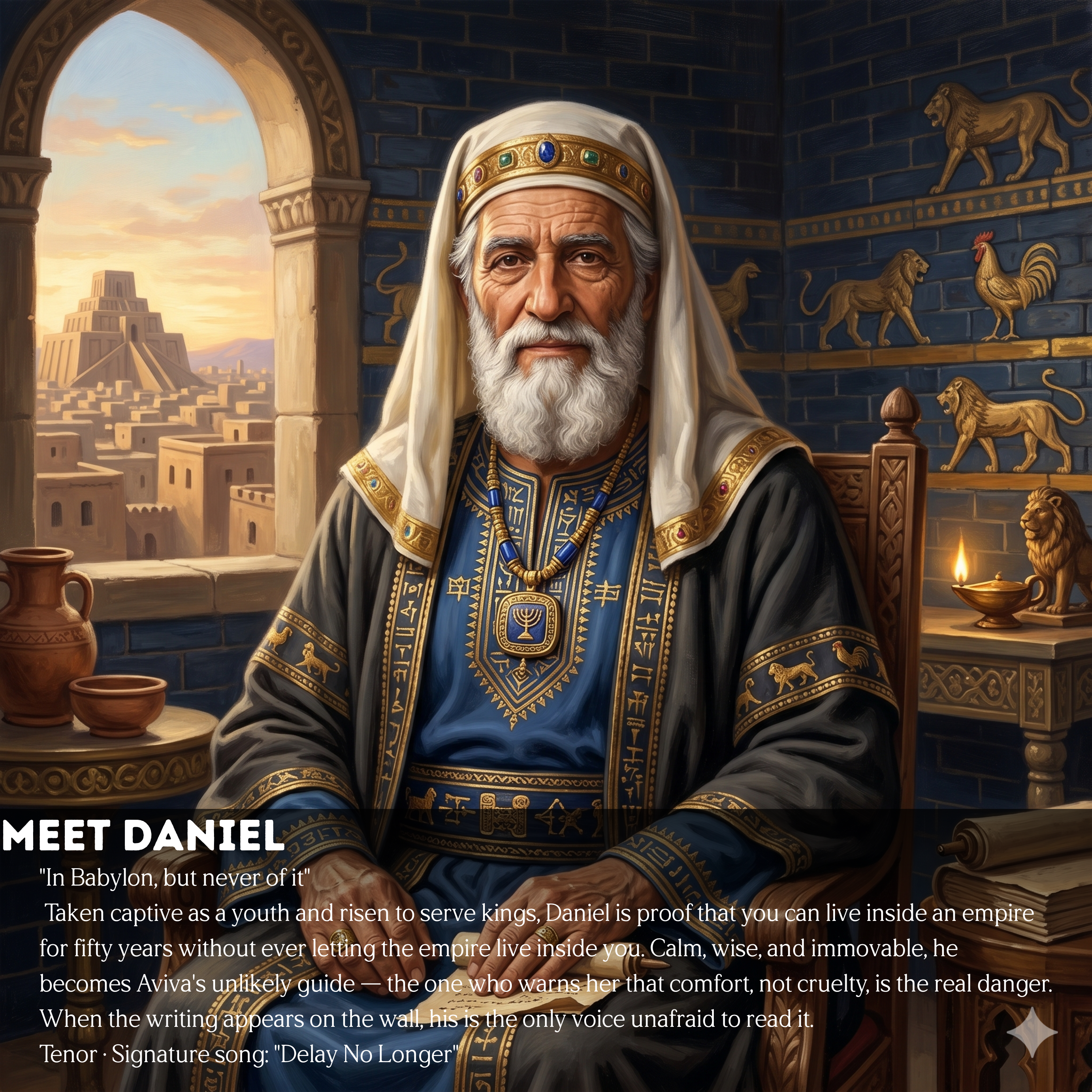
  • Daniel: In Babylon, But Never Of It

    Daniel: In Babylon, But Never Of It

    Posting Date: July 15

    This week I’ve been introducing you to the cast of “Bring Us Home” — and today’s character is a little different from the others, because he’s the one principal in this whole show drawn directly from Scripture rather than invented. Meet Daniel.

    A real biblical figure, fifty years into the story

    Daniel was taken to Babylon as a youth, in one of the earliest waves of deportation — decades before Aviva is even born. By the time we meet him in “Bring Us Home,” he’s an old man. Seventy years old, give or take. He’s served in the Babylonian court under multiple kings. He’s seen empires rise. He’s about to watch one fall.

    And through all of it, he’s held onto something most people in his position would have quietly let go of a long time ago.

    “I have never once let Babylon serve in me”

    There’s a line I wrote for Daniel that I think is the truest thing about him: “I serve in Babylon. I have never once let Babylon serve in me.”

    He’s not bitter about his circumstances. He’s not pretending the last fifty years didn’t happen. He wears the robes. He holds the position. But there’s “an ocean,” as he puts it, between serving in a place and belonging to it — and that ocean is the only thing that’s kept his soul alive.

    This is why Daniel becomes Aviva’s guide when she’s brought into the palace. He’s not warning her from a safe distance. He’s lived inside the exact tension she’s about to face — for fifty years — and he’s still standing.

    “The song under the song”

    When Daniel meets Aviva in the palace, he gives her advice that I think about a lot: “It costs you nothing to wear their gold. But do not let them buy the one thing you brought in through that gate. The song under the song. Do you understand me?”

    He won’t just hand her the answer, either — and that’s deliberate. He tells her if he hands it to her, it stays his. She has to find it herself, or it won’t hold when the weight comes.

    That’s such a real picture of discipleship, honestly. The people who’ve walked the road longest don’t always rescue you from the test. Sometimes the most loving thing they can do is make sure you’re equipped to walk through it yourself.

    His signature song: “Delay No Longer”

    Daniel’s song draws from Daniel 5 and Daniel 9 — moments of crisis and prayer near the end of his life. It’s a driving, urgent tenor solo, and it’s positioned right before Belshazzar’s feast — Daniel on his knees in faith, while across the stage, the king he serves is reaching for a wine cup in fear. Same night. Same approaching doom. Two completely different responses.

    Why Daniel isn’t the lead

    I get asked sometimes why a show about the exile wouldn’t center on Daniel — his story is so well-known, so dramatic. But “Bring Us Home” isn’t trying to retell the book of Daniel. It’s about the everyday people — the refugees, the musicians, the families by the riverbank who didn’t live in the palace.

    Daniel’s story is essential to this show, but it’s not the center of it. He’s the elder statesman who shows up at exactly the right moment to guide the next generation — which, honestly, might be the most faithful way to honor who he actually was.

    The moment everyone remembers

    I don’t want to give too much away here — there’s a whole “Behind the Song” post coming on this — but I’ll just say: when the writing appears on the wall at Belshazzar’s feast, and nobody in that entire palace can read it… Daniel is the only one who can. And the only one who will.

    Join the conversation

    💬 Comment below — how do you live “in” a place — a job, a season, a culture — without letting it change who you are at the core? I’d love to hear how you navigate that.

    📱 Follow me on Instagram and Facebook at @TheMelanieGrace for the next reveal.

    💌 Sign up for my email list for the deeper story behind every character and song.

    🎧 Follow me on Spotify, Apple Music, Amazon Music, and YouTube Music so “Delay No Longer” reaches you the moment it’s released.

    Tomorrow, meet the king at the center of the empire — Belshazzar, and the almost-romance between Aviva and a young Babylonian musician named Nabu is coming up right after that.