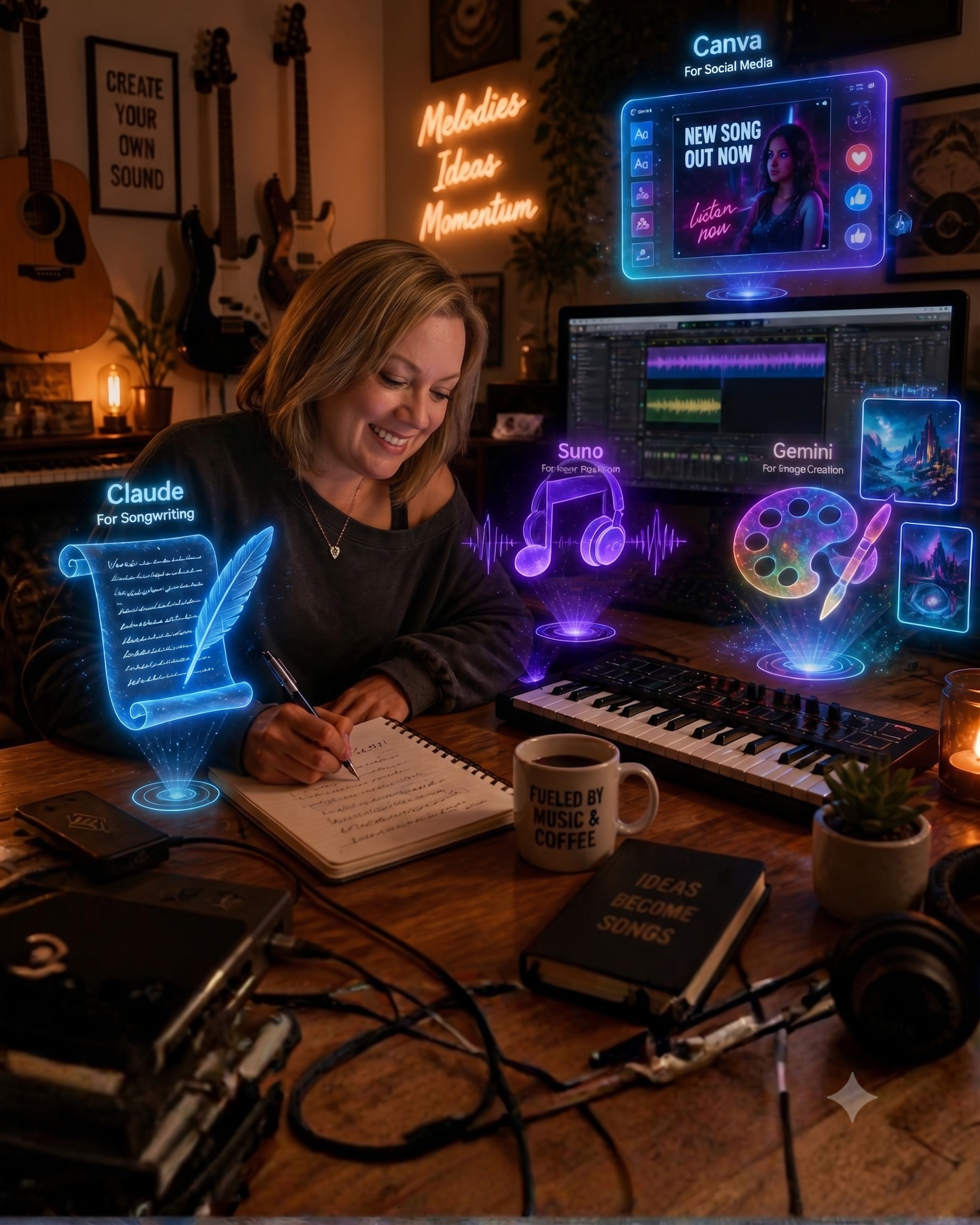
Since I talk about collaborating with AI pretty openly, I want to give you a real behind-the-scenes look at how it actually works. People often imagine AI creation as pressing a single button and having a finished, polished track handed back to you.
The reality is much more active, hands-on, and—honestly—time-intensive. It is a constant loop of refining, tweaking, and iterating.
1. The Spark: Old Notebooks & Human Emotion
It always starts with me—and usually with years of physical notebooks filled with scribbled lines, half-finished ideas, and memories. I bring the original concept, the emotional core, or a rough first verse.
What I need in the room isn’t an automated replacement for a writer; I need a creative sounding board to help me develop those old ideas and push past my initial clichés.
2. Crafting Lyrical Truth with Claude
That’s where Claude comes in as my songwriting partner. I’ll open a session with a clear prompt or feed in a draft from my notebook, like:
“I’m writing a song about the old Blockbuster ritual. It’s warm, nostalgic, and slightly bittersweet. The chorus needs to feel anthemic. Here’s a rough pre-chorus I drafted…”
From there, we workshop in real time. Claude offers options, and my job is to curate, edit, and steer:
- “Okay fine, kid, get the good backpack” came directly out of this back-and-forth. The line started off too sentimental, so I kept pushing the prompts toward the raw, true moment—that exact second your resistance as a parent completely collapses just looking at your kid’s face.
We iterate line by line, paragraph by paragraph, until every word feels grounded, authentic, and true to my voice.
3. Bringing the Sound to Life with Suno
Once the lyrics are locked, I take them into Suno for music production. This is where the marathon of iteration really begins.
Finding the right arrangement, tempo, vocal timbre, and emotional cadence isn’t a quick upload. It takes endless generations, adjusting genre tags, shifting structure cues, and testing different arrangements to get the track to sound like what I hear in my head.
4. Visuals & Storytelling: Gemini & Canva
A song doesn’t stop at the audio—it needs a visual world to live in.
- Gemini for Image Creation: I use Gemini to build out the visual mood, album concepts, and imagery. Getting the exact right tone, lighting, and feel means writing, rewriting, and tweaking image prompts over and over.
- Canva for Social Media: Once the artwork and imagery are created, I move into Canva to design cover art, promotional graphics, and social content to share the story behind each track.
The Real Work is in the Iteration
If there’s one takeaway, it’s that using these tools doesn’t mean skipping the effort—it means spending so much time changing things, testing variations, discarding what doesn’t work, and polishing what does.
All twelve songs on Mixtape Mindset were built this way: notebooks full of history, a stack of AI tools working together, endless hours of iteration, and a human heart guiding every choice.
Listen Now
Stream on Spotify and Apple Music!