Tag: AI music

  • Move Over, “Prince of Egypt” — I Just Wrote the Bible Story Hollywood Forgot

    Move Over, “Prince of Egypt” — I Just Wrote the Bible Story Hollywood Forgot

    And a girl born in captivity, who has never seen her homeland, is about to break your heart.


    Okay. I need to tell you about the thing I’ve been quietly losing my mind over.

    You know that feeling when an idea grabs you by the collar and won’t let go until you write it down? That’s been my whole month. It started with a simple question I asked myself one afternoon: what would it take to write a song as devastating as “Deliver Us” from The Prince of Egypt? You know the one. The opening number. The mothers, the river, the baby, the cry of an entire enslaved people set to music so big it rearranges your ribcage.

    I didn’t expect that one question to turn into a full original biblical musical. But here we are. Twelve songs. A complete two-act book. A cast of characters I now love like family. And honestly? I think it might be the most important thing I’ve ever made.

    So pour yourself some coffee. This is a long one. I want to tell you the whole story.

    A dramatic scene depicting a grand ancient temple with towering columns, filled with people in historical attire. A central figure stands at the forefront, dressed in a flowing cape, as rays of light illuminate the background. The title 'BRING US HOME' is prominently displayed at the top, along with the author's name, 'By: Melanie Grace.'

    The story nobody has dared to tell

    Here’s what got me. We have Prince of Egypt for Moses. We have Joseph and the Amazing Technicolor Dreamcoat. And right now, as I write this, a crowd-funded animated musical called David has shattered box-office records and just landed on Netflix — proof that the world is starving for these stories told with real heart and real music. People showed up in droves. Families. Skeptics. Everybody.

    But there’s one massive biblical epic that nobody has touched. One of the most pivotal events in the entire Old Testament, and somehow no one has set it to music for the screen or the stage.

    The Babylonian Exile.

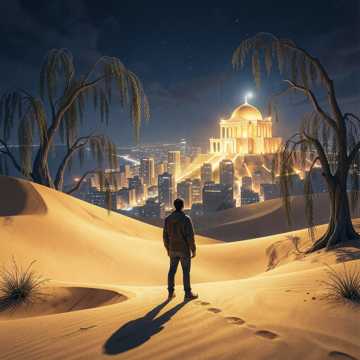
    The fall of Jerusalem. The long march into captivity. Seventy years of a people trying to remember who they are while living inside the most dazzling, seductive empire on earth. And it’s practically begging to be a musical, because the source material literally hands you the premise. Psalm 137 — “By the rivers of Babylon, there we sat down and wept” — is a song about whether you can even sing anymore when everything you love has been taken. The captors demand a song of Zion. The exiles hang their harps in the willow trees and refuse. The whole thing is about music as survival.

    I read that and thought: how has no one done this? So I did it. It’s called Bring Us Home, and I cannot wait for you to hear it.

    Meet Aviva (you’re going to fall in love with her)

    Every epic needs a heart, and mine is a girl named Aviva.

    Here’s the thing that wrecked me when I figured out her character: the exile lasted seventy years. That’s long enough that a whole generation was born in Babylon. So my heroine has never seen Jerusalem. Not once. Everything she knows about her homeland comes from one place — her mother’s lullabies. A golden city she’s only ever met inside a song.

    And that gave me the question that the entire musical hangs on, the one I genuinely can’t stop thinking about:

    How do you ache for a home you’ve never seen?

    Because isn’t that all of us? Haven’t you ever felt homesick for somewhere you’ve never been? That ache for a place you can’t quite name? That’s what I wanted to put into these songs. That’s the feeling I chase every single time I sit down to write — I want to make you feel something real, something you didn’t have words for until the melody handed them to you. Aviva is how I did it this time.

    The prophecies that give me chills

    I’m a stickler for getting the Bible right, so I dug deep — and the prophecies woven through this period are unbelievable. This is the stuff that makes the hair on my arms stand up.

    There’s the writing on the wall — the actual origin of that phrase we still use today. King Belshazzar throws a drunken feast, drinks from the sacred cups looted from the temple, and a disembodied hand writes four words of doom on the palace wall: Mene, Mene, Tekel, Upharsin. Numbered. Weighed. Divided. That very night, the empire falls. I put those real ancient words into the song as whispers under the chorus, and chills — every time.

    There’s Ezekiel’s valley of dry bones — a vision of a dead, scattered nation breathing again — which becomes the moment my whole show turns from grief to hope.

    And here’s my favorite: the prophet Isaiah named Cyrus, the king who would set the exiles free, by name — generations before he was born. And when Cyrus finally issued his decree to let them go home? Here’s the part most people don’t know: most of them chose to stay. Seventy years of comfort had made Babylon feel like home. The real enemy was never cruelty. It was comfort. (That tension became one of my favorite songs — a debate between the ones who stay and the ones who go.)

    I’m telling you, you cannot make this stuff up. History wrote a better screenplay than any of us could.

    Yes, I used AI — and I’m proud of it

    You know me. I’m always honest about my process. I built this using AI as my creative partner — for brainstorming, for workshopping lyrics, for shaping the story, for crafting the production prompts that bring these songs to life. I’m a songwriter and a lyricist, and AI is the collaborator that lets one independent artist build something that used to take a whole studio and a fat Hollywood budget.

    I genuinely believe this is the future for indie creators like me — and I’d rather be transparent and excited about it than pretend. The heart is mine. The faith is mine. The voice is mine. The tools just help me get it out of my head and into your ears faster.

    This is the dream

    I’ll be real with you: I want this to be big. I’m not embarrassed to say it. I want Bring Us Home on a stage. I want it in your earbuds. I want a kid somewhere to belt these songs in their bedroom the way I belted “Deliver Us.” I want this to be the new Prince of Egypt — the untold epic that finally gets told.

    Big dreams for an independent artist working out of Southern California, I know. But every big thing started as somebody refusing to let go of an idea that grabbed them by the collar.

    So here’s where you come in — and this part actually matters to me:

    Hit follow on me on Spotify, Apple Music, Amazon Music, and YouTube Music right now. When you follow (not just save a song — follow), the platforms tell you the second I release something new, so you’ll never miss a track from this album as it rolls out. That following number is also how independent artists like me get noticed, so it genuinely helps more than you know.

    Drop me a comment and tell me: which Bible story do you think Hollywood has been ignoring? I read every single one, and you might just hand me my next project.

    Follow me on Instagram and Facebook @TheMelanieGrace to watch this whole thing come together behind the scenes.

    And sign up for my email list so you’re first in line when Bring Us Home drops. No spam, just music, heart, and the occasional happy ramble like this one.

    We hung our harps in the willow trees for a long time. But the day is finally here to take them down.

    Let’s go home. 🎵

    • Bring Us Home themelaniegrace
    • Why Must I Weep themelaniegrace
    • We Are Home themelaniegrace
    • Two Rivers themelaniegrace
    • The Writing on the Wall themelaniegrace
    • The Shaking Throne
    • The Gold of Babylon
    • The Brick and the River
    • Hush Now (The River Lullaby) themelaniegrace
    • Hush Now (Reprise — Miryam's Farewell)
    • Can These Dry Bones Live?
    • By The Willows

    WHY isn’t this about Daniel:

    The Book of Daniel is a massive, incredible part of the exile history. Daniel, Shadrach, Meshach, and Abednego’s lives in the Babylonian court are legendary, and the historical details in that book are fascinating. 

    The reason Daniel isn’t the main character of this specific story isn’t because I think he’s unimportant—it’s because Bring Us Home is focused on a very specific, beautiful verse in Psalm 137: ‘By the rivers of Babylon, there we sat down… We hanged our harps upon the willows.’ > Daniel’s story is about a statesman, a prophet, and a government official navigating the highest halls of imperial power. My story is about the everyday refugees and musicians down by the riverbanks—the people who didn’t live in the palace, but who had to figure out how to keep their faith and identity alive through worship and song while grieving for a home they lost.

    To me, being biblically accurate means capturing the heart of the exile: the agonizing ache for Jerusalem, the temptation to completely assimilate into Babylonian culture (which is exactly what Aviva faces in the palace, just like the pressures Daniel faced), and the miracle of God keeping His promise to bring them back after seventy years.

    By focusing on Miryam and Aviva, I can show the audience the generational handoff of faith. Miryam represents the generation that remembered the Temple; Aviva represents the generation born in captivity who had to learn to love a homeland they’d never seen. That is a deeply biblical, historical reality for thousands of families who lived through those seventy years.

    Think of it like the movie The Prince of Egypt. It focuses heavily on Moses and Rameses to tell a powerful, cinematic story about the Exodus, but it leaves out a lot of the structural details, genealogies, and smaller events found in the text of Exodus. It doesn’t mean the filmmakers didn’t care about the Bible; it means they were using the art of theater to make the audience feel the massive emotional weight of slavery and deliverance.

    That’s exactly what I’m doing with Bring Us Home. I want people who watch this to leave with a profound, tearful appreciation for how resilient the faith of the Jewish people was, and how God brought them back. I am honoring the scripture by making people feel it, not just read it.

    Melanie

  • How Suno AI Changed My Creative Process

    How Suno AI Changed My Creative Process

    Educational / Personal

    I want to talk about something I get questions about pretty regularly, which is how I use AI in my music. Specifically Suno AI, which is the tool I use to help produce my songs.

    First, the honest version: I was skeptical at first. Not because I am opposed to new tools, but because music has always been something sacred to me. I started as a first soprano in classical and choral settings, I have led worship, I have written songs for as long as I can remember. The idea of bringing a technology component into that felt like it might dilute something I cared about protecting.

    What I found instead genuinely surprised me.

    Suno AI is a generative music tool that can take prompts and produce full musical tracks in a variety of styles, genres, and moods. But here is the thing: the creative voice still has to come from somewhere. The lyrics are still written by hand. The emotional intention, the themes, the decisions about tone and texture and what a song is actually trying to say, none of that is automated. What Suno does is bring a song to sonic life in a way that, as an independent artist working without a full production team, I could not do alone.

    It is a collaboration in the truest sense of the word. I bring the story. I bring the words. I bring the emotional truth of what I am trying to communicate. And then together we figure out what it sounds like.

    Learning to prompt well is genuinely an art form. I have spent a lot of time figuring out how to describe what I want without defaulting to artist name-drops or generic descriptions. I think in terms of mood, texture, instrumentation, era, emotional weight. Is this song heavy or airy? Does it feel like late autumn or early spring? Is the vocal placement warm and close or distant and reverb-heavy? All of those choices matter and they all have to come from me before the tool can do anything useful with them.

    What has changed in my creative process is the volume of what I can produce and explore. I can follow an idea all the way through without it getting stuck in the gap between concept and finished sound. I have made lo-fi albums, baroque-influenced pieces, singer-songwriter records, Broadway-style songs, and dark European folklore-inspired music, all from my home, all starting with words on a page.

    Is it the same as recording in a studio with a full band? No. Is it real music that comes from a real creative place? Absolutely yes.

    I am grateful for tools that make the art more accessible without removing the artist from the process. That is the balance I am always trying to hold.

    Until next time,

    Melanie

     SPOTIFY • APPLE MUSIC • AMAZON MUSIC • DEEZER • PANDORA • YOUTUBE

  • Big Changes: My Music Journey Begins!

    Big Changes: My Music Journey Begins!

    Hello, friends!

    I’m so excited to share some big news with you today. If you’ve been following along, you know I’ve always been creative in many ways—quilting, sewing, bag making—but there’s been another creative passion brewing in the background for years. I’m officially stepping into the world of music!

    Two Websites, Two Creative Worlds

    To keep things organized (and to give each passion the space it deserves), I’m splitting my online presence into two dedicated sites:

    🎵 www.themelaniegrace.com – This is now my music home! Here you’ll find all things related to my songs, my journey as a music producer, and updates on new releases.

    🧵 www.sewmelanie.com – Don’t worry, sewing friends! All my quilting, sewing, and bag-making content will continue right here. I’m not going anywhere!

    From Journals to Songs: My AI-Powered Adventure

    For over a decade, I’ve been scribbling song ideas, lyrics, and melodies across 10+ journals. They’ve sat on shelves, tucked away, waiting for “someday.” Well, someday is NOW!

    I’ve discovered the incredible world of AI music tools, and they’ve helped me finally finish all those songs I started years ago. I’m dusting off those journals, breathing life into old ideas, and producing complete songs. It’s been absolutely magical to hear these fragments become full compositions.

    I never thought I’d call myself a music producer, but here I am—and I’m loving every minute of it!

    The Best of Both Worlds

    Here’s where it gets fun: I’m not leaving my sewing community behind. In fact, I’m bringing my two passions together! I’m planning to write songs for quilters. Yes, you read that right! Music inspired by the craft we love, the community we’ve built, and the joy of creating with fabric and thread.

    Stay tuned for that—I think you’re going to love what I have in store!

    What This Means for You

    • Music lovers: Head over to themelaniegrace.com to follow my musical journey
    • Sewing enthusiasts: Keep visiting sewmelanie.com for all your favorite sewing content
    • Those who love both: You get double the creativity! Follow both sites and watch as I blend these worlds together in unexpected ways

    Thank you for being part of this journey. Whether you’re here for the quilts, the songs, or both, I’m grateful to have you along for the ride.

    Here’s to new beginnings, dusty journals finally getting their day, and the courage to try something you never thought you could do!

    With love and creativity,
    Melanie


    P.S. – Want to be the first to hear my new songs for quilters? Make sure you’re subscribed to updates on both sites!