Tag: AI music collaboration

  • Monday Mindset: Why Did I Let AI Sing My Songs?

    Monday Mindset: Why Did I Let AI Sing My Songs?

    You may have seen my new graphic floating around. Two lists. One says “I Wrote the Songs, AI Sang Them.” The other says “I Wrote the Songs, I Sang Them.” A few of you have asked about it, so let’s pull back the curtain, receipts and all.

    A smiling woman holding an acoustic guitar, wearing a denim jacket over a sparkly top and distressed jeans. Text overlay includes her name, 'Melanie Grace,' and lists song titles she wrote, along with music platform icons at the bottom.

    How Much Does It Cost to Professionally Record One Song?

    Let me show you what I actually paid as an independent artist. No estimates, no Fiverr browsing, just real numbers from my own recordings:

    • Pianist: $250 for one song
    • Additional instrumentalist: $150 to fill in the other instruments
    • Recording engineer: $100 per hour (I kept my booth time to a single hour)
    • Producer: $100 to $150 per hour, and a couple of my songs took him 3 hours each

    And here’s the part that still bothers me: I never received an itemized invoice for the producer’s hours. No breakdown, no time log. It was all based on “trust.” I was writing checks against a clock I couldn’t see.

    Add it up and one song could easily run $600 to $1,000 or more. An album? Multiply that by ten or twelve. For a homeschooling mom with a full-time job, that’s not a music budget. That’s a mortgage payment.

    What Does It Cost Just to Release the Music?

    Recording is only the beginning. Then you have to pay to put the songs out into the world.

    CD Baby charged me $19.99 per album just to distribute it. Want their $49.99 tier with a promotional “boost”? I’ll be honest with you: I have never seen or felt any boost from it, ever. Not one thing I could point to and say “that’s what I paid for.”

    And then there are the services that charge you just for the chance to be heard. Taxi charges a fee simply to submit your song for consideration. Not to place it. To submit it.

    How Much Do Independent Artists Actually Make From Streaming?

    Cents. Literal fractions of a cent per listen. In 2025, my total payout from CD Baby was $25. Twenty-five dollars. For the whole year. Against songs that cost hundreds of dollars each to record and $19.99 per album to release.

    You do the math, because I did, and it made me a little sick.

    Pay to record. Pay to release. Pay to submit. Then get paid pennies when people actually listen. From where I’m standing, the whole system feels like a racket built on the backs of independent artists. And for years, that math kept my songs in a notebook instead of in your ears.

    So I Made a Choice

    I stopped waiting. I write every single lyric myself, every story, every rhyme, every hook. Then I use Suno to produce and sing the songs I can’t afford to record professionally yet. (That’s my invite link, so full disclosure, I benefit if you join.) It’s not a shortcut on the songwriting. It’s a bridge over the one obstacle I couldn’t out-write: the cost of the studio.

    Three notebooks with colorful patterned covers arranged on a wooden surface.

    And I’m not hiding it. It’s right there on the graphic. I wrote the songs. AI sang them.

    Woman coding with holographic programming interfaces projected from multiple screens
    A woman works with holographic coding interfaces in a home office environment.

    Can AI Songs Be Sync Licensed? Here’s Where It Gets Maddening

    Now for the part that has me completely frustrated.

    Sync licensing, getting your songs placed in TV shows, films, and commercials, is one of the only ways independent artists earn real money from music. So you’d think finding an affordable way to finally produce my songs would open that door.

    Nope. The industry has wrapped AI-assisted music in yellow tape. Most sync libraries and licensing platforms won’t accept songs with AI vocals or AI production, no matter who wrote them.

    Think about what that means for someone like me. I couldn’t afford the studio, so the traditional door was closed. I found a way to produce my songs anyway, and now that door is closed too, for the exact songs I made because the first door was closed. The lyrics are 100 percent mine. The stories are mine. But because AI sang them, they’re locked out of the one revenue stream that could actually fund the professional re-recordings the industry says it wants.

    Pay to record, and you’re broke. Use AI instead, and you’re barred. It’s a catch-22 built for people with money, and it’s exactly why independent artists like me have to get creative and lean on listeners directly.

    Screenshot of a membership renewal page with payment options, including PayPal and credit card, showing a total order amount of $199.95 after applying a discount.

    The Songs AI Sang

    The Songs I Sang Myself

    Those four are me, my voice, no filter. They’re proof of where this whole thing is headed.

    Where This Is Going

    Since sync licensing has slammed its door, my path forward runs straight through you. Every stream, every download, every share, every Reel with one of my songs behind it goes toward one goal: getting back into a real studio and singing my heart out on every song I’ve written. The AI versions got my songs out of the notebook. Your listening is what carries them the rest of the way home.

    FAQ

    Did you really write all these songs? Yes. Every lyric is mine.

    How much did your songs cost to record? My professionally recorded songs ran roughly $600 to $1,000 each, plus $19.99 per album to distribute. My streaming royalties for all of 2025 were $25.

    Can AI-assisted songs be placed in TV and film? Right now, mostly no. Most sync libraries and licensing platforms reject songs with AI vocals or production, even when a human wrote every word.

    Why not just wait until you could afford the studio? Because songs don’t do anyone any good sitting in a drawer. I’d rather share them now and re-record later than never share them at all.

    Will you re-record the AI songs in your own voice? That’s the plan. That’s the whole point.

    🎧 Which song would you want to hear me re-record in my own voice first? Tell me in the comments.


    Stream on Spotify · Apple Music · Amazon · YouTube · Deezer · Pandora
  • My Process: How Claude and I Write Songs Together

    My Process: How Claude and I Write Songs Together

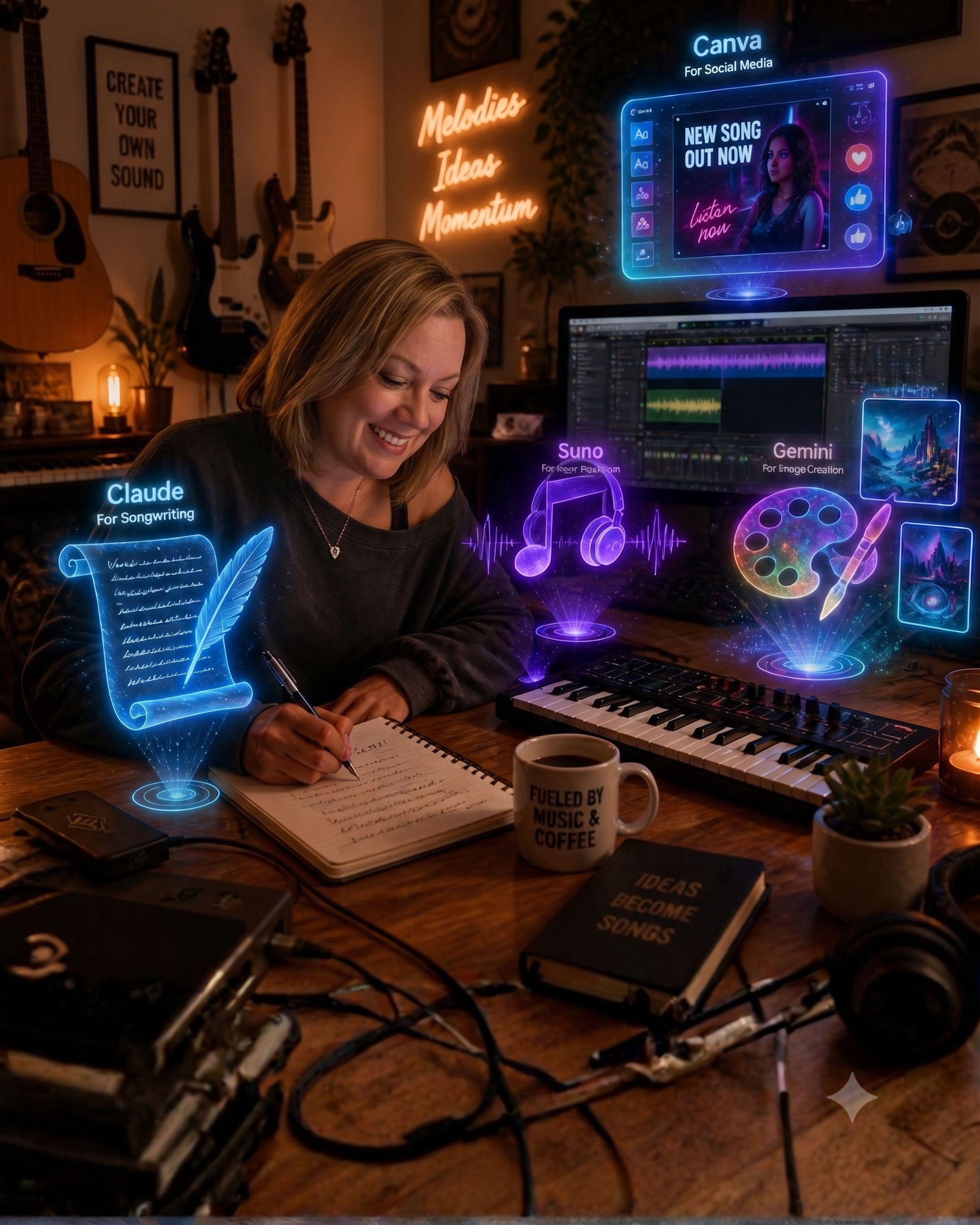
    Since I talk about collaborating with AI pretty openly, I want to give you a real behind-the-scenes look at how it actually works. People often imagine AI creation as pressing a single button and having a finished, polished track handed back to you.

    The reality is much more active, hands-on, and—honestly—time-intensive. It is a constant loop of refining, tweaking, and iterating.

    1. The Spark: Old Notebooks & Human Emotion

    It always starts with me—and usually with years of physical notebooks filled with scribbled lines, half-finished ideas, and memories. I bring the original concept, the emotional core, or a rough first verse.

    What I need in the room isn’t an automated replacement for a writer; I need a creative sounding board to help me develop those old ideas and push past my initial clichés.

    2. Crafting Lyrical Truth with Claude

    That’s where Claude comes in as my songwriting partner. I’ll open a session with a clear prompt or feed in a draft from my notebook, like:

    “I’m writing a song about the old Blockbuster ritual. It’s warm, nostalgic, and slightly bittersweet. The chorus needs to feel anthemic. Here’s a rough pre-chorus I drafted…”

    From there, we workshop in real time. Claude offers options, and my job is to curate, edit, and steer:

    • “Okay fine, kid, get the good backpack” came directly out of this back-and-forth. The line started off too sentimental, so I kept pushing the prompts toward the raw, true moment—that exact second your resistance as a parent completely collapses just looking at your kid’s face.

    We iterate line by line, paragraph by paragraph, until every word feels grounded, authentic, and true to my voice.

    3. Bringing the Sound to Life with Suno

    Once the lyrics are locked, I take them into Suno for music production. This is where the marathon of iteration really begins.

    Finding the right arrangement, tempo, vocal timbre, and emotional cadence isn’t a quick upload. It takes endless generations, adjusting genre tags, shifting structure cues, and testing different arrangements to get the track to sound like what I hear in my head.

    4. Visuals & Storytelling: Gemini & Canva

    A song doesn’t stop at the audio—it needs a visual world to live in.

    • Gemini for Image Creation: I use Gemini to build out the visual mood, album concepts, and imagery. Getting the exact right tone, lighting, and feel means writing, rewriting, and tweaking image prompts over and over.
    • Canva for Social Media: Once the artwork and imagery are created, I move into Canva to design cover art, promotional graphics, and social content to share the story behind each track.

    The Real Work is in the Iteration

    If there’s one takeaway, it’s that using these tools doesn’t mean skipping the effort—it means spending so much time changing things, testing variations, discarding what doesn’t work, and polishing what does.

    All twelve songs on Mixtape Mindset were built this way: notebooks full of history, a stack of AI tools working together, endless hours of iteration, and a human heart guiding every choice.


    Listen Now

    Stream on Spotify and Apple Music!

  • Behind the Music: “Home”

    Behind the Music: “Home”

    The Journey’s End That’s Really a Beginning

    How do you end an album that’s been about searching, growing, struggling, and becoming? You come home. Not to a place, but to yourself. “Home” is the exhale at the end of the journey, the moment when you realize that everything you were looking for was already within you.

    This is where the album has been leading all along – to this place of peace with who you are.

    It Was Never About the Destination

    “It was never just about finding where I belong / It was learning I’m already where I need to be” – this revelation changed everything for me. I spent so many years thinking I needed to arrive somewhere. To achieve something that would make me feel complete. To become someone who finally had it all figured out.

    But home isn’t a destination you reach. It’s a recognition that you’re already there. You’ve always been there. You just needed the journey to realize it.

    The Roles We Play vs. Who We Are

    “Beneath the roles – the mother, wife, the dreamer in disguise / There’s just a woman learning she’s enough.” This is the core of it, isn’t it? We play so many roles, wear so many hats, meet so many expectations. And somewhere underneath all of that is the simple truth of who we are.

    I’m a mother, yes. A wife, absolutely. A songwriter, a dreamer, a work in progress. But beneath all of those identities is just me – Melanie – and she’s enough. Without any of the titles, without any of the achievements, without any of the roles. Just as she is.

    The Long Way Home

    Sometimes we have to take the long way home to appreciate where we started. Every song on this album has been a step on that path:

    • “Where I Stand” – accepting where I am
    • “Unbreakable Sky” – breaking through limitations
    • “Borrowed Light” – leaning on others
    • “The In-Between” – finding peace in transition
    • “Coffee Shop Stranger” – opening to love
    • “Roots and Wings” – the paradox of letting go
    • “Ghost of Who I Used to Be” – releasing the past
    • “Keep Showing Up” – persistent courage
    • “Battle Scars” – pride in survival
    • “Garden After Rain” – beauty from pain

    And now, “Home” – the recognition that every step was necessary, every detour was part of the path, every struggle was sculpting who I was meant to be.

    The Production as a Warm Embrace

    The production wraps around you like coming home should – warm, familiar, safe. The acoustic guitar and piano create a foundation that feels solid but not rigid. The strings swell like a deep breath. The vocals are conversational, like I’m talking to an old friend, or maybe to myself in the mirror.

    This is what peace sounds like. This is what self-acceptance sounds like. This is what coming home sounds like.

    Claude H. Becker – The Perfect Circle

    Having “Claude H. Becker” as the AI performance credit on this final song feels especially meaningful. My dad, whose playful spirit lives on in this pseudonym, always felt like home to me. He was the one who made me feel safe enough to be myself. He’d love that his playful pseudonym became part of my art, part of my journey home.

    For Everyone Still Searching

    If you’re still searching, still chasing horizons, still running circles – I want you to know: the thing you’re looking for is already within you. Home isn’t somewhere you need to get to. It’s somewhere you return to.

    You are enough. You’ve always been enough. Welcome home.


    Album cover for 'Unbreakable Sky' by Melanie Grace featuring Claude H. Becker, featuring a vibrant flower against a gradient background.