In 1411, a poet in South Tyrol named Hans Vintler finished a long book of moral instruction called Die Pluemen der Tugent, The Flowers of Virtue. It is a dull book, mostly. It is a list of things you should not do. But one of its illustrations is not dull at all. It shows a figure with an iron nose.
Look closer and the figure is not a demon. It is a person. It is a person in a mask, dressed up, playing the part of Percht.
That picture is the earliest image we have of anyone impersonating a Christmas monster. It is four hundred years older than the first American drawing of Santa Claus. Somebody in the Alps was already pulling a mask over his face in midwinter and walking into a neighbor’s house to frighten the children, and he was doing it while Gutenberg was still a boy.
This is the part of Christmas nobody tells you about, and it is the reason I wrote a book.
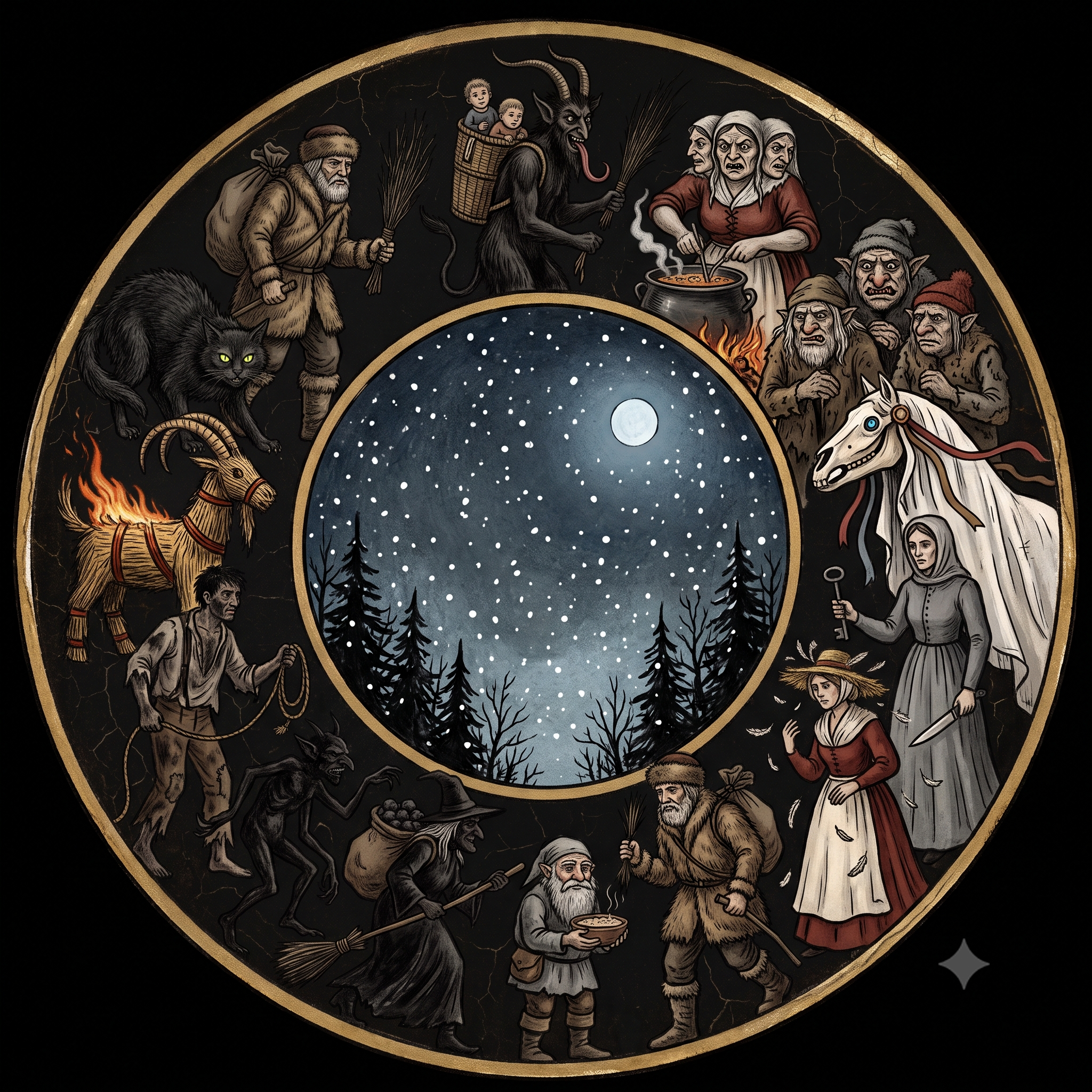
A Folklore Christmas: The Monsters, Witches, and Demons Behind Christmas comes out in hardcover and paperback on October 1. It is twenty-three chapters, one creature to a chapter. Krampus in Austria. La Befana in Italy. The Kallikantzaroi coming up through the floor in Greece. Grýla in her cave in Iceland with thirteen sons and a cat the size of a house. Frau Perchta with her knife. Frau Holle shaking out the snow. The Mari Lwyd, a horse’s skull on a pole, at your door on New Year’s Eve, demanding you out-rhyme it or let it in. The Wild Hunt overhead. Belsnickel. The Tomte. Père Fouettard. The Gävle Goat, which is a modern tradition and burns down most years anyway.
They are not decorations. Each of them did a job.
The job was mostly this: winter used to kill people. Not metaphorically. In the parts of Europe these stories come from, the dark months were the season when the food ran out, when the cold got in, when a child who wandered off did not come back. Every one of these figures is a way of saying something true about that danger to someone too small to be told plainly. Grýla eats the naughty ones. The Yule Cat eats the ones without new clothes, which meant the ones whose families had not done the autumn wool work, which meant the ones who were going to freeze. The Cat is not a fairy tale. The Cat is a labor policy with teeth.
We kept Christmas. We threw the monsters out. And the argument of this book, which I will spend the next month making and which I will not pretend is neutral, is that we lost something real when we did it.
Not because darkness is fun. Because a holiday that only knows how to say joy has no way to hold anyone who is not feeling it. The old Christmas had a place for the fear, the debt, the missing chair at the table, the dark outside the window. It gave those things a name and a face and a date on the calendar, and then, on Epiphany, it sent them back up the mountain for a year. That is not a bleak tradition. That is a functional one.
There is one more thing worth saying before October.
The first American Santa Claus we have any picture of appeared in New York in 1821, in a small book called The Children’s Friend. He drives a sleigh, he comes on Christmas Eve, he is dressed in red. He also leaves, for the children he finds “in manners crude, in temper haughty,” a long black birchen rod, for their parents to use on them.
That is the founding document of the American Santa. He was carrying a switch before Coca-Cola existed. Everything soft about him came later, and it came from us.
I will be posting twice a week from now until release. Some of it is folklore. Some of it is going to be me taking apart stories you have heard your whole life and probably repeated, including the one about the red suit, which is not true, and which I will get to on the fifteenth.
The Kindle edition is out now if you would rather not wait for October.
