People sometimes ask me how a lyric on a page turns into a finished song with a full orchestra or a horn section, so today I want to talk a little about the sound of this album, because the range of it is a huge part of what makes it feel new.
Every song on Midnight Masquerade got its own world. Carve It Out is Danny Elfman-style whimsy, a music box that grows into a parade. Skeleton Twist is a 1960s sock hop with reverb-soaked surf guitar and honky-tonk piano. The title track is grand gothic opera, pipe organ and a soaring soprano. It’s Our Halloween Party is frantic new wave with a horn section playing sharp, percussive stabs. Bone-rattle percussion ties the skeleton songs together. Phantom Parade is a snare-driven funeral march. Reign of Shadows is the one time the full symphony and choir get to go completely monumental. Halloween T-Shirt Dad is loose, warm country-rock.
Matching the arrangement to the story is half the fun and half the work, but getting both the lyrics and the musical atmosphere right requires a ton of deliberate thought. Take a track like Carve It Out—it wasn’t something that just fell together on the first try. Claude and I went back and forth, rewriting and refining lines again and again until every syllable matched the rising energy of the song. A gargoyle who longs to fly needs space and a single cello, not a wall of sound. A carnival needs a calliope that detunes as it winds down, and a ghost parade needs a snare drum and the feeling of something heavy passing by. It took endless tweaking to make sure the story and the music hit at the exact same moment, but when the sound and the words finally say the same thing at the same time, that is when a song really clicks into place.
Here is why that range matters to the bigger mission. The reason Halloween music feels stuck is partly that we keep reaching for the same one or two sounds. This album deliberately spans surf rock, gothic opera, ska, country, electro-pop, and full orchestral choir, all under one roof, all still recognizably Halloween. Fresh music is not just new words. It is new sounds for a season that has been wearing the same outfit for a very long time.
You may have seen my new graphic floating around. Two lists. One says “I Wrote the Songs, AI Sang Them.” The other says “I Wrote the Songs, I Sang Them.” A few of you have asked about it, so let’s pull back the curtain, receipts and all.
How Much Does It Cost to Professionally Record One Song?
Let me show you what I actually paid as an independent artist. No estimates, no Fiverr browsing, just real numbers from my own recordings:
Pianist: $250 for one song
Additional instrumentalist: $150 to fill in the other instruments
Recording engineer: $100 per hour (I kept my booth time to a single hour)
Producer: $100 to $150 per hour, and a couple of my songs took him 3 hours each
And here’s the part that still bothers me: I never received an itemized invoice for the producer’s hours. No breakdown, no time log. It was all based on “trust.” I was writing checks against a clock I couldn’t see.
Add it up and one song could easily run $600 to $1,000 or more. An album? Multiply that by ten or twelve. For a homeschooling mom with a full-time job, that’s not a music budget. That’s a mortgage payment.
What Does It Cost Just to Release the Music?
Recording is only the beginning. Then you have to pay to put the songs out into the world.
CD Baby charged me $19.99 per album just to distribute it. Want their $49.99 tier with a promotional “boost”? I’ll be honest with you: I have never seen or felt any boost from it, ever. Not one thing I could point to and say “that’s what I paid for.”
And then there are the services that charge you just for the chance to be heard. Taxi charges a fee simply to submit your song for consideration. Not to place it. To submit it.
How Much Do Independent Artists Actually Make From Streaming?
Cents. Literal fractions of a cent per listen. In 2025, my total payout from CD Baby was $25. Twenty-five dollars. For the whole year. Against songs that cost hundreds of dollars each to record and $19.99 per album to release.
You do the math, because I did, and it made me a little sick.
Pay to record. Pay to release. Pay to submit. Then get paid pennies when people actually listen. From where I’m standing, the whole system feels like a racket built on the backs of independent artists. And for years, that math kept my songs in a notebook instead of in your ears.
So I Made a Choice
I stopped waiting. I write every single lyric myself, every story, every rhyme, every hook. Then I use Suno to produce and sing the songs I can’t afford to record professionally yet. (That’s my invite link, so full disclosure, I benefit if you join.) It’s not a shortcut on the songwriting. It’s a bridge over the one obstacle I couldn’t out-write: the cost of the studio.
And I’m not hiding it. It’s right there on the graphic. I wrote the songs. AI sang them.
A woman works with holographic coding interfaces in a home office environment.
Can AI Songs Be Sync Licensed? Here’s Where It Gets Maddening
Now for the part that has me completely frustrated.
Sync licensing, getting your songs placed in TV shows, films, and commercials, is one of the only ways independent artists earn real money from music. So you’d think finding an affordable way to finally produce my songs would open that door.
Nope. The industry has wrapped AI-assisted music in yellow tape. Most sync libraries and licensing platforms won’t accept songs with AI vocals or AI production, no matter who wrote them.
Think about what that means for someone like me. I couldn’t afford the studio, so the traditional door was closed. I found a way to produce my songs anyway, and now that door is closed too, for the exact songs I made because the first door was closed. The lyrics are 100 percent mine. The stories are mine. But because AI sang them, they’re locked out of the one revenue stream that could actually fund the professional re-recordings the industry says it wants.
Pay to record, and you’re broke. Use AI instead, and you’re barred. It’s a catch-22 built for people with money, and it’s exactly why independent artists like me have to get creative and lean on listeners directly.
Those four are me, my voice, no filter. They’re proof of where this whole thing is headed.
Where This Is Going
Since sync licensing has slammed its door, my path forward runs straight through you. Every stream, every download, every share, every Reel with one of my songs behind it goes toward one goal: getting back into a real studio and singing my heart out on every song I’ve written. The AI versions got my songs out of the notebook. Your listening is what carries them the rest of the way home.
FAQ
Did you really write all these songs? Yes. Every lyric is mine.
How much did your songs cost to record? My professionally recorded songs ran roughly $600 to $1,000 each, plus $19.99 per album to distribute. My streaming royalties for all of 2025 were $25.
Can AI-assisted songs be placed in TV and film? Right now, mostly no. Most sync libraries and licensing platforms reject songs with AI vocals or production, even when a human wrote every word.
Why not just wait until you could afford the studio? Because songs don’t do anyone any good sitting in a drawer. I’d rather share them now and re-record later than never share them at all.
Will you re-record the AI songs in your own voice? That’s the plan. That’s the whole point.
🎧 Which song would you want to hear me re-record in my own voice first? Tell me in the comments.
I talk about Suno AI in these blogs fairly often, but I want to dedicate a full post to it because it deserves a real explanation, not just a passing mention.
Suno is a music production platform that takes a text prompt describing musical style, vocal delivery, instrumentation, and mood, and generates a produced song from it. Combined with my own lyrics, it means I can go from a finished lyric to a produced, listenable track in a fraction of the time traditional production would take. For an independent artist without a label budget, this is genuinely transformative.
What I want to be completely clear about is this: Suno does not write my songs.
The emotional heart, the specific imagery, and the turns of phrase that make a song feel like me all come directly from my own writing process, often developed in collaboration with Claude. Suno simply gives that content a musical home. It takes the lyrics and the production prompt I craft, creating the sonic world around them.
The prompts matter enormously. Specificity is everything in this process. You have to describe the exact instruments, the tempo, the vocal style, the energy, and the decade influences. Get it right, and the result is something I am genuinely proud to share with the world. Get it wrong, and you iterate. There is always iteration.
This technology has been pivotal in helping me keep my 2026 creative promises. At the beginning of this year, I set two massive goals for myself: publish a daily blog post and release at least one new piece of music every single month.
Maintaining a daily writing schedule while consistently outputting full musical tracks would be nearly impossible under traditional production constraints. Working with Suno as a production partner allows me to stay true to both of these commitments without sacrificing quality or creative vision. It bridges the gap between my ideas and a finished track, giving me the momentum to keep showing up every single day.
Twelve songs on Mixtape Mindset were created through this exact partnership. Every single one was produced this way, shaped with care and intention.
Go listen and tell me if it sounds like it was made with love, because it truly was.
Since I talk about collaborating with AI pretty openly, I want to give you a real behind-the-scenes look at how it actually works. People often imagine AI creation as pressing a single button and having a finished, polished track handed back to you.
The reality is much more active, hands-on, and—honestly—time-intensive. It is a constant loop of refining, tweaking, and iterating.
1. The Spark: Old Notebooks & Human Emotion
It always starts with me—and usually with years of physical notebooks filled with scribbled lines, half-finished ideas, and memories. I bring the original concept, the emotional core, or a rough first verse.
What I need in the room isn’t an automated replacement for a writer; I need a creative sounding board to help me develop those old ideas and push past my initial clichés.
2. Crafting Lyrical Truth with Claude
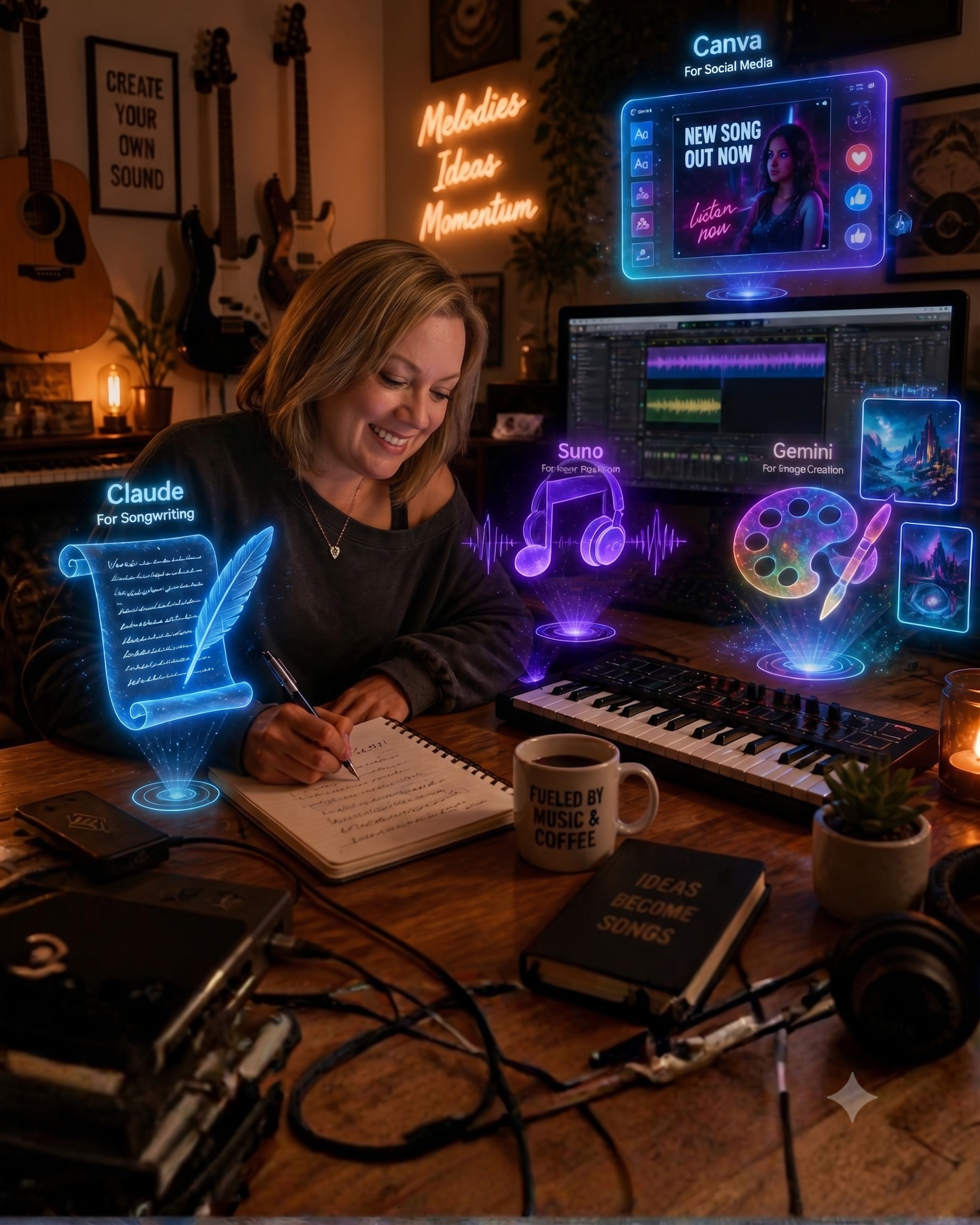
That’s where Claude comes in as my songwriting partner. I’ll open a session with a clear prompt or feed in a draft from my notebook, like:
“I’m writing a song about the old Blockbuster ritual. It’s warm, nostalgic, and slightly bittersweet. The chorus needs to feel anthemic. Here’s a rough pre-chorus I drafted…”
From there, we workshop in real time. Claude offers options, and my job is to curate, edit, and steer:
“Okay fine, kid, get the good backpack” came directly out of this back-and-forth. The line started off too sentimental, so I kept pushing the prompts toward the raw, true moment—that exact second your resistance as a parent completely collapses just looking at your kid’s face.
We iterate line by line, paragraph by paragraph, until every word feels grounded, authentic, and true to my voice.
3. Bringing the Sound to Life with Suno
Once the lyrics are locked, I take them into Suno for music production. This is where the marathon of iteration really begins.
Finding the right arrangement, tempo, vocal timbre, and emotional cadence isn’t a quick upload. It takes endless generations, adjusting genre tags, shifting structure cues, and testing different arrangements to get the track to sound like what I hear in my head.
4. Visuals & Storytelling: Gemini & Canva
A song doesn’t stop at the audio—it needs a visual world to live in.
Gemini for Image Creation: I use Gemini to build out the visual mood, album concepts, and imagery. Getting the exact right tone, lighting, and feel means writing, rewriting, and tweaking image prompts over and over.
Canva for Social Media: Once the artwork and imagery are created, I move into Canva to design cover art, promotional graphics, and social content to share the story behind each track.
The Real Work is in the Iteration
If there’s one takeaway, it’s that using these tools doesn’t mean skipping the effort—it means spending so much time changing things, testing variations, discarding what doesn’t work, and polishing what does.
All twelve songs on Mixtape Mindset were built this way: notebooks full of history, a stack of AI tools working together, endless hours of iteration, and a human heart guiding every choice.
I get asked a lot: how do you write a song that feels like a memory rather than just a song about a memory?
There’s a real difference. A song about a memory describes it from the outside. “I remember when we had payphones. That was a long time ago.” Fine. Technically accurate. Emotionally hollow.
A song that feels like a memory puts you inside it. It uses sensory detail. The smell of newsprint. The click-click-clack of a VHS rewind machine. The weight of a laminated Blockbuster card in your pocket. The specific feeling of glitter gel pens rolling down a hall.
Specificity is the time machine. The more precise the detail, the more powerfully it triggers the listener’s own version of that memory. “Glitter gel pens rolling down the hall” doesn’t just describe a folder. It puts you in a specific hallway with a specific smell and suddenly you’re eleven again.
That’s the whole goal of Mixtape Mindset. Not to describe the 90s. To put you back inside it, even for three minutes.
Working with Claude on these lyrics helped enormously. We pushed each other toward specificity constantly. The first draft is always more general. Revision is always about finding the detail that unlocks the door.