Category: Lifestyle

  • To Every Kid Going Back to School This Week

    To Every Kid Going Back to School This Week

    This one is for the kids.

    Not the moms today. Moms, I have got you covered all month and you know I love you, but today I am talking directly to the backpack carriers. The new pencil smellers. The ones feeling that strange mix of excitement and nerves about a new class, a new school, or just the general uncertainty of another beginning.

    I see you.

    Going back to school contains something deeply universal that stays with us long after we leave the classroom. It is the crisp air on an August or September morning, the satisfying click of a brand-new binder, and the smell of fresh notebook paper waiting for its first word. It is that classic brown paper bag or patterned lunchbox packed with a sandwich, a juice box, and maybe a little note tucked inside to remind you that someone is thinking of you.

    Those small details sound simple, but they are the exact moments that turn into lifelong memories. Years from now, a certain scent or the sound of a school bus door opening will bring all of this right back to you in a wave of nostalgia.

    That feeling of starting fresh is why I am so passionate about showing up every single day in my own work. At the start of 2026, I made a strict promise to myself: write a daily blog post and release at least one new piece of music every single month.

    Juggling a daily writing habit alongside a consistent music release schedule requires the exact same courage as stepping through the school doors on day one. You have to embrace the unknown, trust the process, and show up even when you feel a little nervous. The discipline of staying true to those creative promises keeps my mind sharp and reminds me that growth only happens when you step into a new beginning.

    Here is what I want you to know: the specific, weird, wonderful, and hard things about your right now life are worth paying attention to. The packed lunches, the locker combinations, the nervous butterflies, and the laughter in the hallway are forming who you are. None of it is wasted, and one day someone might even write a song about it.

    Maybe that someone will be you.

    Good luck this school year. I am rooting for you.

    Stream Mixtape Mindset on Spotify. And if you have a mom who needs a laugh today, share it with her. Follow me on Instagram!

  • The 13 Yule Lads of Iceland: The Complete Guide to the World’s Strangest Christmas Fortnight

    The 13 Yule Lads of Iceland: The Complete Guide to the World’s Strangest Christmas Fortnight

    Every year on December 12, the first of them comes down from the mountain. He has stiff legs, a sheep obsession, and twelve brothers behind him, arriving one per night until Christmas Eve. Iceland’s strangest fortnight, and this is the whole story: every name, every date, every crime, the shoe on the windowsill, the rotten potato, and the giant cat waiting at the end of it.

    Settle in. There are thirteen of them, and every one is worse at his job than the last.

    Who are the Yule Lads?

    The Yule Lads (jolasveinar) are the thirteen sons of Gryla, the child-eating ogress of the Icelandic mountains, and her famously useless husband Leppaludi. Beginning December 12, the Lads descend from the highlands one per night, each specializing in a single, weirdly specific household crime. One licks spoons. One slams doors. One steals sausages from the rafters. Each Lad stays exactly thirteen days, so as the last brother arrives on Christmas Eve, the first is already heading home, and they depart in arrival order, one per night, until the final Lad walks out on January 6 and the Icelandic Christmas closes behind him. The season does not end so much as drain, one troll at a time.

    They were not always charming. In older Icelandic tradition the Lads were genuinely menacing, monster children of a monster mother, deployed by parents to frighten children so effectively that a 1746 public decree forbade tormenting children with tales of Gryla and her household. Very few families in world folklore have achieved regulatory status. This one did.

    The Lads’ modern personalities, their names, their order, and their crimes, were fixed in 1932, when the poet Johannes ur Kotlum published “Jolin koma” (“Christmas Is Coming”), the beloved collection that standardized the canon. Before that, tradition was gloriously unruly: the National Museum of Iceland has recorded many dozens of Yule Lad names from around the country, and the count varied by region. Thirteen won because the poem won.

    What is the shoe in the window?

    Here is the custom, and it is the best interactive folklore in the Christmas world. Starting December 12, Icelandic children place a shoe on the windowsill before bed. Each night, the arriving Lad leaves something in it. Good children get a small gift or a sweet. Children who misbehaved get a raw potato, traditionally a rotten one.

    Thirteen nights. Thirteen verdicts. A child’s December behavior is scored nightly, in produce, by a committee of mountain trolls, and there is no appeals process. No annual naughty-or-nice list can compete with that feedback loop. Santa audits you once a year from another hemisphere; the Lads grade you every single night from inside your own weather. Icelandic children take the shoe seriously in a way a letter to the North Pole cannot touch, because the audit is continuous and the results are published by morning.

    The 13 Yule Lads of Iceland: creature card showing the thirteen troll brothers descending the mountain with Gryla behind them

    Now, the brothers themselves, in arrival order. Watch what they steal as the nights pass, because there is a design hiding in the pettiness, and we will name it at the end.

    The 13 Yule Lads, night by night

    1. Sheep-Cote Clod (Stekkjastaur), December 12

    The fortnight opens with a livestock criminal the livestock can outrun. Sheep-Cote Clod comes to bother the sheep in their pens, sucking milk from the ewes, and he is barely capable of it, because folklore gave him two stiff peg legs. The very first Lad of Christmas hobbles into the sheep-cote, alarms exactly no one with wool, and sets the family standard: maximum ambition, minimum equipment. His brothers do not improve much from here.

    2. Gully Gawk (Giljagaur), December 13

    The second brother does not enter the house. He conceals himself in a gully, waits until the cowshed is unattended, then slips in and steals the froth off the milk. Not the milk. The froth. Somewhere in the centuries of Icelandic tradition, an entire troll was assigned to foam. But in a subsistence winter the top of the milk was the cream, the richest part, the part worth skimming, and Gully Gawk is a lesson in supervision: leave the shed for one minute and the best of what you have walks off with someone who was lying in a ditch waiting for exactly that minute. Every workplace has a Gully Gawk. Guard your froth. His arrival night is also St. Lucy’s Day, when Scandinavia crowns children with candles against the dark, which means December 13 fields both a light procession and a milk thief. The season contains multitudes.

    3. Stubby (Stufur), December 14

    His name is not a nickname. Stubby is the short one, in a family of trolls, which is its own quiet tragedy, and his crime is scaled to match: he steals pans in order to eat the crusts baked onto them. Not the food in the pan. The residue. Stubby’s entire criminal enterprise is the part of dinner you were going to scrub into the sink, which makes him the only figure in world folklore whose theft doubles as washing up. Gryla raised a houseful of thieves and one of them functions as a dishwasher. Of the thirteen, he may be the one to welcome.

    4. Spoon-Licker (Thvorusleikir), December 15

    The fourth brother steals the thvara, the long wooden stirring spoon, and licks it clean. Tradition adds one devastating detail: he is horribly thin. Of course he is. He chose a food source measured in film. Spoon-Licker is what happens when you commit fully to a niche without checking whether the niche can support life. His brothers watched him select “residue on utensils” as a career, said nothing, and let him find out. It is the most Icelandic of fates: no one stopped him, and the consequences were allowed to teach.

    5. Pot-Scraper (Pottaskefill), December 16

    The family’s intellectual. Pot-Scraper’s technique is a knock at the door: the children run to answer it, nobody is there, and while they stand puzzled in the doorway he is in the kitchen, making off with the pots to scrape out whatever dinner left behind. That is a genuinely competent con. Among brothers who mostly lurk, lick, and cower under furniture, Pot-Scraper alone employs misdirection, and he spends the gift entirely on leftover scrapings, which tells you everything about the ceiling in this family. If someone knocks tonight and no one is there, count your cookware before you go back to bed.

    6. Bowl-Licker (Askasleikir), December 17

    Here the fortnight moves into the bedroom. Bowl-Licker’s target is the askur, the traditional lidded wooden bowl Icelanders ate from, often kept by the bed in the old turf houses, where the household ate sitting on their beds in the communal badstofa. His method: hide under the bed, wait in the dark, and when a bowl is set down on the floor, take it and lick it clean. Every child who has ever feared the space under the bed: Iceland would like you to know you were right, and furthermore, the thing under there is after your dishes. There is something almost merciful in that. The universal childhood monster, finally identified, turns out to want your leftovers and nothing else. Fear him, but fear him accurately.

    7. Door-Slammer (Hurdaskellir), December 18

    Seven nights in, the family produces its first pure vandal. Door-Slammer steals nothing and eats nothing. His entire practice is slamming doors in the middle of the night, hardest when people are trying to sleep. After six brothers of careful caloric larceny, this is almost refreshing: noise for its own sake, chaos as a vocation, the middle child who discovered that attention is also a food. But sleep, in a twenty-hour Icelandic night, was one of the few resources winter gave freely, and here is a troll designed to spend it. Every culture eventually names the sound the house makes at 3 a.m. Iceland gave it a face and put it in the family.

    8. Skyr-Gobbler (Skyrgamur), December 19

    For once, no translation gymnastics: his target is in your grocery store. Skyr, the thick Icelandic cultured dairy that modern marketing sells as a protein lifestyle, has been Iceland’s staple for a thousand years, and the eighth Lad breaks into the pantry and eats all of it, gorging from the tub until he can barely move. Skyr-Gobbler was warning households about unattended skyr centuries before the world learned to pronounce it, which makes him, technically, the most ahead-of-his-time figure in this entire series. The stakes were real: skyr was winter survival food, made in autumn and stored in barrels to last the dark months, and a raided store was a hole in the winter. The tradition posted a guard, and the guard is a glutton, because nothing teaches you to protect a food supply like imagining exactly the appetite that would empty it.

    9. Sausage-Swiper (Bjugnakraekir), December 20

    Vertical crime. Icelandic households smoked their sausages by hanging them in the rafters, up in the drifting hearth smoke, which was both preservation and storage. Sausage-Swiper simply moves in upstairs: he climbs into the beams, settles among the hanging bjugu, and helps himself, enduring smoke in the eyes for meat in the hand, a trade he considers excellent. He is the first Lad to attack the protein reserves rather than the scraps and dairy, and the escalation is deliberate. Tonight, if the ceiling creaks, it is either the house settling or a troll conducting inventory in your smoke-cured assets. Icelandic folklore declines to reassure you either way.

    10. Window-Peeper (Gluggagaegir), December 21

    He arrives on the winter solstice, the longest night of the year, and he looks at all that darkness pressing against your windows and sees a work environment. Window-Peeper creeps to the glass and peers in, scouting the household for things worth stealing, and folklore notes he will take what catches his eye. But the theft is almost incidental; the peering is the thing. On the longest night, every lit window in Iceland became a bright box visible for miles, and everyone inside felt it: the sense of being seen from a darkness you cannot see into. Window-Peeper is that feeling, given a name and a face at the glass. You have felt him in December. Everyone has. Now you know what to call it. Close the curtains.

    11. Door-Sniffer (Gattathefur), December 22

    Folklore gave the eleventh brother the family’s finest piece of equipment: an abnormally large nose and an infallible sense of smell. He deploys this instrument, which could find anything on the island, toward exactly one target: laufabraud, the paper-thin, intricately hand-cut “leaf bread” that Icelandic families fry for Christmas, a craft passed down generations. He stations himself at the doorway, hoovering the escaping aroma, waiting to snatch the bread itself. Note the timing: he arrives exactly when Icelandic kitchens historically hit peak Christmas baking. Each brother shows up when his target is actually in season. Whoever assembled this tradition kept an honest household calendar and then staffed it with criminals.

    12. Meat-Hook (Ketkrokur), December 23

    The only brother who brought a tool. Meat-Hook carries, as advertised, a long hook, which in the classic tellings he lowers down through the chimney to snag the household’s meat, above all the hangikjot, the smoked lamb at the center of the Icelandic Christmas table. After eleven nights of lurkers, lickers, and sniffers, there is something genuinely alarming about a Lad with equipment. He comes on the eve of the eve of Christmas, aimed at the single most valuable food in the house, and he arrives prepared. His brothers improvise. He packed. His night is also Thorlaksmessa, St. Thorlak’s Day, Iceland’s great day of last-minute shopping, tree decorating, and the traditional meal of fermented skate, whose aroma is famous enough that Door-Sniffer, one assumes, takes the evening off.

    13. Candle-Stealer (Kertasnikir), December 24

    The last Lad is different from all his brothers. Twelve came for food. The thirteenth comes for the light. Candle-Stealer arrives on Christmas Eve and follows children to steal their candles, and to feel why that was a real theft, you need two old facts. First, in a turf house in an Icelandic December, a candle was not decor; it was the light, precious enough that a child’s own candle was a classic Christmas gift, sometimes the only one. Second, old candles were tallow, rendered animal fat, which means they were, technically, food. When Candle-Stealer takes a child’s candle, he takes the two scarcest things in the winter house at once, light and calories, in a single object. His brothers stole from the pantry. He steals from the darkness’s only opponent. The tradition saved its most poignant thief for last, and put him on the holiest night.

    And then there is the Cat

    The Lads have a pet, and Christmas Eve belongs to it as much as to their last brother. The Jolakottur, the Yule Cat, is the monstrous cat of Gryla’s household, vast and glowing-eyed, and it prowls Iceland on Christmas Eve with a single criterion: anyone who did not receive at least one new item of clothing before that night risks being eaten. No naughty list, no behavior review. The Cat runs a dress code, and the dress code is capital.

    It sounds like the most arbitrary rule in folklore until you see the labor system underneath. New clothes by Christmas meant the household’s autumn wool had been fully processed in time: carded, spun, knitted, sewn, every hand contributing through the fall. A house where everyone got something new was a house that had finished its work. The Cat is a production deadline wearing fur. And the custom the threat produced was gentler than the monster: the tradition, fixed in the same 1932 poem collection that canonized the Lads, ends by urging that children who have nothing be given some small new thing, so the Cat finds no one. A child-eating monster whose actual function was charity.

    Why thirteen petty criminals instead of one big monster?

    Because the system is smarter this way, and by now you have seen the design. Line up the crimes in order: milk froth, pan crusts, spoon film, pot scrapings, the bowls, the sleep, the skyr, the sausages, the windows, the doorway, the smoked lamb, the candles. That is not a random rap sheet. It is a complete inventory of an Icelandic winter household’s actual margins and treasures, climbing night by night from scraps to stores to the boundaries of the house itself to the light inside it, each item personified as exactly the appetite that would take it, each arriving precisely when the real thing was in season and at risk.

    Gryla, up the mountain, supplies the big existential fear. Her sons supply the daily maintenance: thirteen small reminders that everything in the house has value, down to the coating on a spoon, so mind all of it. It is the difference between a final exam and homework, and every teacher knows which one actually changes behavior. The nightly shoe made children partners in the whole audit. The Lads are what happens when a community turns its winter survival checklist into a serialized monster story, and the remarkable thing is not that it is strange. It is that it worked, nightly, for centuries, and still does. Iceland’s children will put out their shoes again this December 12.

    FAQ

    When do the Yule Lads come?

    One per night, December 12 through December 24. Each stays 13 days, and they depart in arrival order, December 25 through January 6.

    What are the names of the 13 Yule Lads?

    In arrival order: Sheep-Cote Clod, Gully Gawk, Stubby, Spoon-Licker, Pot-Scraper, Bowl-Licker, Door-Slammer, Skyr-Gobbler, Sausage-Swiper, Window-Peeper, Door-Sniffer, Meat-Hook, and Candle-Stealer.

    What do the Yule Lads leave in shoes?

    A small gift or sweet for good behavior; a rotten potato for bad behavior. The shoe goes on the windowsill each night from December 12 through December 24.

    Are the Yule Lads Santa’s helpers?

    No. They are the troll sons of the ogress Gryla, and their gift-giving is a modern softening of a much darker tradition once alarming enough to prompt a 1746 decree against frightening children with it.

    Why are there exactly 13 Yule Lads?

    The 1932 poem collection “Jolin koma” by Johannes ur Kotlum standardized thirteen. Older regional traditions recorded many dozens of names and varying counts.

    What is the Yule Cat?

    The monstrous cat of Gryla’s household, said to eat anyone who received no new clothing by Christmas Eve, a rule rooted in finishing the household’s autumn wool work on time.


    The songs: “Thirteen Nights” for the brothers, “Gryla’s Feast” for their mother, and “The Yule Cat” waiting at the end, all on the companion album. Play “Thirteen Nights” thirteen times, once per Lad; consider it your shoe.

    Follow the run: Get every post by email, nothing else, no spam: join the nightly email list

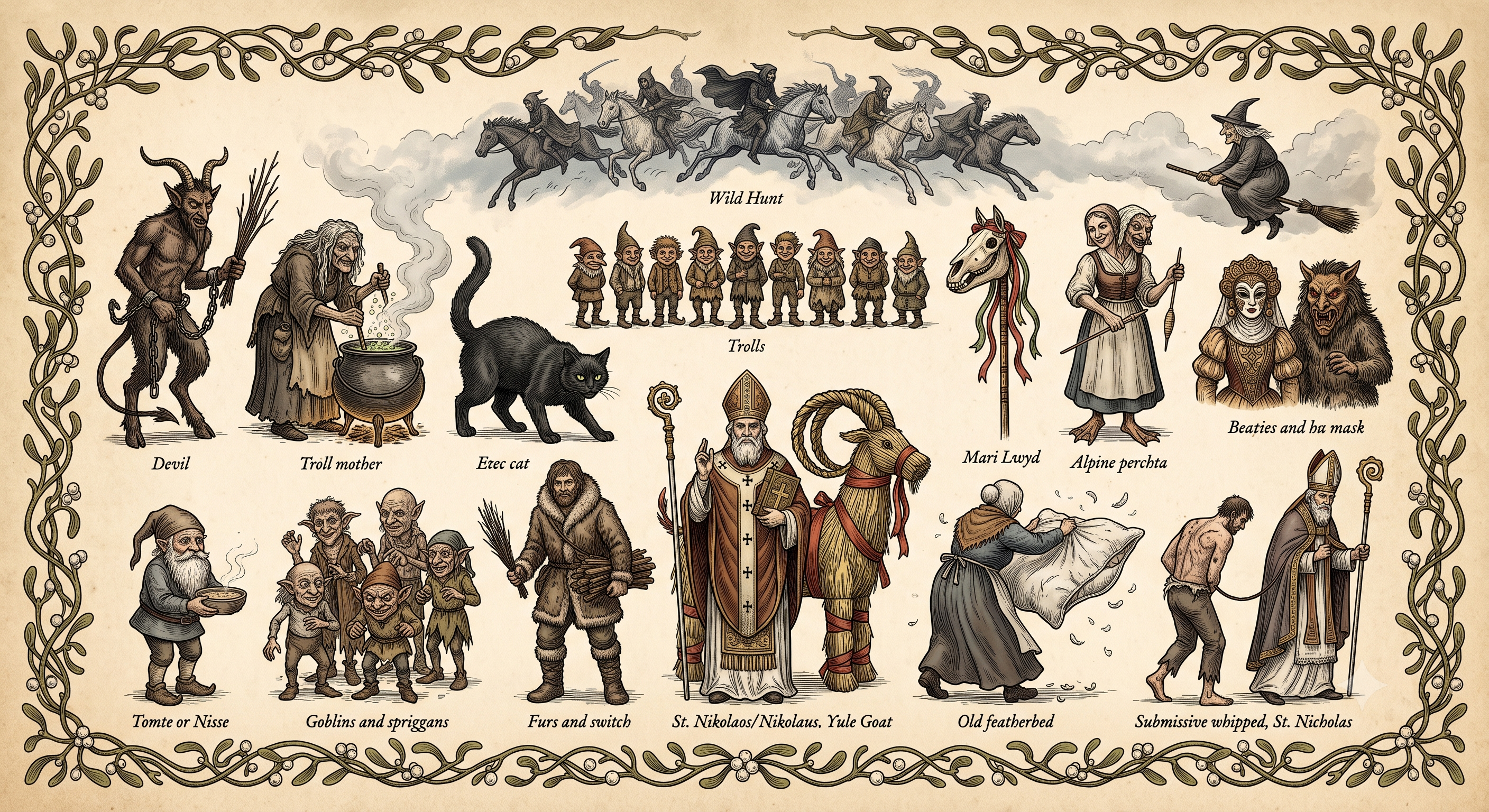
    Read the full stories: A Folklore Christmas: The Monsters, Witches, and Demons Behind Christmas covers all 23 figures with sources.

    Listen: Streaming now on Spotify | Apple Music | Amazon Music | Deezer | Pandora, or follow my artist page direct on Spotify. Every stream counts.

    Come say hello: Instagram | Facebook | TikTok | YouTube

  • Mixtape Mindset Is HERE and I Have a Lot of Feelings About It

    Mixtape Mindset Is HERE and I Have a Lot of Feelings About It

    It is August 1st and the album is out and I am barely holding it together.

    Mixtape Mindset is available right now on all streaming platforms and I want to tell you what this album is before you press play.

    It is twelve songs that flow together as one continuous experience — the way songs on a great mixtape always belong together. Not in sections or categories. Just one song leading naturally into the next the way a really good mix always does. You let it take you somewhere.

    Where? Somewhere specific. The school bus pulling away on the first day of school. The Blockbuster parking lot on a Friday night. 3am with the modem screaming and a blank CD in the drive. The living room floor on a Saturday morning with cereal and cartoons. A phone number you still know by heart that you haven’t dialed in twenty years.

    This album surprised me. It started with one song and kept going until it was twelve, and somewhere in the middle I realized I was building something about memory, connection, and the specific rituals of a decade that shaped everyone who lived it.

    It is funny. It is heartfelt. It will make you text someone. Go listen.

    Stream Mixtape Mindset on SpotifyApple MusicAmazon MusicDeezer, and Pandora! Follow me on InstagramYouTube, and FacebookJoin my email list for behind the scenes content!

  • Make Me a Mixtape: The Song That Names This Whole Album

    Make Me a Mixtape: The Song That Names This Whole Album

    “Three AM, modem screaming loud. Napster’s up, I’m in the crowd.”

    If that opening doesn’t take you somewhere specific immediately, I genuinely don’t know what to say.

    Make Me a Mixtape is the song that names what this whole album is about. A mixtape wasn’t just a playlist. It was a declaration. A carefully curated argument for how you felt about someone, written in track order, burned at 3am, handed over like it was nothing when it was actually everything.

    “Every song we burned meant something we couldn’t say.” That is the whole album in one line.

    The bridge hits me hardest every time: “We don’t pass notes! We don’t burn CDs! But I remember every song you gave to me!” Because you DO remember. Whatever mixtape someone made for you is still somewhere in your body. You know the track order. You know which song said something nobody had said quite like that before.

    Playlists are easy. Mixtapes were intentional. The effort was the message and that deserves a ska-punk anthem at 3am with the volume all the way down.

    Stream Mixtape Mindset on SpotifyJoin my email list for more!

    Melanie Grace, TheMelanieGrace, independent artist, Song Writer, Make Me a Mixtape, mixtape nostalgia, burned CD memories, 90s love songs, Mixtape Mindset album, independent music 2026

  • That Pinterest Image Outfit I Looked Everywhere For (And Finally Found on Amazon)

    That Pinterest Image Outfit I Looked Everywhere For (And Finally Found on Amazon)

    A woman wearing a beige cardigan over a white shirt, accessorized with layered necklaces, and blue high-waisted jeans, holding a brown shoulder bag.

    You know the one. You are scrolling through Pinterest, minding your own business, and then it stops you cold. The perfect fall outfit. Cozy, put together, effortless in that way that actually takes a little effort. A soft mocha cardigan, a crisp white tee, the exact right jeans, and a bag you would carry until it fell apart.

    So you tap the pin, ready to shop it.

    And nothing. No links. No brands tagged. Just a beautiful photo floating in the void with zero way to actually buy any of it.

    That was me this week. I fell hard for this outfit and there was nothing clickable anywhere. So I did what any slightly obsessed person would do. I went digging through Amazon and hunted down the closest match to every single piece. The good news for you is that I already did the work, so you can skip the scrolling and just shop the whole look.

    Collage showcasing a stylish outfit, featuring a white tank top, beige cardigan, light blue jeans, brown crossbody bag, flat sandals, and layered jewelry, with a text overlay that reads 'That Pinterest Image Outfit I Looked Everywhere'.

    Shop the entire outfit here.

    Why This Outfit Works

    Before I break down the pieces, let me tell you why this look is so easy to love. It is built on neutrals, so nothing competes. The whole thing lives in a soft palette of oatmeal, warm brown, white, and denim blue. That means it goes with almost everything you already own, and it photographs beautifully whether you are grabbing coffee, running errands, or meeting a friend for lunch.

    It is also layered in a smart way. A cardigan over a simple tee gives you options all day long. Chilly in the morning, button it up. Warm by afternoon, slip it off and you still look polished in the tee and jeans. This is the kind of outfit that quietly does a lot of work for you.

    Breaking Down Every Piece

    Here is exactly what I found, and why each piece earns its spot.

    The Mocha Cardigan

    This is the heart of the whole look. A chunky button up knit in a warm oatmeal brown, with just enough texture to feel special. It is soft, a little slouchy, and reads expensive even though it is not. If you only add one piece from this outfit to your closet, make it this one. It layers over everything and instantly makes jeans and a tee feel intentional.

    The Simple White Tee

    Do not underestimate the humble white tee. A good one is worth its weight in gold. Look for a slightly relaxed fit with a neckline that sits just right, so it peeks out perfectly under the cardigan. This is a piece you will reach for constantly, so it is worth having a few on hand.

    The High Waisted Jeans

    The jeans in this look are a medium wash with a relaxed straight leg and a cuff at the ankle. High waisted so everything stays tucked and comfortable, roomy enough to move in, but still structured. This silhouette is flattering on just about everyone and it balances the cozy volume of the cardigan.

    The Layered Gold Necklaces

    The tiny detail that pulls it all together. A set of delicate gold layers, one dainty chain up high and a coin pendant that drops a little lower. Layered necklaces add just enough shine to keep the neutrals from feeling flat, and buying them as a set means you skip the fuss of untangling separate chains.

    The Brown Crossbody Bag

    Oh, this bag. A warm cognac brown crossbody with a woven guitar strap that gives the whole outfit a little personality. Crossbody bags are my love language because they keep your hands free, which every busy woman knows is non negotiable. The rich brown ties right back to the cardigan and grounds the look.

    The White Platform Sandals

    Comfort meets cute. These footbed sandals have a supportive platform and a sporty little strap, so you get all day wearability without sacrificing style. They keep the outfit feeling fresh and casual, which is exactly the vibe.

    How to Style It Your Way

    The beauty of a neutral base is that you can make it your own. Here are a few easy swaps.

    Swap the sandals for white sneakers or ankle boots and you have carried this outfit straight into cooler weather. Trade the white tee for a soft cream or oatmeal one for a tonal look. Add a belt at the waist if you want a little more shape. Change the gold necklaces for silver if that is more your metal. The bones of this outfit are so versatile that you really cannot get it wrong.

    Ready to Shop the Look?

    I rounded up every piece so you would not have to fall down the same rabbit hole I did. No more staring at a pretty pin with no way to buy it.

    Click here to shop the full Pinterest outfit on Amazon.

    If you recreate this look, I would love to see it. Tag me so I can cheer you on, and let me know in the comments which piece is your favorite. My money is on that cardigan.

    Check out my other curated outfits


    This post contains affiliate links, which means I may earn a small commission at no extra cost to you if you shop through them. Thank you for supporting the work here.